Need help?
Do you have a question about the Haier HDW12-SFE1 Series and is the answer not in the manual?
Check packaging for transport damage and dispose of materials properly.
Ensure proper installation: connect electricity correctly, use grounded wiring, and ensure plug accessibility.
Use by adults only, avoid outdoor installation, do not place heavy objects on the door, or use solvents.
Turn off water/power, consult 'Fault finding', use authorized personnel and spare parts.
Adjust feet to level the dishwasher; incline not more than 2° for proper performance.
Connect water supply hose to 3/4" gas connector. Flush pipes if new or unused.
Insert drain hose into pipe (min 4cm diameter) or sink, height 40-100 cm.
Connect to earthed socket matching rating plate voltage. Replace cable if incompatible.
Clean filters ('7', '8') after washing. Remove particles and rinse under running water.
Inspect spray arms ('9', '10') for blocked nozzles. Clean arms under running water.
Guide to resolving common issues yourself to save costs and time.
Check fuse, plug, door closure, programme button, water tap, and intake hose strainer.
Check if the drain hose is too low.
Check if the drain hose is crimped or bent, or if it is too high.
Check water supply, hose connection, pressure, hose crimping, and filter clogging.
Check for blockage in drain hose, jammed pump, blocked filters, or running programme.
Check electricity supply and water supply interruption.
Check loading, rack items touching, detergent amount, programme, spray arm obstruction, nozzles, filters.
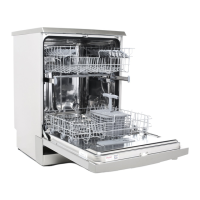
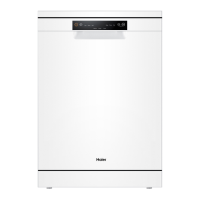
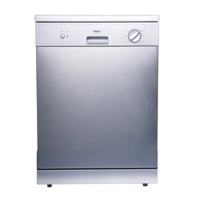
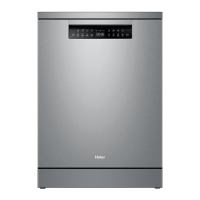
This document outlines the operation and maintenance of the Haier HDW12-SFE1 Series Dishwasher, a household appliance designed for washing dishes and cooking utensils.
The dishwasher is designed to efficiently clean a variety of crockery, cutlery, and glassware. It operates through a series of wash cycles, including pre-wash, main wash, and rinses, with options for different water temperatures and durations depending on the selected program. The appliance utilizes a detergent dispenser for both pre-wash and main wash cycles, and a rinse aid dispenser to ensure dishes sparkle and dry without spotting. Water is supplied via a dedicated inlet hose and drained through a drain hose, with internal spray arms distributing water effectively across the dishes. The control panel features an ON-OFF button, program indicators, and a program selection button, allowing users to choose the most appropriate cycle for their needs.
Before using the dishwasher, it's crucial to properly install it, ensuring it's level, connected to a cold water supply, and correctly wired to an earthed electrical socket. The drain hose must be securely fitted to prevent leaks.
Loading the dishwasher involves arranging crockery, glasses, and cutlery in the designated racks. The lower rack is ideal for difficult-to-clean items like pots, pans, and serving dishes, which should be placed face down and slanted for optimal water drainage. The silverware basket can be adjusted or even placed in the upper rack for flexibility. The upper rack is designed for more delicate and lighter items such as glasses, cups, saucers, and small bowls. It is height-adjustable to accommodate taller items in the lower basket. Items should be positioned to avoid obstruction of the spray arms.
Detergent, specifically designed for dishwashers, must be added to the dispenser before each wash cycle. The dispenser has separate compartments for pre-wash and main wash detergent. Rinse aid should also be filled in its dedicated dispenser, with a dosage adjustor allowing users to fine-tune the amount for optimal drying and to prevent spotting or streaking.
To start a wash cycle, load the appliance, turn on the water tap, close the door, press the ON-OFF button, and then select the desired program using the program button. The corresponding program indicator light will illuminate. The dishwasher signals the end of a program with six beeps.
For energy savings, if only a small number of dishes are loaded, selecting a program with a lower temperature may suffice. The program data, including duration and consumption, can vary based on factors like the amount of dishes, water temperature and pressure, ambient temperature, mains voltage fluctuations, and machine-related factors.
If a program needs to be interrupted, the door can be opened carefully, but users should be aware of the risk of hot water squirting out. If the appliance has heated up, the door should be left ajar for a few minutes before closing to prevent expansion issues. A running cycle can be modified or cancelled by using the "Reset drain function," which involves pressing and holding specific buttons for 3 seconds, initiating a drain phase.
Regular care and maintenance are essential for the dishwasher's longevity and efficient performance. After every wash, the water supply should be turned off, and the door left slightly ajar to prevent moisture and odors from being trapped. Before any cleaning or maintenance, the appliance must be switched off and unplugged from the socket.
For cleaning the exterior and rubber parts, only a cloth with warm soapy water is recommended; solvents or abrasive cleaning products should be avoided. Spots or stains on the interior surface can be removed with a cloth dampened with water and white vinegar, or a specialized dishwasher cleaning product.
The filters, located at the bottom of the dishwasher, prevent larger food particles from reaching the pump. These filters (coarse micro-filter and filter unit) should be checked after each wash for food particles and cleaned under running water if necessary.
The spray arms (upper and lower) should also be inspected periodically for blocked nozzles, which can be caused by lime and food remnants. The lower arm can be pulled upwards and lifted off, while the upper arm can be unscrewed for cleaning under running water. Both arms must be refitted securely.
The seals around the door should be cleaned periodically with a damp sponge to prevent food remnants from causing odors. When going on holiday, it is recommended to run an empty wash cycle, unplug the appliance, turn off the water supply, and leave the door slightly ajar to maintain the seals and prevent odors.
Troubleshooting guidance is provided for common issues such as the appliance not starting (checking fuses, plug, door closure, program button, water tap, and water intake hose strainer), blinking program indicators (checking drain hose height), and problems during washing (e.g., unusual foam, appliance stopping, knocking/rattling sounds). Issues with dishes, cutlery, and glassware (e.g., food remnants, discolouration, dull appearance, stains, rust, clouding, smears) are also addressed, often pointing to improper loading, insufficient detergent/rinse aid, or unsuitable wash programs. For any complex repairs, only qualified specialists should be consulted.
 General
| Category | Dishwasher |
|---|---|
| Model | HDW12-SFE1 Series |
| Type | Freestanding |
| Capacity | 12 place settings |
| Noise Level | 49 dB |
| Child Lock | Yes |
| Delay Start | Yes |

 To Next Page