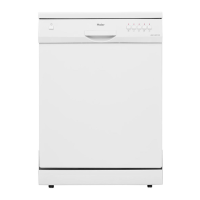
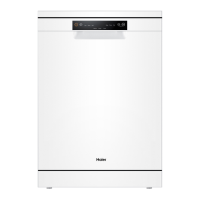
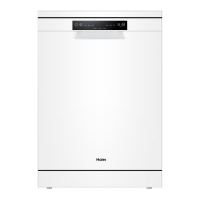
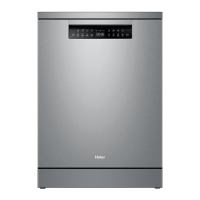
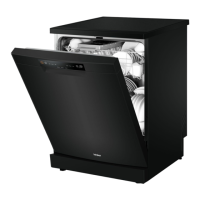
This document provides comprehensive instructions for the Haier Dishwasher models HDW12-TFE3SS and HDW12-TFE3WH, covering safety, installation, operation, and maintenance.
Function Description
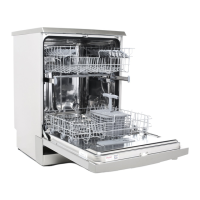
The Haier Dishwasher is designed for household use, specifically for washing dishes and cooking utensils. It offers various wash programmes tailored to different levels of soiling and types of dishware, ensuring efficient and effective cleaning. The appliance incorporates features like rinse aid dispensing for improved drying and shine, and a detergent dispenser for both pre-wash and main wash cycles. Its internal layout includes an upper rack for delicate items, a lower rack for heavier items, and a silverware basket, all designed for optimal loading and water spray coverage.
Usage Features
Programme Selection: The dishwasher offers a range of programmes, including:
- HEAVY: For very dirty dishes, pots, and pans, not suitable for delicate items. It includes a pre-wash with hot water, extended wash, cold rinses, hot rinses, and drying.
- NORMAL: For dirty dishes, pots, and pans, featuring a cold pre-wash, extended wash, cold rinses, hot rinses, and drying.
- NORMAL ECO: For normally soiled loads, an economic cycle with a cold pre-wash, extended wash, cold rinses, hot rinses, and drying.
- GLASSWARE: An economic cycle for delicate items, to be run immediately after dishes are used, including an extended wash, cold rinse, hot rinse, and drying.
- QUICK 30: For very lightly soiled mixed dishes, a short wash with a cold rinse.
- RINSE: For dishes that only require a rinse and dry, featuring a hot rinse and drying.
- PRE-RINSE: A short cold wash to prevent food residue from drying on dishes while waiting for a full load.
Loading the Dishwasher:
- Lower Rack: Designed for pots, pans, lids, serving dishes, and bowls. Items should be placed face down, and deep pots should be slanted for water drainage. The silverware basket can be used in the lower rack, with handles at the bottom. Long utensils can be placed horizontally in the upper rack.
- Upper Rack: For delicate and lighter dishware such as glasses, cups, saucers, plates, small bowls, and shallow pans. The upper rack's height can be adjusted using side knobs to accommodate taller items in the lower basket. A shelf is available for tall glasses and an additional cup rack for glasses, cups, and small bowls. A knife rack clips onto the side of the top basket for sharp knives.
Detergent and Rinse Aid:
- Detergent: Use detergent specifically intended for dishwashers. The dispenser has compartments for pre-wash and main wash detergent.
- Rinse Aid: Fills into a dispenser on the inner door panel. The dosage can be adjusted to prevent water spots and improve drying. A low rinse aid indicator signals when a refill is needed.
Operating the Dishwasher:
- Switching ON: Turn on the tap, close the door, press the "POWER" button, and rotate the knob to select the desired programme. The time-remaining indicator will display the programme duration. The appliance starts after 3 seconds with a short warning signal.
- "HALF LOAD" Function: This button allows washing only the upper rack for smaller loads, saving water and energy.
- Delayed Start: The start of a programme can be delayed in increments of 1 to 24 hours.
- Interrupting a Programme: Open the door carefully to avoid water squirting out. The dishwasher will beep every thirty seconds. If the appliance has heated up, leave the door ajar for several minutes before closing to prevent expansion issues.
- Cancelling a Programme: Press the "POWER" button for 3 seconds to cancel all settings.
- Reset Drain Function: Rotate the knob to "RESET" to stop the washing cycle and initiate a drain phase.
- End of Programme: Six beeps indicate the cycle has finished. Turn off the "POWER" button, open the door, turn off the water tap, and remove cooled dishes.
Maintenance Features
After Every Wash:
- Turn off the water supply and leave the door slightly ajar to prevent moisture and odors from being trapped.
Cleaning:
- Exterior and Rubber Parts: Use a cloth and warm soapy water. Avoid solvents or abrasive cleaning products.
- Interior: Use a cloth dampened with water and white vinegar, or a dishwasher-specific cleaning product.
- Seals: Periodically clean with a damp sponge to prevent food remnants from causing odors.
Filters:
- The filters (coarse micro-filter and filter unit) prevent large food particles from reaching the pump.
- After each wash, check filters for food particles and clean if necessary.
- To clean, undo the coarse micro-filter, remove the filter unit, rinse under running water, and then reinsert and tighten.
Spray Arms:
- Inspect the nozzles of the upper and lower spray arms for blockages from food remnants or lime.
- To clean, pull the lower arm upwards to remove, and unscrew the upper spray arm. Rinse both under running water.
- Ensure the power supply is turned off before removing and cleaning internal parts. Refit the spray arms, ensuring they are locked into place and screwed tight.
Moving the Appliance:
- Keep the appliance in a vertical position if possible. If necessary, it can be positioned on its back.
When on Holiday:
- Run an empty wash cycle, then remove the plug, turn off the water supply, and leave the door slightly ajar. This helps preserve seals and prevent odors.
Troubleshooting:
- The manual provides a detailed troubleshooting guide for common issues, such as the appliance not starting, unusual foam, appliance stopping during a wash, knocking/rattling sounds, food remnants on dishes, discoloured plastic, white stains, undried dishes, dull glasses, tea/lipstick stains, rust on cutlery, and clouded glasses.
- Error displays on the time-remaining indicator (E3, E4, E5, E2, E6) are explained, with corresponding checks and remedies. For persistent issues or specific error codes (E2, E6), contact an authorized service center.


 To Next Page
 General