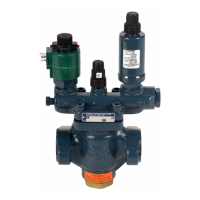
HA4AP PNEUMATICALLY
COMPENSATED REGULATOR
OPERATION
A pneumatic controller regulates the amount of air
pressure applied to the top of the M3P control module
diaphragm. A rise in temperature sensed by the
pneumatic controller reduces the air pressure to the
control module, allowing inlet pressure to enter the
space on top of the piston which forces the main valve
seat to open and regulate flow. A decrease in sensed
temperature increases the pressure of air to the M3P
control module. This increase in air pressure reduces
the opening at the M3P control module and restricts the
flow of inlet pressure to the piston, thus reducing the
opening at the valve main seat. See page 6 for M3P
pilot details.
ADJUSTMENT
Disconnect the air line to the M3P control module and
follow the adjustment procedures for the HA4A
Standard Regulator. See page 10. This sets the low
inlet pressure setting for the regulator. Connect the air
line back to the M3P control module. For every 1 psi
(0.069 bar) of increase in air pressure, the inlet
refrigerant pressure setting increases 1 psi (0.069 bar).
Adjust the controller as specified by the manufacturer.
In lieu of air, low- pressure refrigerant or other fluid can
be used for compensation. The differential between
inlet pressure and pressure to the M3P control module
must not exceed 45 psi (3.1 bar). Range A, 0 to 150 psig
(0 to 10 bar).
HA4AT TEMPERATURE
OPERATED REGULATOR
OPERATION
Temperature changes are detected by the thermal bulb.
The expansion or contraction of the charge inside the
bulb and capillary tube is transferred across the
diaphragm in the M3T control module. A rise in
temperature above the set-for temperature opens the
M3T control module and allows inlet pressure to enter
the space on top of the piston which forces the main
valve seat to open and regulate flow. A decrease in
temperature closes the M3T control module which
allows the piston to rise and close the main valve seat.
A reverse acting model is also available: rising
temperature closes the regulator, as for reheat. See
page 6 for M3T pilot details.
ADJUSTMENT
Connect a pressure gauge via a gauge valve at the
gauge port on the regulator adapter. Place a
thermometer in the cooled medium. With the system
operating, set the M3T regulator control module to the
desired temperature by turning the adjustment ring
clockwise to lower opening temperature or
counterclockwise to increase opening temperature.
One turn is equivalent to a change of approximately
11F (6.1°C). Tighten the locking ring after the final
adjustment has been made. Range –40F to +30F (–40°C
to 0°C); or +15F to +75F (–10°C to +25°C).
HA4AJ ELECTRONICALLY
CONTROLLED REGULATOR
OPERATION
The controller receives signals from an air or liquid
sensor and transmits an electrical voltage to the M3J
electronic actuator control module. An increase in
temperature lowers the voltage to actuator, opening the
regulator to increase flow. A decrease in sensor
temperature increases the voltage from the controller
to the M3J electronic actuator control module closing
the valve to reduce flow. This precision control can
maintain temperatures within 1F (0.5°C) of setting. The
M3J electronic actuator control module must be
operated by one of the control packages below.
See page 6 for M3J pilot details.
CONTROL PACKAGES
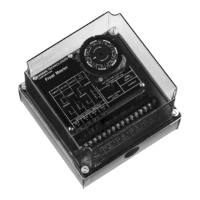
ECP This standard electronic control package
consists of a controller, controller base,
sensor, and transformer.
DDS This control package includes the standard
ECP components plus a digital temperature
readout, set-for/actual temperature switch
to easily check temperature, assembled and
mounted on a metal back plate. To display
the set-for temperature, simply depress and
hold the set-for/actual temperature switch.
When released, the digital readout will again
display the actual temperature at the sensor.
DDL Same as the DDS with a minimum evaporator
pressure adjustment. This adjustment sets
an evaporator pressure “floor” independent
of temperature. This is ideal to prevent too
cold of an evaporator surface in flooded
evaporators or during loading of critical,
temperature-sensitive products.
WTE2 Watertight controller enclosure for the above
“DD” series control packages. This industrial-
grade enclosure is polycarbonate with clear
gasketed cover.
EKA46 This computer interface is available for direct
connection of the electronic actuator control
module to a plant computer, PLC, or other
controlling device. Input to interface is a
regulated 4–20 mA or 0 to 10 volt signal from
an intelligent control device. The EKA46
package includes interface module and
transformer.
ADJUSTMENT
Set the desired temperature (REF) using both coarse
and fine adjustments. Set the alarm limits (LIM) on
deviation from the desired temperature, +1°C to +5°C.
Adjust the alarm delay timer (DEL) to delay alarm
release from 10 to 60 minutes. Both Proportional
amplification (Kp) and Integration time (Tn) are factory
set to 4. Consult the instruction manual or contact the
factory if adjustment is necessary. See the instructions
supplied with the EKA46 for its adjustment
recommendations. M3J electronic actuator control
module ranges: J1, 0 to 85 psig (0 to 6 bar); or J2, 25 to
115 psig (1.7 to 8 bar).


 To Next Page
 Loading...