Page 3For technical questions, please call 1-888-866-5797.Item 59709
GROUNDING INSTRUCTIONS
TO PREVENT ELECTRIC SHOCK AND DEATH FROM INCORRECT GROUNDING
WIRE CONNECTION:
The product is equipped with an appropriate 2-conductor cord and 2-prong grounding type plug to
fit the proper grounding-type receptacle. To reduce the risk of an electric shock, the plug must be
plugged into an appropriate outlet that is properly installed and grounded. Consult a qualified electrician or
serviceman if the grounding Instructions are not completely understood, or if in doubt as to whether proper
grounding exists.
Double Insulated Tools: Tools with Two Prong Plugs
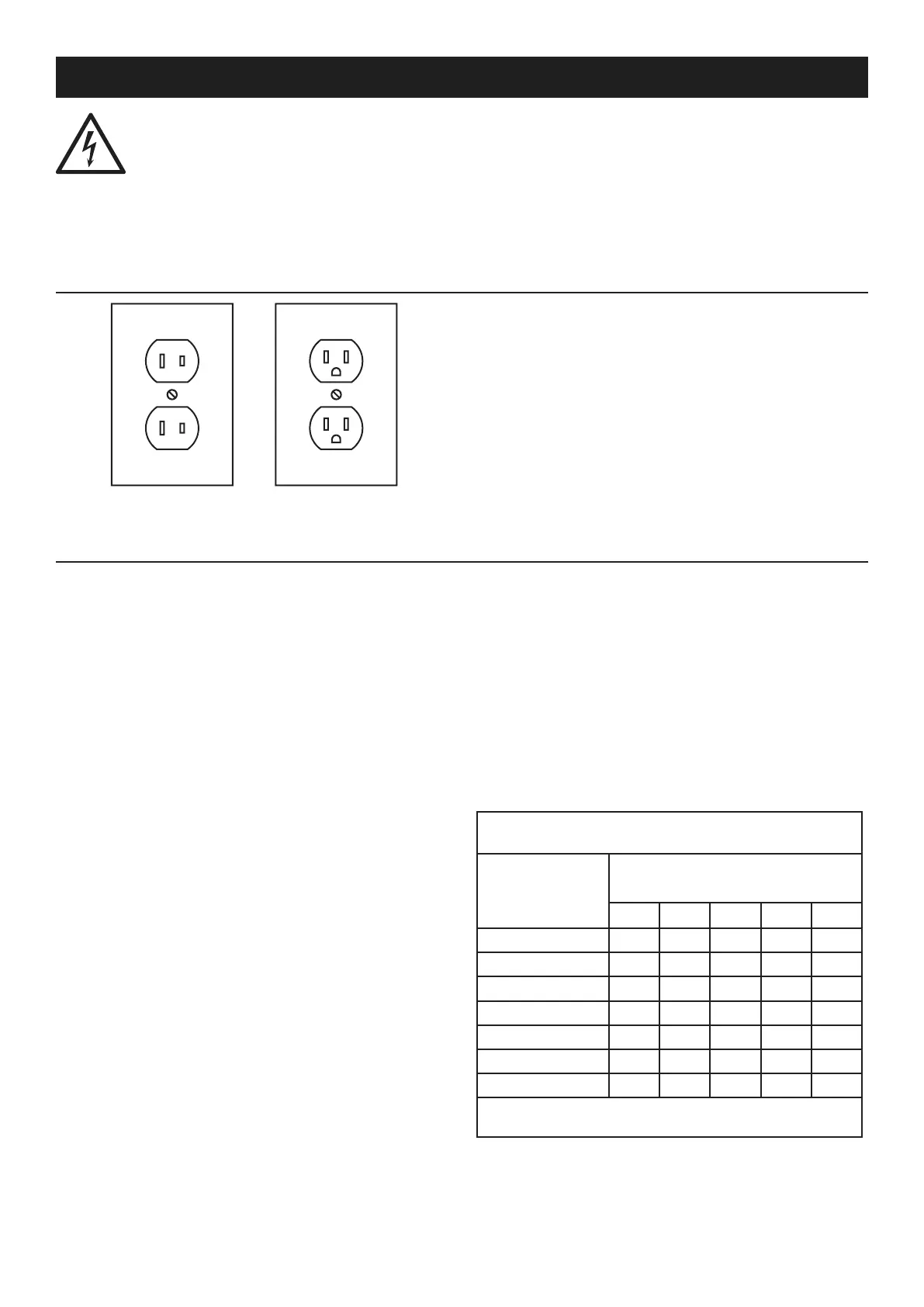
Outlets for 2-Prong Plug
1. Tools marked “Double Insulated” do not
require grounding. They have a special
double insulation system which satisfies
OSHA requirements and complies with
the applicable standards of Underwriters
Laboratories, Inc., the Canadian Standard
Association, and the National Electrical Code.
2. Double insulated tools may be used in either of the
120 volt outlets shown in the preceding illustration.
(See Outlets for 2-Prong Plug.)
Extension Cords
1. Use only 3-wire extension cords which have
3-prong grounding-type plugs and 3-pole
receptacles which accept the product’s
plug. Replace or repair damaged cords.
2. As the distance from the supply outlet increases, you
must use a heavier gauge extension cord. Using
extension cords with inadequately sized wire causes
a serious drop in voltage, resulting in loss of power
and possible damage to product. (See Table A.)
3. The smaller the gauge number of the wire,
the greater the capacity of the cord. For
example, a 14 gauge cord can carry a
higher current than a 16 gauge cord.
4. When using more than one extension cord to
make up the total length, make sure each cord
contains at least the minimum wire size required.
5. If you are using one extension cord for more than one
product, add the nameplate amperes and use the
sum to determine the required minimum cord size.
6. Outdoor extension cords must be used with
outdoor use products and are surface marked
with suffix letters “W-A” and with a tag stating
“Suitable for Use with Outdoor Appliances”.
7. Make sure the extension cord is properly wired
and in good electrical condition. Always replace
a damaged extension cord or have it repaired
by a qualified electrician before using it.
8. Protect the extension cords from sharp objects,
excessive heat, and damp or wet areas.
9. Keep the connection to an extension
cord dry and off the ground.
10. Devices for retaining a connection between an
extension cord and a power supply cord are available.
TABLE A: RECOMMENDED MINIMUM WIRE
GAUGE FOR EXTENSION CORDS* (120 VOLT)
NAMEPLATE
AMPERES
(at full load)
EXTENSION CORD
LENGTH
25´ 50´ 75´ 100´ 150´
0 – 2.0 18 18 18 18 16
2.1 – 3.4 18 18 18 16 14
3.5 – 5.0 18 18 16 14 12
5.1 – 7.0 18 16 14 12 12
7.1 – 12.0 16 14 12 10 -
12.1 – 16.0 14 12 10 - -
16.1 – 20.0 12 10 - - -
* Based on limiting the line voltage drop to five volts at
150% of the rated amperes.



 To Next Page
 Loading...