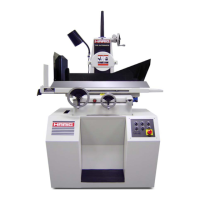
OPERATIONAL PROBLEMS - ADJUSTMENTS
Your
Harig surface grinder has been designed
and
manufactured
to
give a long life
of
accurate
finish surface grinding. It has been
thoroughly
checked during
manufacture
and
final assembly,
and has been
run
in
and
given a performance
test
.
A final inspection
report
showing
the
actual devia-
tions found in six
of
the
many checks performed
on
this
machine,
is
included with
this
manual.
The
following section
is
set
up
to
assist you in
getting maximum performance
from
the
machine.
Each
trouble
or
malfunction
is
listed followed
by
possible causes,
together
with
suggested adjust-
ments
or
changes you can make.
CAUTION: Electrical
tests
with
the
current
on
should be made
only
by
a qualified electrician.
ORDERING
REPLACEMENT PARTS
When repair
parts
are
ordered,
be sure
to
include
serial
number
of
the
machine as well as
the
part
number
shown in
the
following drawings.
The
machine serial
number
is
stamped
into
the
column
cap casting
next
to
the
elevating handwheel.
1.
CHATTER
OR
VIBRATION
MARKS IN FINISH
A.
Wheel loose on
sleeve.
Put
additional tension
on
wheel
adaptor
nut
. Even if
this
nut
is
not
loose,
motor
starting
torque
may be causing
wheel
to
shift slightly. Re-dress
after
adding
tension
to
the
wheel
nut.
B. Wheel
out
of
balance. Unbalanced wheels
cause vibration
in
the
spindle assembly, result-
ing
in
a
chatter
in
the
work. Dressing sides
of
the
wheel may bring it
into
balance. Balancing
the
wheel
on
the
grinder with a
dynamic
balancer, if available, should
correct
situation.
Balancing wheel
and
adaptor
assembly with a
static
balance arrangement will usually cor-
rect
the
problem.
Replace wheel with
one
balanced
by
the
manufacturer. Check whe-
ther
wheel balance
is
the
cause
of
vibration
by
holding projecting
part
of
the
spindle hous-
ing while grinder
is
running.
Compare
this
to
the
feel
when
the
grinder
is
run
with
the
wheel, wheel
nut
and
washer removed.
C. Wheel in need
of
dressing. If
chatter
appears
after
the
wheel has been used
for
a
time,
it is
probably
due
to
the
fact
that
most
grinding
wheels vary
in
hardness
around
the
periphery.
Since
this
chatter
appearance
is
usually
only
a few millionths
of
an inch high, weigh
the
·
economics
of
more
frequent
wheel dressing
against
the
slight loss
of
appearance.
D.Grade
of
wheel
too
hard. Loading
up
of
the
wheel, particularly if grinding
without
cool-
ant
can cause
chatter.
Replace wheel with
one
of
a
softer
grade.
E.
Taper
of
adaptor
sleeve in error. If
the
taper
in
the
wheel
adaptor
sleeve
is
not
the
same as
that
on
the
spindle nose,
or
if a piece
of
dirt
or
grit has been assembled
on
the
taper,
a
chatter
can
appear
on
the
work. Check
the
adaptor
sleeve
by
putting
a
thin
film
of
Prussian blue inside
the
sleeve
and
press it
on
the
spindle.
The
spindle
taper
should
show
contact
all
around
the
circumference
on
two
separate rings.
F. Single phase
motor.
If a single phase,
rather
than
the
regular 3 phase
motor
has been pur-
chased for
the
spindle, a
poorer
finish
may
result. Because
of
its design, a 3 phase
motor
runs
more
smoothly
than
a single phase
motor.
The
six poles
of
the
3 phase
motor
give a
smoother
pull
than
the
two
poles
of
the
single phase
motor.
The
moving
part
of
the
switch
for
cutting
out
the
starting circuit
of
of
the
single phase
motor
does
not
always
move
to
exactly
the
same position, slightly
changing
the
balance
of
the
motor.
G. Ball bearing failure.
The
super
precision bear-
ings used in
the
Harig Spindle
are
sized
to
give
an average life
of
many
years
of
service. If a
failure
of
either
the
spindle
or
motor
bearings
does occur, a
chatter
will appear
on
the
work
being ground,
and
an
audible
noise will be
heard when
the
spindle is running. (Wheel,
wheel
nut,
and
washer
should
be
removed
to
make certain
an
unbalanced wheel
is
not
caus-
ing
the
noise.) Replacement
of
all bearings
on
the
spindle assembly,
or
a
new
motor,
is
required. It is
recommended
that
the
spindle
assembly be
returned
to
the
factory
for
this
repair
so
that
dynamic
balance
of
the
unit
can be checked.
9



 To Next Page
 Loading...