EasyManua.ls Logo

Harig 612 - Grinding Magnetic Chucks; Grinding Wheel Mounting

Default Icon
22 pages
Print Icon
To Next Page IconTo Next Page
To Previous Page IconTo Previous Page
Loading...
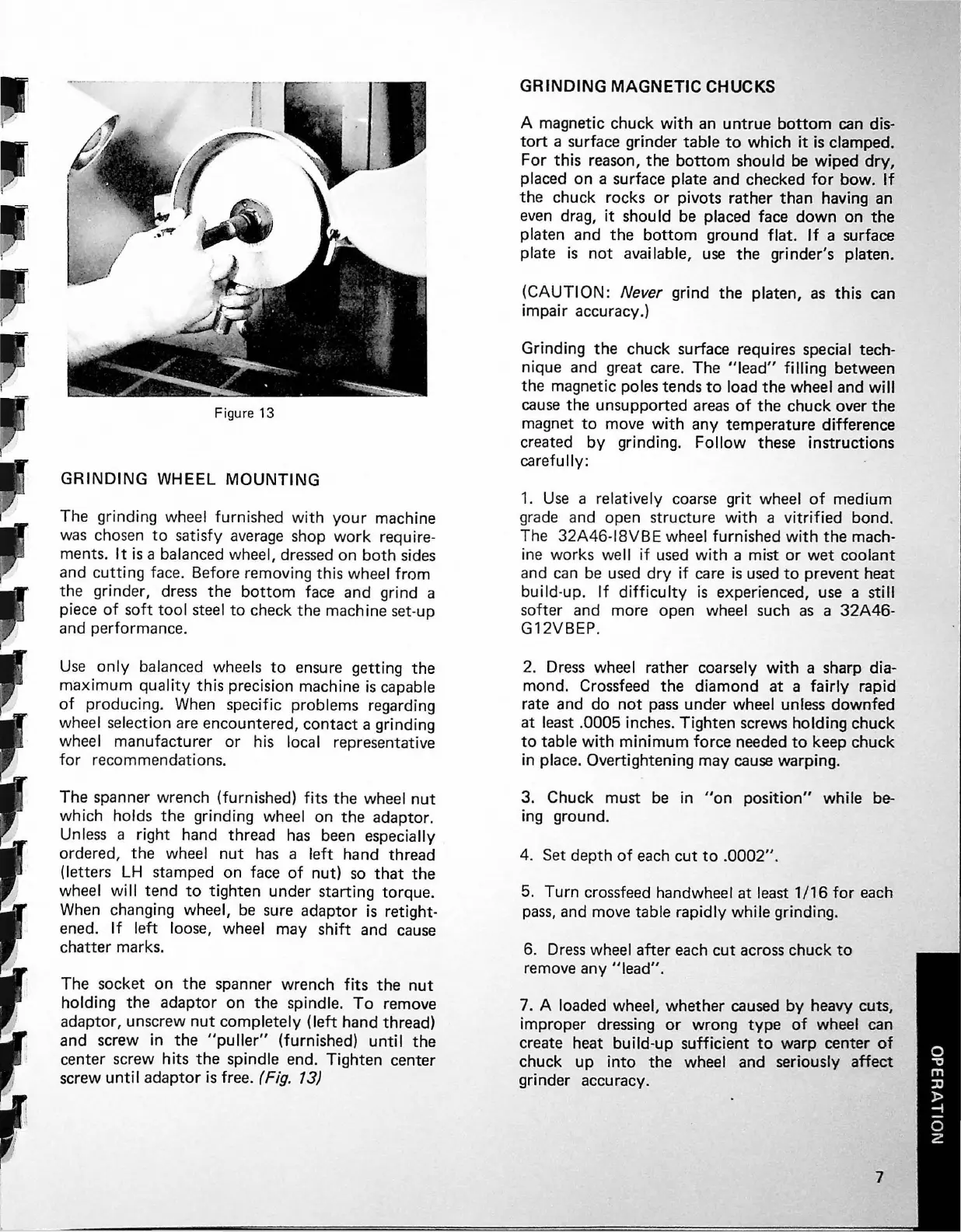
Figure 13
GRINDING
WHEEL
MOUNTING
The
grinding wheel
furnished
with
your
machine
was
chosen
to
satisfy
average
shop
work
require-
ments.
It
is
a
balanced
wheel, dressed
on
both
sides
and
cutting
face. Before removing
this
wheel
from
the
grinder, dress
the
bottom
face
and
grind a
piece
of
soft
tool
steel
to
check
the
machine
set-up
and
performance.
Use
only
balanced
wheels
to
ensure
getting
the
maximum
quality
this
precision
machine
is
capable
of
producing.
When specific
problems
regarding
wheel
selection
are
encountered,
contact
a grinding
wheel
manufacturer
or
his local
representative
for
recommendations.
The
spanner
wrench
(furnished)
fits
the
wheel
nut
which
holds
the
grinding wheel
on
the
adaptor.
Unless a right
hand
thread
has
been
especially
ordered,
the
wheel
nut
has a left
hand
thread
(letters
LH
stamped
on
face
of
nut)
so
that
the
wheel will
tend
to
tighten
under
starting
torque.
When changing wheel,
be
sure
adaptor
is retight-
ened.
If left loose, wheel
may
shift
and
cause
chatter
marks.
The
socket
on
the
spanner
wrench
fits
the
nut
holding
the
adaptor
on
the
spindle.
To
remove
adaptor,
unscrew
nut
completely
(left
hand
thread)
and
screw
in
the
"puller"
(furnished)
until
the
center
screw
hits
the
spindle
end.
Tighten
center
screw
until
adaptor
is free. (Fig. 13)
GRINDING
MAGNETIC
CHUCKS
A
magnetic
chuck
with
an
untrue
bottom
can
dis-
tort
a
surface
grinder
table
to
which
it
is
clamped.
For
this
reason,
the
bottom
should
be
wiped
dry,
placed
on
a
surface
plate
and
checked
for
bow.
If
the
chuck
rocks
or
pivots
rather
than
having
an
even drag,
it
should
be
placed
face
down
on
the
platen
and
the
bottom
ground
flat.
If a
surface
plate
is
not
available, use
the
grinder's
platen.
(CAUTION:
Never
grind
the
platen,
as
this
can
impair accuracy.)
Grinding
the
chuck
surface
requires
special
tech-
nique
and
great
care.
The
"lead"
filling
between
the
magnetic
poles
tends
to
load
the
wheel
and
will
cause
the
unsupported
areas
of
the
chuck
over
the
magnet
to
move
with
any
temperature
difference
created
by
grinding.
Follow
these
instructions
carefully:
1. Use a relatively coarse grit wheel
of
medium
grade
and
open
structure
with
a vitrified
bond.
The
32A46-18VBE wheel furnished
with
the
mach
-
ine
works
well if used
with
a mist
or
wet
coolant
and
can
be
used
dry
if care
is
used
to
prevent
heat
build-
up.
If
difficulty
is
experienced,
use a still
softer
and
more
open
wheel
such
as
a
32A46-
G 12VBEP.
2.
Dress wheel
rather
coarsely
with
a
sharp
dia-
mond
. Crossfeed
the
diamond
at
a fairly
rapid
rate
and
do
not
pass
under
wheel unless
downfed
at
least
.0005
inches.
Tighten
screws
holding
chuck
to
table
with
minimum
force
needed
to
keep
chuck
in place. Overtightening
may
cause
warping.
3.
Chuck
must
be in
"on
position"
while be-
ing
ground.
4.
Set
depth
of
each
cut
to
.0002"
.
5.
Turn
crossfeed handwheel
at
least 1
/16
for
each
pass,
and
move
table
rapidly while grinding.
6. Dress wheel
after
each
cut
across
chuck
to
remove
any
"lead".
7.
A loaded wheel,
whether
caused
by
heavy
cuts,
improper
dressing
or
wrong
type
of
wheel
can
create
heat
build-up
sufficient
to
warp
center
of
chuck
up
into
the
wheel
and
seriously
affect
grinder
accuracy.
7

Related product manuals