EasyManua.ls Logo

Heathkit HW-12 - Page 11

Heathkit HW-12
67 pages
Print Icon
To Next Page IconTo Next Page
To Previous Page IconTo Previous Page
Loading...
~n
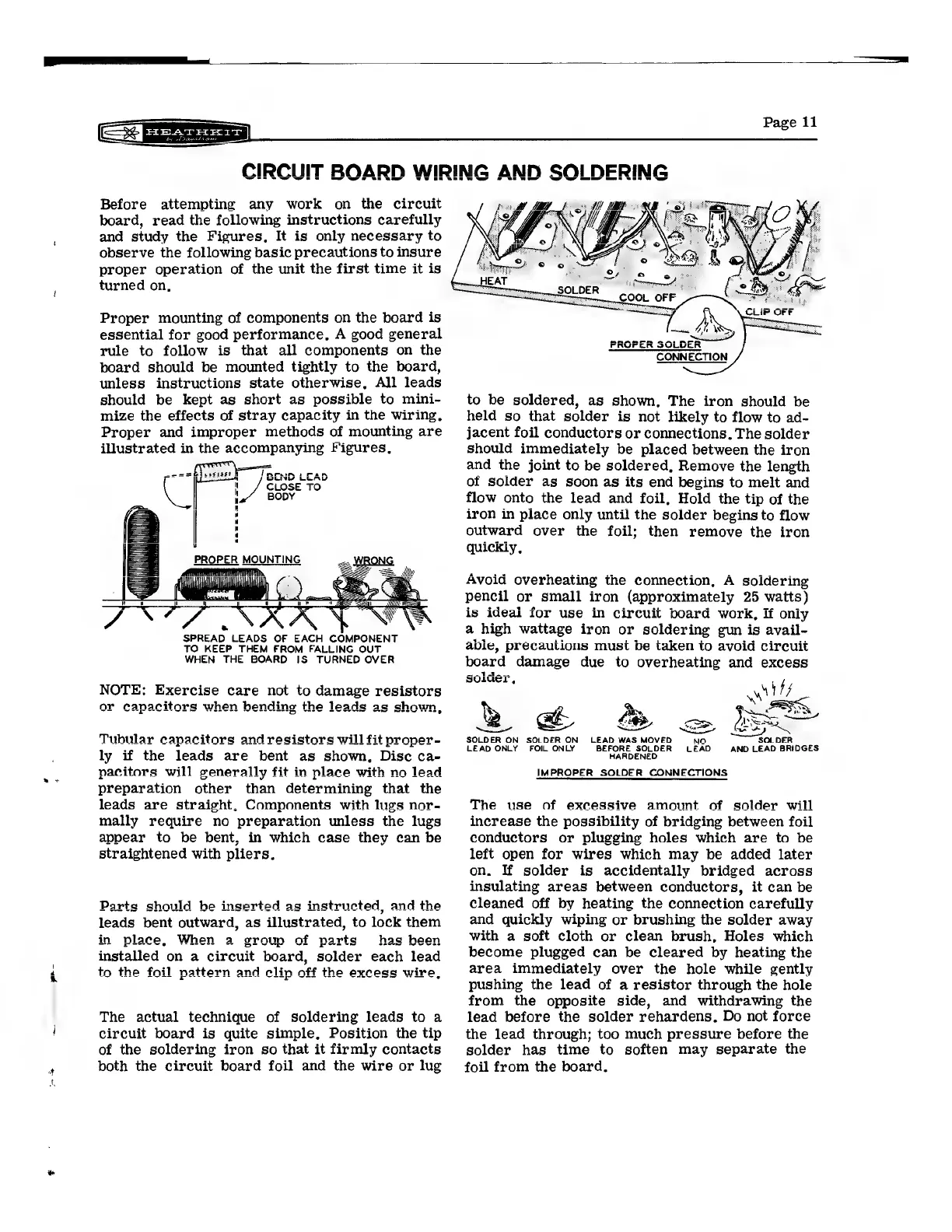
Before
attempting
any
work
on
the
circuit
board,
read
the
following
instructions
carefully
and
study
the
Figures,
It
is
only
necessary
to
observe
the
following
basic
precautions
to
insure
proper
operation
of
the
unit
the
first
time
it
is
turned
on,
Proper
mounting
of
components
on
the
board
is
essential
for
good
performance,
A
good
general
rule
to
follow
is
that
all
components
on
the
board
should
be
mounted
tightly
to
the
board,
unless
instructions
state
otherwise,
All
leads
should
be
kept
as
short
as
possible
to
mini-
mize
the
effects
of
stray
capacity
in
the
wiring,
Proper
and
improper
methods
of
mounting
are
illustrated
in
the
accompanying
Figures,
amin:
can
va
ob
iy
SEND
LEAD
H
CLOSE
TO
1
BODY
4
SPREAD.
LEADS
OF
EACH
COMPONENT
TO
KEEP
THEM
FROM
FALLING
OUT
WHEN
THE
BOARD
IS
TURNED
OVER
NOTE:
Exercise
care
not
to
damage
resistors
or
capacitors
when
bending
the
leads
as
shown
201
aris
Ae
wee
Wal,
pacitors
will
generally
fit
in
place
with
no
lead
preparation
other
than
determining
that
the
leads
are
straight.
Components
with
lugs
nor-
mally
require
no
preparation
unless
the
lugs
appear
to
be
bent,
in
which
case
they
can
be
straightened
with
pliers.
'D
n>
eS
+
iA
Fay
J
2
i=
2
zs
‘D
=
ia
iy
3
<<
oO
Qe
p
in
place,
When
ag
eae
Pe
ate
ee
t=)
fat
a
ui
The
actual
technique
of
soldering
leads
to
a
circuit
board
is
quite
simple,
Position
the
tip
of
the
soldering
iron
so
that
it
firmly
contacts
both
the
circuit
board
foil
and
the
wire
or
lug
O{o
opps
Ss
ONNECTION
to
be
soldered,
as
shown,
The
iron
should
be
held
so
that
solder
is
not
likely
to
flow
to
ad-
jacent
foil
conductors
or
connections.
The
solder
should
immediately
be
placed
between
the
iron
and
the
joint
to
be
soldered,
Remove
the
length
of
solder
as
soon
as
its
end
begins
to
melt
and
flow
onto
the
lead
and
foil,
Hold
the
tip
of
the
iron
in
place
only
until
the
solder
begins
to
flow
outward
over
the
foil;
then
remove
the
iron
quickly,
Avoid
overheating
the
connection,
A
soldering
pencil
or
small
iron
(approximately
25
watts)
is
ideai
for
use
in
circuit
board
work,
If
only
a
high
wattage
iron
or
soldering
gun
is
avail-
able,
precautions
must
be
taken
to
avoid
circuit
board
damage
due
to
overheating
and
excess
solder,
SOLDER
ON
SOLDER
ON
LEAD
WAS
MOVED
NO
LEAD
ONLY
FOIL
ONLY
BEFORE
SOLDER
LEAD
HARDENED
IMPROPER
SOLDER
CONNECTIONS
“SOLDER
AND
LEAD
BRIDGES
The
use
of
excessive
amount
of
solder
will
increase
the
possibility
of
bridging
between
foil
conductors
or
plugging
holes
which
are
to
be
left
open
for
wires
which
may
be
added
later
on.
If
solder
is
accidentally
bridged
across
insulating
areas
between
conductors,
it
can
be
cleaned
off
by
heating
the
connection
carefully
and
quickly
wiping
or
brushing
the
solder
away
with
a
soft
cloth
or
clean
brush,
Holes
which
become
plugged
can
be
cleared
by
heating
the
area
immediately
over
the
hole
while
gently
pushing
the
lead
of
a
resistor
through
the
hole
from
the
opposite
side,
and
withdrawing
the
lead
before
the
solder
rehardens,
Do
not
force
the
lead
through;
too
much
pressure
before
the
solder
has
time
to
soften
may
separate
the
foil
from
the
board.

Related product manuals