EN
Heinz Electrodynamic Designs
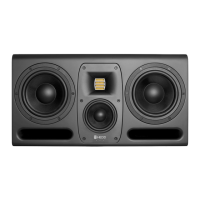
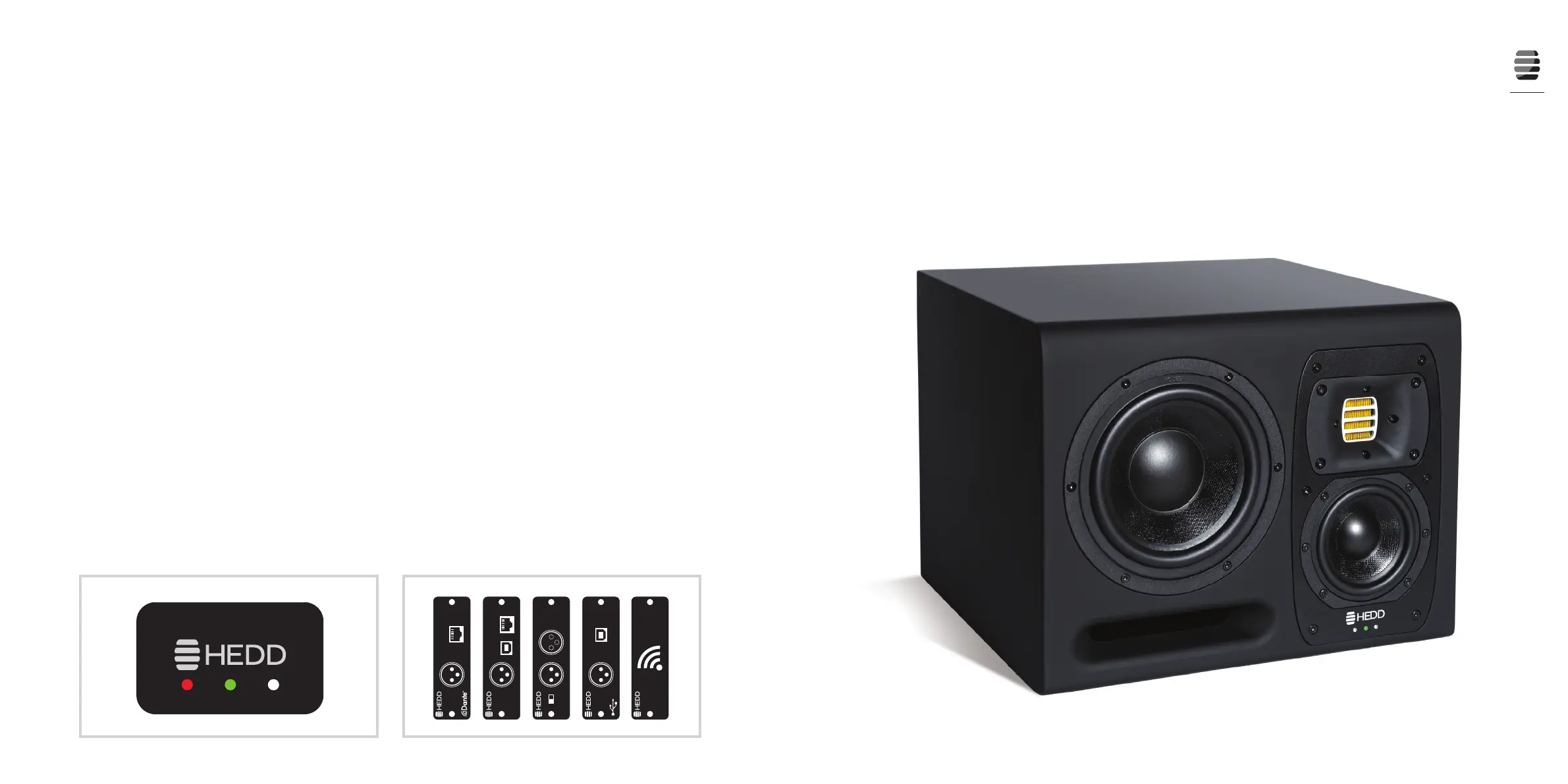
STATUS LEDs
On the front of your speaker, you can see a front LED
panel which will indicate its operational status in the fol-
lowing way:
• Red “OL”: lights up if the limiter circuit of the speaker
kicks in and protects the drivers from overloading
• Green “PWR / STBY”: normal operational power-on
status
• White “SYNC”: lights up if the speaker is synchronized
with a digital source (HEDD Bridge card)
HEDD BRIDGE
The HEDD Bridge was inspired by the rather simple and
yet absolutely vital idea that our analog speakers should
feature a freely confi gurable system that, being located
on the back panel of each monitor, allows for the optional
integration of specifi c digital audio protocols. The HEDD
Bridge is nothing less than a modular system of input
cards that enables all HEDD monitors to fully handle
digital protocols such as USB2, AES3, Wireless and even
AES67 / Dante, that is Audio-over-IP. As a customer you
can either stay completely in the analog domain or can
choose the HEDD input module that fi ts your workfl ow
and audio environment in the best possible way.
The HEDD Bridge brings versatile digital input connectiv-
ity including two AoIP options to the world of professional
monitoring. For the fi rst time, it becomes possible for
studio monitors to be integrated into today’s most es-
tablished audio network protocols: Audinate’s Dante and
Ravenna Network / AES67.
Here are a few examples of how loudspeakers can be used
in an AoIP environment:
• Directly connect a computer to the loudspeakers via a
CAT.6 Ethernet cable and stream high resolution audio
• In complex multi-channel setups (like Dolby Atmos,
Auro 3D), multiple separate loudspeakers can be fed
with a single high-resolution audio stream and each one
of these speaker channels can be controlled individually
by software control applications
• Audio devices in di erent rooms or facilities (e.g. movie
theaters, conference rooms, live concerts and music
festivals) can be controlled from one or multiple work-
spaces connected to the Ethernet network
• AoIP will enable broadcast engineers to simplify the in-
house signal distribution in broadcast stations
Introduction
EN
Heinz Electrodynamic Designs
DIG. THRU AES IN
B3-AES3
AES3/EBU
BRIDGE
CH2 OUT
B4-USB
BRIDGE
CH2 OUT
Dante
B1-DANTE
BRIDGE
USB 2.0
B5-WIRELESS
BRIDGE
L/R
CH2 OUT
B2-AES67
BRIDGE
AES6
7
USB 2.0
AES67


 To Next Page
 Loading...