EN
Heinz Electrodynamic Designs
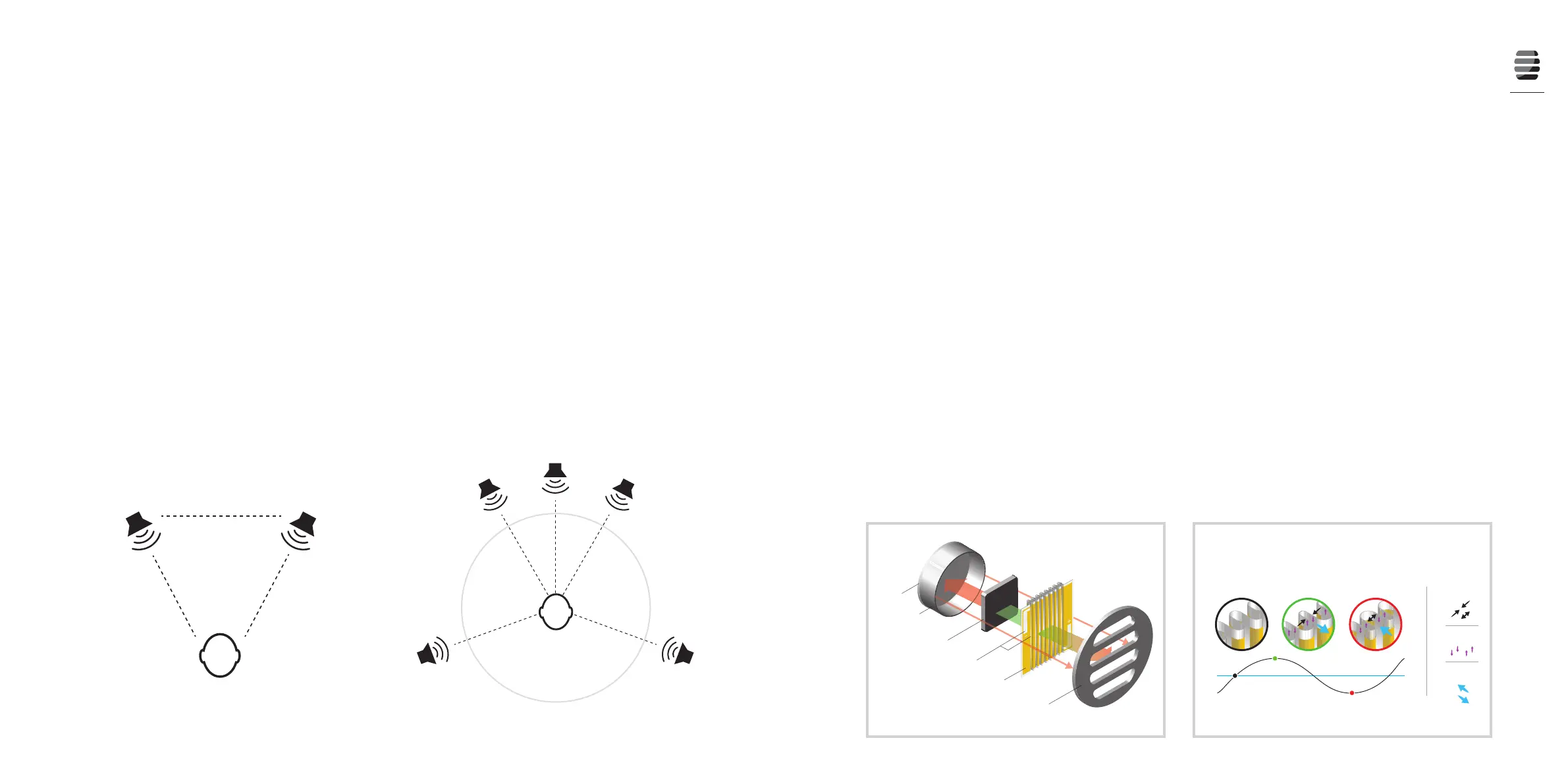
STEREO POSITIONING
In a stereo setup the speakers should be placed horizon-
tally and facing towards you. The tweeters should match
the height of your ears. This is the best way to perceive
the intended character of the monitor. For optimizing
your listening position, place the two speakers so that
they form an equilateral triangle with your listening
position (see fi gure below). This position should be an
imaginary center point between the two speakers. Play
a recording that you are familiar with and try playing
around with adjusting the distance of the speakers and the
distance of your listening position accordingly. Stop when
you think that you hear an authentic stereo panorama.
Trust your ears, they are your best friend.
SURROUND POSITIONING
Place the speakers in a circle around your listening posi-
tion and work with the following angles: Center 0°, Front/
Right 30°, Rear/Right 110°, Rear/Left 250° and Front/
Left 330°. The surrounding walls should be at least 40cm
away from every speaker to avoid early refl ections. We
recommend that you use the same type of speaker for
every channel (except the subwoofer, of course), because
otherwise you can run into negative frequency and/or
phase coloration. Check out the ITU recommendation
BS.2159-4 for a detailed explanation.
Speaker Placement
30°
110°
110°
30°
CENTER
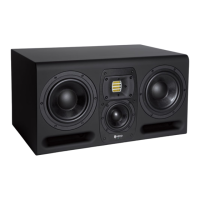
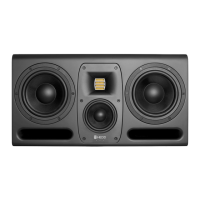
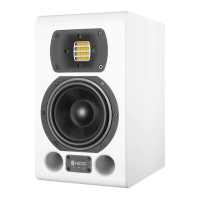
HEDD studio monitors are equipped with a special tweeter
design that - based on a brilliant idea by the German-
American physicist Oskar Heil - was introduced to the
professional audio world by HEDD founder Klaus Heinz. It
is called the Air Motion Transformer (AMT).
Unlike the vast majority of tweeters (electro- and magne-
tostatic designs, cones, domes), which move the air in a
1 : 1 ratio (diaphragm velocity equals the air velocity),
the Air Motion Transformer is based on a folded elastic
diaphragm, where the single folds open and close in an
alternating pattern and thus breathe the air in and out. The
air driven through the folds is accelerated to a 4 : 1 ratio,
meaning that the air fl ow is four times as fast as the single
moving fold (see fi gure). This is a huge advantage when it
comes to reproducing musical signals with fast transients
/ short attacks such as cymbals, voices or plugged guitar
strings.
Another aspect of this fascinating design has to do with
the actual diaphragm area and its importance for the
dynamic range of the transducer. In a cone-like design,
the cone itself is the acoustically active area – and this is
true for pretty much all other drive units. The diaphragm
of the HEDD Air Motion Transformer, however, is folded
into the 3rd dimension, meaning that a signifi cantly larger
foil can be used. That way, the acoustically e ective area
of the diaphragm is increased by a factor of more than 2.5,
resulting in an increased dynamic output and a much wider
disperson.
In their new monitor designs, HEDD introduces an even
further improved version of the AMT. A strong magnetic
fi eld lowers distortion and intermodulation while a special
waveguide is used to reach lower crossover frequencies,
which is crucial for shaping the midrange of 2- and 3-way
studio monitors.
HEDD Air Motion Transformer
N
S
Pole plate
(back)
Pole plate
(front)
Neodyme
magnet
Magnetical
yoke
Aluminum
conductor
Diaphragm
Heinz Electrodynamic Designs
HEDD Air Motion Transformer
- Design and Principle -
Zero crossing Positive halfwave Negative halfwave
t
Direction
of current
Accelerated
air flow
Lorentz
force
N
S
Pole plate
(back)
Pole plate
(front)
Neodyme
magnet
Magnetical
yoke
Aluminum
conductor
Diaphragm
Heinz Electrodynamic Designs
HEDD Air Motion Transformer
- Design and Principle -
Zero crossing Positive halfwave Negative halfwave
t
Direction
of current
Accelerated
air flow
Lorentz
force


 To Next Page
 Loading...