4
IRON CURTAIN
®
2.0
The advantages of a multi-media bed are:
1. Longer runs between backwash times.
2. Caking of the bed and breakthrough turbidity are virtually
eliminated.
3. Much higher service ow rates per square foot.
4. Higher degree of clarity because of the heavier, ner lter
media in the bottom.
The standard Iron Curtain
®
System uses four layers of lter
media. The top layer is made up of large, lighter weight par-
ticles. The second layer contains a slightly heavier media.
The third layer contains a much heavier media, smaller in
size than the one above. The fourth layer is a special sup-
port bed to retain lter media so it does not pass through
the distribution system, and allows an even distributed ow
of backwash water.
Operation of Aeration System
The Iron Curtain
®
System introduces air into the aeration
tank and bleeds o the old head of air automatically. A relay
controls the air recharge cycle and how frequently it occurs.
The relay turns on the air pump, opening the drain port and
the top air recharge port of the aeration tank. The air pump
runs for a pre-set amount of time, replenishing the head of
air and discharging excess water and/or air to drain.
Advantages Over
Other Systems
1.
The original system was tested and validated by WQA.
2. Uses no chemicals or salt.
3. Eliminates the need for air injectors, venturis, or micron-
izers that can plug with iron.
4. No oats or air volume controls are used to regulate air
volume in aeration tank which “foul” from iron.
5. Two-tank system consisting of a pressurized aeration
tank and multi-media depth lter.
6. 110V aeration pump to recharge aeration tank.
7. "Piggy-back" plug allows control valve to be plugged
into same outlet.
8.
Can be used on shared wells, municipal water supplies, or
with buried pressure tanks without additional equipment.
9. Higher service ow rates.
10. Better ltration results.
11. U.S. Patents #B1 5,096,596 and 7,156,995.
12. Variable settings on air recharge that is independent of
backwash frequency.
13. Can reduce both dissolved and particulate iron.
Iron Filtration System
Aeration/precipitation/multi-media ltration for:
1. Iron Reduction/Removal
2. Manganese Reduction/Removal
3. Hydrogen Sulde Reduction/Removal
Principle of Operation
The Iron Curtain
®
System uses a three step process of
oxidation, precipitation, and mechanical ltration for
the reduction/removal of iron, manganese, and hydrogen
sulde. The process of how the Iron Curtain
®
System does
each one of these separate procedures is the key to the
successful results this product has obtained in the market
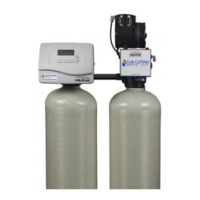
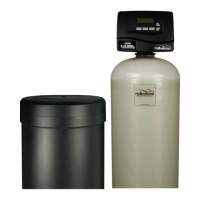
place. There are two main components that make up the
Iron Curtain
®
System. They are:
1. Iron Curtain
®
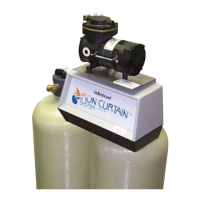
2.0 Aeration Assembly
2. Iron Curtain
®
Multi-Media Depth Filter
1
The rst step in any oxidizing process is to bring the
raw water into intimate contact with a strong oxi-
dant. This will begin to convert the dissolved element such
as iron or manganese to a physical particle or nonsoluble
precipitate. A strong, inexpensive, environmentally-safe oxi-
dant is oxygen, which makes up about 21% of ambient air.
To do this, the Iron Curtain
®
System sprays water through
a regulated head of air in the aeration tank.
2
The second step in this three step process is to
provide adequate reaction or contact time for the
precipitation reaction to go to completion. This allows
time for the iron and/or manganese particles to become large
enough to lter out. The aeration tank with the Iron Curtain
®
System allows for several minutes of contact time at the rated
service ows, compared to only seconds on other systems.
It should be noted that this reaction time will also be aected
by temperature; the warmer the water the faster the reac-
tion. A low pH can slow the oxidation reaction of the iron.
This reaction time may also be aected by the presence of
organic material (such as tannins). If tannins are present,
eld tests have shown that they will not be removed and
will also hinder the ability of this system to eectively
remove iron, manganese, and/or hydrogen sulde. Instal-
lation of this system on water supplies with more than
0.5 ppm of tannins will void warranty.
3
The third and nal step is ltration for the removal of
the precipitates from the water. A WQA Water Filtration
Study Guide states:
“The ideal lter bed would be one with large grains at the top
to prevent the formation of a surface cake and to provide
large pores for course particles and small grains at the bot-
tom to entrap smaller particles. This allows the entire depth
of the bed to be used as a lter. This also allows for longer
lter runs and faster ow rates. Unfortunately, such an ideal
bed, when consisting of a single media is not possible, the
way to solve this problem is to use layers of media.”



 To Next Page