42
General
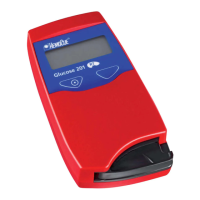
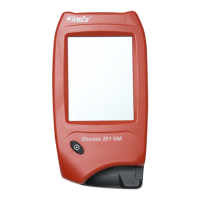
The HemoCue Glucose 201
+
is a system for the determination of
the total amount of glucose in whole blood. The system consists of
a specially designed analyzer with specially designed cuvettes
containing dried reagents. The cuvette serves as a pipette, reaction
vessel and as a measuring cuvette. No dilution is required. The
glucose measurement takes place in the analyzer, which follows
the progress of the reaction and presents the result only when the
end point of the reaction has been reached. The system is factory
calibrated according to a wet chemistry glucose dehydrogenase
method using haemolysis and deproteinisation.
Intended purpose
Quantitative determination of glucose in whole blood using a
specially designed analyzer, the HemoCue Glucose 201
+
.
The quantitative determination of the instant blood glucose con-
centration in circulation supplements the clinical evidence in the
diagnosis and treatment of the diabetic patient as well as in the
monitoring of neonatal blood glucose levels. To establish HemoCue
Glucose reference values and an intervention level, neonatal blood
samples should be evaluated against a suitable laboratory method,
taking into consideration the difference between whole blood and
plasma reference values. HemoCue Glucose 201 Microcuvettes
are for In Vitro Diagnostic use only.
The HemoCue Glucose 201
+
Analyzer is only to be used with
HemoCue Glucose 201 Microcuvettes.
IVD Medical Device Directive
The HemoCue Glucose 201
+
complies with the IVD Medical
Device Directive 98/79/EC and carries the CE mark.
Theory
The chemistry method utilised by the HemoCue Glucose 201
Microcuvette is a modified glucose dehydrogenase method described
by Banauch et al.
2
A chromogen compound is added to the reagents
according to the principle outlined by Bergmeyer
3
with saponin
used for haemolysing the erythrocytes. The absorbance is measured
at two wavelengths (660 and 840 nm) to compensate for turbidity.
Reagents
Saponin, NAD, MTT and NaF.
Enzyme mix: Glucose Dehydrogenase, Diaphorase and Mutarotase.
Sample material
Capillary, venous or arterial blood may be used. Appropriate
a
nticoagulants in solid form (e.g. EDTA and Heparin) and glycolysis
inhibitors (e.g. Sodium Oxalate, Sodium Fluoride and Potassium
Oxalate) may be used. Glycolysis is a major concern in all glucose
measurements. To minimise the effect of glycolysis, measure the
blood sample as soon as possible after it has been obtained.
Samples of blood collected in containers with recommended
anticoagulants should be analysed within 30 minutes. If the blood
has been kept in a refrigerator it must be allowed to reach room
temperature 15 – 30 °C (59 – 86 °F) before analysis. Mix all
samples thoroughly by inverting the sample container at least
10 times before measurement.
Storage and environmental requirements for
HemoCue Glucose 201 Microcuvettes
Use the HemoCue Glucose 201 Microcuvettes prior to their expiry
date. The expiry date is printed on each package.
Storage for cuvettes kept in a vial
Store HemoCue Glucose 201 Microcuvettes in a refrigerator at
2–8 °C (35 – 46 °F) or in a freezer at ≤ -18 °C (≤ -1 °F). Note
that if the vial is taken directly from the freezer the cuvettes must
be allowed to reach room temperature (app. 30 minutes) before ana-
lysis. Cuvettes kept in an opened vial are stable for 30 days when
stored in a refrigerator at 2–8 °C (35 – 46 °F).
Specifications
GB


 To Next Page