EasyManua.ls Logo

HermanMiller Headway - User Manual

HermanMiller Headway
5 pages
Print Icon
To Next Page IconTo Next Page
Loading...
Parts Included
DP1EP., DP1EG., DP1EF.
Tools Required
HermanMiller
Headway
Communal Table Installation and
Disassembly for Recycling Instructions
How to assemble your Communal Table.
End Panel () Leg Cover ()
Spanner Rail ()
Rail Cover ()
Leg Support ()
Glide Support ()
Rail Brace ()
(” & ” Tables)
Connector Plate ()
(” & ” Tables)
# Locknut
Cover Button (18)
LH Split Spanner Rail ()
(” & ” Tables)
LH Split Rail Cover ()
(” & ” Tables)
RH Split Spanner Rail ()
(” & ” Tables)
RH Split Rail Cover ()
(” & ” Tables)
Worksurface
# x / Pan
Head Screw ()
M x . Flange Socket
Head Screw ()
Safety Glass
M8 Allen Wrench
Ratchet Wrench
/8” Socket
. Place Worksurface upside down on clean padded surface. Observe bow
in worksurface. If signicant, place blocks roughly  times height of bow.
. Place weight on middle of surface.
Note: Sequence of screw installation is important.
Step 1
Power Driver
Phillips Bit
Carpenter’s Square
Work Surface
Block
Block
RH Split Spanner Rail
LH Split Spanner Rail
Rail Brace
“R”
L”
Locknut
. If table is over ”, Spanner Rail will be  piece assembly. Mate Split
Spanner Rail marked ”L” with another marked “R”.
. Join together by placing Rail Brace over studs on rails.
. Secure brace to rail with () Locknuts.
Step 2
Torque Wrench
HermanMiller Assembly Instructions1
1BR5TN rev B
Question and Answer IconNeed help?

Do you have a question about the HermanMiller Headway and is the answer not in the manual?

Summary

Communal Table Assembly and Disassembly

Parts Included and Tools Required

Lists the components and tools necessary for assembling the communal table.

Step 1: Worksurface Preparation

Instructions for placing the worksurface upside down and adding support blocks if needed.

Step 2: Spanner Rail Assembly

Details on joining two-piece spanner rails using a rail brace and locknuts.

Step 3: Spanner Rail Installation

Guidance on positioning spanner rails and securing them with screws.

Step 4: Cover Button Attachment

Instructions for attaching cover buttons to the worksurface using screws.

Step 5: Rail Cover Assembly

How to join two-piece rail covers using a connector plate and securing with locknuts.

Step 6: Rail Cover Installation

Procedure for attaching rail covers to spanner rails and worksurface edges.

Step 7 & 8: Leg Post and Glide Support Attachment

Attaching leg posts and glide supports to the end panels using screws.

Step 9 & 10: End Panel and Leg Post Finalization

Securing cover buttons to end panels and connecting leg posts to spanner rails.

Step 11 & 12: Leg Cover Installation and Table Orientation

Attaching leg covers and orienting the table upright.

Disassembly and Recycling

Materials Identification for Recycling

Guidelines for identifying and segregating plastic and metal components for recycling.

Disassembly Procedure

Instructions to reverse the installation steps for product disassembly.

Overview

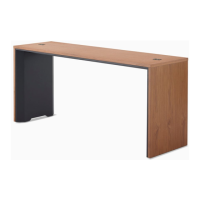
The Herman Miller Headway Communal Table is a versatile and robust furniture solution designed for collaborative workspaces, offering a blend of aesthetic appeal, functional design, and ease of assembly/disassembly for recycling. This manual details the installation process, highlighting the modular nature of the table and its components, as well as providing guidance for end-of-life material segregation and recycling.

Function Description:

The Headway Communal Table serves as a central hub for group activities, meetings, and shared work. Its design emphasizes stability, durability, and a clean aesthetic suitable for modern office environments. The table's modular construction allows for various configurations, particularly evident in its ability to support longer lengths (108" and 120" tables) through split components like spanner rails and rail covers. The table is designed to be assembled and disassembled with common tools, facilitating both initial setup and subsequent recycling efforts. The inclusion of features like leg covers and cover buttons contributes to a polished look while also protecting internal components.

Important Technical Specifications:

The table utilizes a variety of fasteners and components to ensure structural integrity:

  • Screws: #10 Pan Head Screws are extensively used for attaching various components, including spanner rails, cover buttons, leg posts, glide supports, and leg covers. #10-12 x 3/4 Pan Head Screws are also specified, with a quantity of 125, indicating their widespread use.
  • Locknuts: #10-32 Locknuts are used for securing rail braces to spanner rails and for attaching rail covers to connector plates, ensuring a tight and secure connection.
  • Socket Head Screws: M10 x 1.5 Flange Socket Head Screws (8 pieces) are employed for critical connections, likely providing enhanced strength and torque capabilities.
  • Cover Buttons: 18 cover buttons are included, serving both aesthetic and protective functions by concealing screw heads and providing a smooth surface.
  • Structural Components:
    • Worksurface: The primary flat surface of the table.
    • End Panel (2): Provides structural support at the ends of the table.
    • Leg Cover (2): Encases the leg posts for a finished appearance.
    • Spanner Rail (2): Main structural beams running lengthwise under the worksurface. For longer tables (108" & 120"), these are split into LH (Left Hand) and RH (Right Hand) sections.
    • Rail Cover (2): Covers the spanner rails for aesthetics and protection. Also split into LH and RH sections for longer tables.
    • Rail Brace (2): Used to join split spanner rails on longer tables, providing additional rigidity.
    • Connector Plate (2): Used to join split rail covers on longer tables.
    • Glide Support (4): Provides a base for the table, likely incorporating adjustable glides for leveling.
    • Leg Support (4): Internal structural components that connect to the end panels and support the table's weight.
    • Leg Post: The vertical support structure of the table.
  • Dimensions: The manual specifically mentions configurations for 108" and 120" tables, indicating the product's capability to accommodate large spaces.

Usage Features:

  • Modular Design: The table's construction with separate worksurface, end panels, spanner rails, and leg components allows for easier transportation, assembly, and potential reconfiguration. The split spanner rails and rail covers for longer tables exemplify this modularity, enabling the creation of extended surfaces.
  • Clear Assembly Instructions: The manual provides a step-by-step guide with detailed illustrations, ensuring a straightforward assembly process. Important notes, such as the sequence of screw installation and the need for proper alignment, are highlighted to prevent errors.
  • Tool Compatibility: The assembly requires common tools: a power driver, Phillips bit, carpenter's square, M8 Allen wrench, ratchet wrench, 3/8" socket, and safety glasses. This ensures that the table can be assembled without specialized equipment.
  • Stability and Leveling: The instructions emphasize proper installation of leg posts and glide supports, which likely include leveling capabilities to ensure a stable and even surface, crucial for a communal table. The note on fully tightening flange head screws for rigidity underscores this.
  • Aesthetic Finish: Cover buttons and rail covers are integrated into the design to conceal fasteners and structural elements, contributing to a clean and professional appearance. The instruction to ensure a consistent gap between the rail cover and worksurface edge further emphasizes attention to detail in the final look.
  • Large Table Support: The design explicitly addresses the needs of larger tables (over 96") by incorporating split components and additional bracing (rail brace, connector plate), ensuring structural integrity for extended lengths.

Maintenance Features:

  • Disassembly for Recycling: A key feature of the Headway Communal Table is its design for end-of-life recycling. The manual provides clear instructions for disassembly by reversing the installation steps.
  • Material Identification and Segregation: The manual guides users on how to identify and segregate materials for recycling:
    • Plastic Components: Where possible, plastic parts are marked with ASTM recycling codes. Unmarked plastics should be treated as mixed plastic.
    • Ferrous Metals: Can be identified using a small magnet and should be recycled separately.
    • Non-Ferrous Metals: Should be separated and recycled separately.
  • Durability and Repairability: While not explicitly detailed as "maintenance," the robust construction with numerous fasteners and structural components suggests a design intended for long-term use. The ability to disassemble and reassemble implies that individual components could potentially be replaced if damaged, extending the product's lifespan before full recycling is necessary. The emphasis on proper tightening of screws for rigidity also contributes to the table's long-term stability and reduces the need for frequent adjustments.

HermanMiller Headway Specifications

General IconGeneral
BrandHermanMiller
ModelHeadway
CategoryIndoor Furnishing
LanguageEnglish

Related product manuals