27
Surface Roughness and Tipping
Because of the small penetration depth surface roughness of the material has relatively
strong influence on the measured data. Surface roughness in the category of plaster or
floor isn’t a serious problem, but for a reliable measurement surface roughness
shouldn’t be larger.
The area, where the sensing head has to be put onto, shouldn’t have too large
roughness and ledges. It could be better if the measurement would be repeated at a
smoother place. If such smooth places aren’t available then a mean value should be
generated from several single measurements. By calculation of the standard deviation
the reliability of the measurement can be checked.
Take care during the measurement that the sensing head isn’t tipping. Even low
variations in the distance between the active microwave element and the surface of the
material, as they can be caused by tipping, may cause considerable falsification of the
measured values.
Minimum Thickness of Material
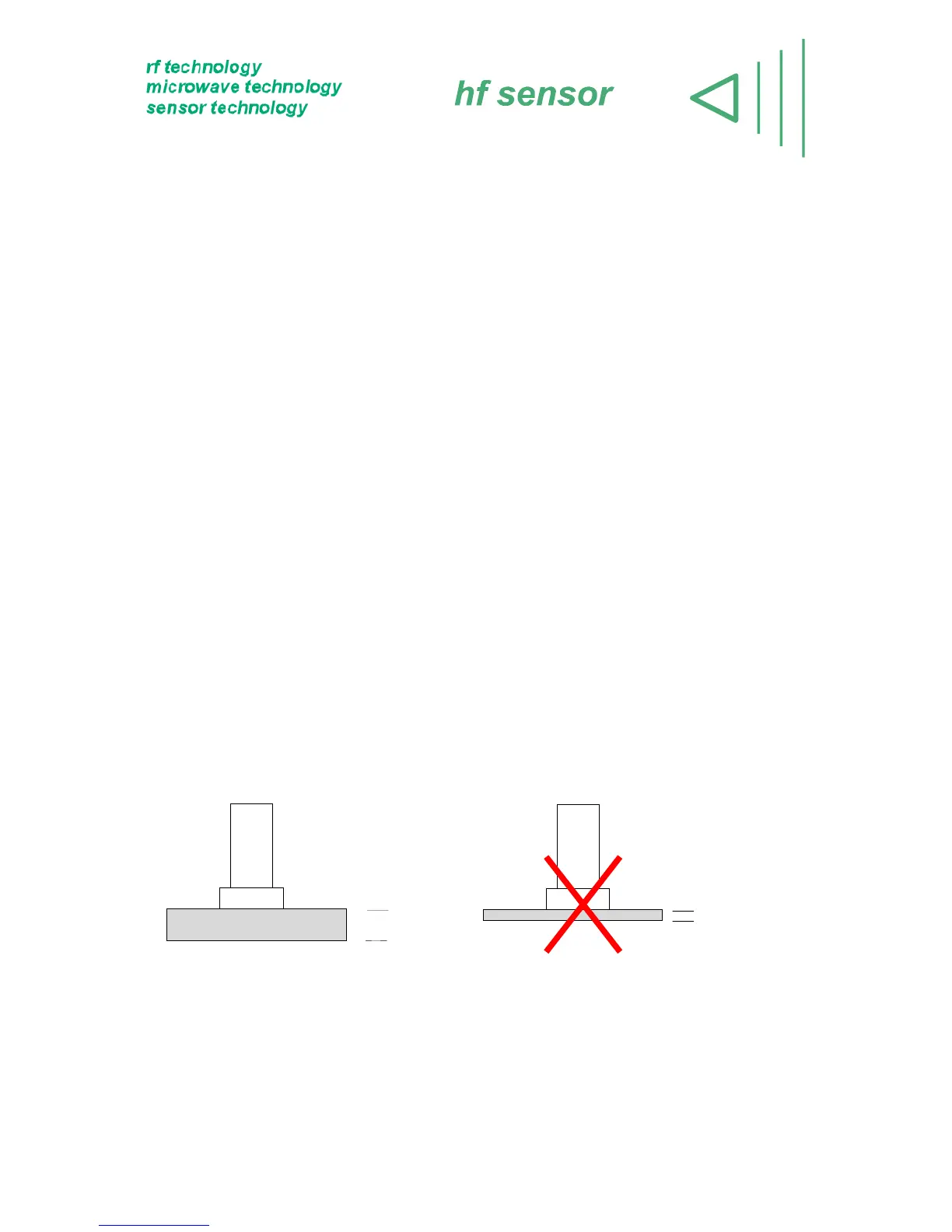
The field penetrates the material, depending on moisture and material type, in the range
of 1 ... 3 cm. Therefore test objects must have a minimum thickness in this range. If
material thickness is lower, the measurement can be falsified.
Moisture measurement with the surface sensing head MOIST-R1M V2 is also possible
in objects with lower thickness.
Before doing such a measurement hf sensor must be consulted, because usually
for such measurements special arrangements must be used.
> 1 ... 3 cm
< 1 cm



 To Next Page