
 Need help?
Do you have a question about the HIKVISION DS-K1109 Series and is the answer not in the manual?
Provides instructions for using and managing the product, subject to change.
Lists Hikvision's trademarks and logos and those of other owners.
Outlines limitations of liability, warranties, and user responsibilities for product use.
Details data collection, storage, processing principles and user responsibilities for privacy.
Details FCC compliance, limits for Class B digital devices, and interference prevention measures.
Specifies the two conditions for FCC compliance: no harmful interference and acceptance of received interference.
Confirms product compliance with EU harmonized standards for EMC and RoHS directives.
States compliance with Industry Canada standards for digital devices.
Covers critical dangers and cautions for preventing injury, death, or equipment damage during operation.
Provides guidelines on device handling, cleaning, battery replacement, and card management for safe operation.
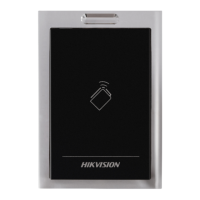
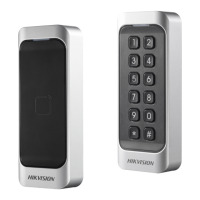
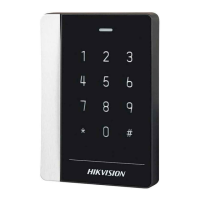
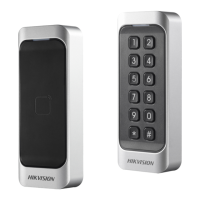
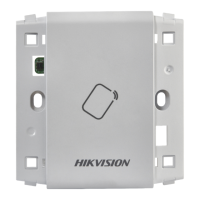
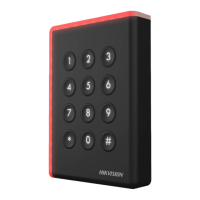
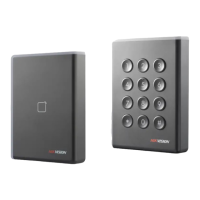
Illustrates the front appearance of the card reader, with and without a keypad.
Shows the rear view of the card reader, indicating ports and components.
Explains the function and settings of the 8-position DIP switch for configuration.
Details the process of wiring cables for communication between the controller and card reader.
The DS-K1109 Series Card Reader is a high-performance access control device designed for secure and efficient card-based authentication. Equipped with a 32-bit high-speed processor, this card reader ensures rapid and reliable processing of access requests. It offers flexible communication options, supporting both RS-485 and Wiegand protocols, allowing for seamless integration with various access control systems. This versatility makes it suitable for a wide range of applications, from basic entry control to more complex security setups.
A key feature of the DS-K1109 Series is its robust construction and built-in tamper-proof module. The device is crafted from PC+ABS material, providing excellent water and dust resistance, which makes it suitable for deployment in challenging environments. This physical resilience, combined with the tamper-proof design, helps protect the card reader from malicious damage and unauthorized interference, enhancing the overall security of the access control system.
The card reader's functionality extends beyond simple card presentation. Depending on the model, it supports different card presenting frequencies, including 13.56 MHz and 125 KHz, and some models also incorporate Bluetooth connectivity for enhanced flexibility. This allows for compatibility with various card technologies and potentially mobile-based access solutions. The device can be configured to operate in different communication modes, such as RS-485 or Wiegand, through a user-friendly DIP switch mechanism. This configurability allows installers to adapt the reader to specific system requirements, including setting the RS-485 address, enabling or disabling M1 card encryption, and selecting Wiegand protocols (26-bit or 34-bit).
For user interaction, the DS-K1109 Series provides clear sound prompts and LED indicators. Upon power-on, the device performs a self-check, indicated by a green flash followed by three red flashes and a beep, confirming its readiness. During operation, various sound prompts guide the user, such as a single beep for card presentation or key presses, two rapid beeps for valid operations, and three slow beeps for invalid actions. Rapidly continuous beeps signal tamper-proof or buzzer alarms, while slowly continuous beeps indicate an unencrypted card reader. The LED indicators complement these audio cues, with flashing green for power-on or password entry prompts, solid green for valid operations, solid red for normal working status, and flashing red for invalid operations or, in RS-485 mode, for registration failure or offline status. These intuitive feedback mechanisms ensure users are aware of the device's status and the outcome of their access attempts.
Installation of the DS-K1109 Series is designed to be straightforward, with clear instructions for wiring cables between the card reader and the access controller. The manual provides a detailed description of the 10-core cable, outlining the function of each wire, such as Wiegand data lines (W0, W1, ERR, OK), RS-485 communication lines (RS-485+, RS-485-), power (PWR, GND), tamper control, and beep control. This clarity helps ensure correct wiring and proper communication setup. The DIP switches play a crucial role in configuring the communication mode and other operational parameters, offering granular control over the device's behavior.
Maintenance and longevity of the DS-K1109 Series are supported by several preventive and cautionary tips. To ensure proper power supply and communication, it is recommended that the power supply distance for controller-powered readers not exceed 100m; for longer distances, an external 12V DC power supply is advised. The use of RVVP cable above 0.5 for connections is specified to guarantee reliable communication. For outdoor or permeable environments, installing a waterproof shield is recommended. When multiple card readers are installed, a minimum distance of 30 cm between them is suggested to prevent interference. To reduce noise in long-distance transmissions, the cable shield should be connected to the GND of both the controller and the card reader terminal.
Users are also advised on best practices for card management, including reporting lost cards promptly and considering multiple authentication modes for higher security levels. The device supports various card types, and users are encouraged to select the appropriate type based on performance and usage scenarios. For physical maintenance, users are cautioned against dropping the device or subjecting it to physical shock, and to avoid high electromagnetism radiation. It should not be placed in extremely hot, cold, dusty, or damp locations, nor exposed to direct sunlight, low ventilation, or heat sources. When opening the device cover, using the provided glove is recommended to prevent acidic sweat from eroding the surface coating. Cleaning should be done with a soft, dry cloth, avoiding alkaline detergents. Keeping the original packaging is advised for potential future returns or repairs, as transportation without it may lead to damage and additional costs. Finally, proper disposal of batteries, if applicable, is emphasized, following the manufacturer's instructions to prevent explosion hazards. These guidelines collectively aim to ensure the DS-K1109 Series Card Reader operates reliably and securely over its lifespan.
 General
| Model | DS-K1109 Series |
|---|---|
| Type | Card Reader |
| Card Reading Frequency | 13.56MHz |
| Supported Card Types | MIFARE |
| Card Reading Range | 0-5 cm |
| Communication Interface | RS-485 |
| Power Supply | 12 VDC |
| Humidity | 10% to 90% (non-condensing) |


 To Next Page