Need help?
Do you have a question about the Hilti PLT 300 and is the answer not in the manual?
Comprehensive safety rules for PLT 300 and PLC 300, covering general safety, laser tools, and batteries.
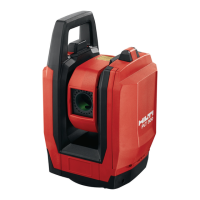
Diagram and key identifying components of the PLT 300 layout tool.
Describes the PLT 300 and PLC 300 system for measuring, calculating, and laying out positions.
Specifications for wavelength, laser class, power output, pulse duration, frequency, and beam divergence.
Accuracy specifications for measurements at different distances (50m, 164ft).
Technical data for tracking capabilities, including wavelength, intensity, and range.
Specifications for the camera, including aperture angle, focal length, zoom, and field of view.
Details WLAN standard, transmission power, and frequency range for wireless communication.
Specifications for the PLC 300's power source: voltage, capacity, battery life, and charging time.
The Hilti PLT 300 is a cordless layout tool designed for professional use, forming a system with the PLC 300 cordless controller. This system is engineered for precise measurement of distances and directions, calculation of target positions in three dimensions, and the layout of given coordinates or values relative to a control line. The PLT 300 and its ancillary equipment are intended for operation, servicing, and maintenance by trained and authorized personnel only, who must be informed of any potential hazards.
The PLT 300 utilizes laser distance measurement and tracking (LED tracker) to perform its layout functions. It features a green Class 2 laser for visibility and accuracy. The device is equipped with a camera, allowing for visual assistance during operation. A servo drive enables precise rotation and telescope repositioning, facilitating accurate targeting and measurement. Wireless communication between the PLT 300 and the PLC 300 is established via WLAN, allowing for remote control and data exchange. The PLC 300 controller, which runs the Hilti PROFIS Layout Field software, serves as the primary interface for operating the PLT 300. Data can be processed and transferred to other systems using the Hilti PROFIS Layout Office PC software, and directly to USB data media from the PLC 300.
Before initial operation, users must read the documentation and observe all safety instructions and warnings. The PLT 300 and PLC 300 should never be used without proper instruction. Safety devices must not be rendered ineffective, and information/warning notices should not be removed. Modifications to the PLT 300 or PLC 300 are not permitted. Only genuine Hilti accessories and ancillary equipment should be used to minimize injury risk. The PLT 300 or its accessories should never be pointed towards oneself or others. Laser tools must be kept out of reach of children. The accuracy of the PLT 300 should be checked before each use, especially for important measurements or after the device has been dropped or subjected to mechanical stress.
The PLT 300 is designed for use within defined application limits, avoiding measurements from highly reflective surfaces like mirrors or polished stone. Measurements to plastic foam, snow, or highly reflective surfaces may result in incorrect readings. Rapid changes in environmental conditions, such as people walking through the laser path, can affect measurement accuracy. The device should not be pointed at the sun or other powerful light sources. When switching between prism and reflectorless measurement modes, ensure no one looks into the PLT 300 lens. The PLT 300 is not to be used near medical instruments, expectant mothers, or persons with cardiac pacemakers. Operation near military installations, airports, or radio astronomy facilities requires prior permission.
For proper preparation of the working area, secure the measurement area and ensure the laser beam is not directed at people during setup. The tripod must be securely standing, and the PLT 300 firmly attached. Applicable accident prevention regulations in the user's country must be observed. While the tool meets electromagnetic compatibility requirements, interference with other devices or susceptibility to powerful electromagnetic radiation are possible, necessitating confirmatory measurements if unsure.
When working with laser tools, avoid staring into the beam or directing it at others. In case of direct eye contact, close eyes and move out of the beam's path. Class 2/Class II tools should only be operated by trained personnel, and laser beams should not be projected at eye height. Precautions must be taken to prevent the laser beam from striking highly reflective surfaces or extending beyond the controlled area. The laser tool should be switched off when not in use and stored in a place inaccessible to unauthorized persons.
The PLT 300 and PLC 300 are powered by Hilti lithium-ion batteries (B 18 / B 22 series) and charged with Hilti C 4/36 series chargers. Batteries should not be exposed to high temperatures, direct sun, or fire, nor disassembled, crushed, or incinerated above 80°C, due to explosion and injury risks. Mechanical impacts should be avoided. Batteries must be kept out of reach of children, and moisture ingress prevented to avoid short circuits. In case of battery liquid contact, flush with water and seek medical attention if it contacts eyes. Only approved batteries should be used. Batteries should be stored in a cool, dry place, away from direct sunlight or heat sources. When not in use, batteries and chargers should be kept away from metal objects that could cause short circuits. Damaged batteries should not be charged or used. Special guidelines for Li-ion battery transport, storage, and use must be followed. Batteries should be insulated or removed from the tool before shipping to prevent damage from leaks.
Before starting work, verify the accuracy of the tools for the task. Do not operate the PLT 300 in explosive atmospheres. Always wear personal protective equipment, including protective glasses and gloves. Inspect the PLT 300 and PLC 300 for damage before use and have any damage repaired by Hilti Service. Stay alert and use common sense; avoid operating the tool while tired or under the influence of drugs, alcohol, or medication. Observe operating and storage temperatures. Allow the device to acclimatize when moving between environments with significant temperature differences. Ensure the PLT 300 is correctly mounted on a tripod or wall mount, and that the tripod is stable. Keep the laser exit window clean to prevent measurement errors.
The PLT 300 should be maintained carefully. Check for misalignment, binding parts, breakage, or any other condition affecting operation. Damaged parts should be replaced before use. Despite being designed for jobsite conditions, the PLT 300, like other optical and electronic instruments, should be handled with care. If the device gets wet, it should be wiped dry before storage in its transport container. Previous settings or adjustments should be checked as a precaution. The battery compartment cover must be fastened carefully to prevent battery loss and potential data loss if the PLT 300 switches off.
For cleaning, avoid touching the optical system's glass surfaces with fingers to prevent damage. Only pure alcohol or water should be used for cleaning plastic parts. Dust should be blown off the glass, and the tool cleaned with a soft, clean cloth.
For safe and reliable operation, only genuine Hilti spare parts and consumables should be used. These can be found at a local Hilti Center or online. Hilti Measuring Systems Service offers checks, recalibration, and verification of conformity with specifications, providing a written service certificate. It is recommended to choose a suitable test/inspection interval based on tool usage, and to have the product checked by Hilti Measuring Systems Service after exceptionally heavy use, subjection to unusual conditions, or at least once a year. This service does not relieve the user's obligation to check the product before and during use.
For transport, remove or insulate the battery to prevent damage from leaks. Use the Hilti shipping box or equivalent quality packaging. For storage, remove the battery if the tool will be unused for a long period. Do not store the tool when wet; allow it to dry first. Always clean the tool, its transport container, and accessories before storage. Check equipment accuracy after long storage or transport periods. Observe temperature limits during storage (-40°C to +63°C).
Disposal of the equipment must be done properly. Burning plastic components can generate toxic fumes. Damaged or high-temperature exposed batteries can explode, causing poisoning, burns, or environmental pollution. Careless disposal can lead to unauthorized use, serious injury, and environmental pollution. Defective batteries should be disposed of immediately, kept out of reach of children, and not disassembled or incinerated. End-of-life batteries must be disposed of according to official regulations or returned to Hilti. Most Hilti materials are recyclable; separate them correctly. Old tools can be returned to Hilti for recycling.
For warranty questions, contact the local Hilti representative. The device complies with FCC and IC regulations. In residential areas, it may cause radio interference, which users may need to remedy at their own expense. Changes not expressly approved by Hilti may restrict user authorization. The device accepts any received interference, including that which may cause undesired operation.
 General
| Battery type | Li-ion |
|---|---|
| Laser type | 635 nm, <1 mW |
| Range | 30 m |
| Protection Class | IP54 |
| Laser class | Class 2 |
| Operating temperature range | -10°C to +50°C |
| Storage Temperature | -30°C to 60°C |

 To Next Page