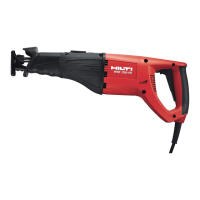
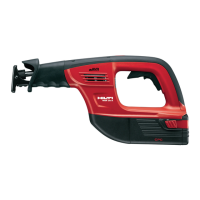
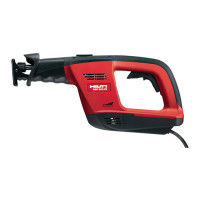
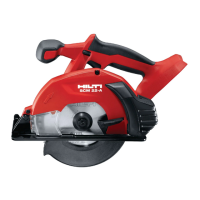
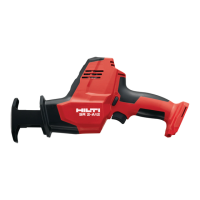
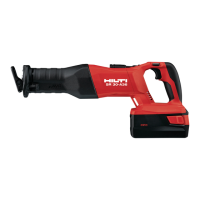
The Hilti WSR 900, WSR 900-PE, WSR 1250-PE, and WSR 1400-PE are reciprocating saws designed for professional use. It is essential to read and understand the operating instructions before operating the tool for the first time. These instructions should always be kept with the tool and passed on to other users.
Function Description
The Hilti reciprocating saws are primarily used for cutting various materials. The WSR 900 and WSR 900-PE models are suitable for cutting wood, wood-like materials, metals, and plastics. They are designed for use in dry environments and must be powered by an electric supply voltage compliant with the type plate information. These models are intended for two-handed operation and should only be used with the blades and accessories listed in the operating instructions. It is important not to use these models for cutting bricks, concrete, cellular concrete, natural stone, or tiles, and cutting materials containing asbestos is not permissible.
The WSR 1250-PE and WSR 1400-PE models offer broader material compatibility, including wood, wood-like materials, metals, plastics, bricks, cellular concrete, and tiles. Like the other models, they must be used in dry environments, powered by a compliant electric supply voltage, and operated with two hands using only specified blades and accessories. However, these models are not to be used for cutting concrete or natural stone, and cutting materials containing asbestos is also prohibited.
The tools feature a blade clamp/blade holder (①), a stroke rate regulator (③) for adjusting cutting speed, and a control switch (⑤). The WSR 900-PE, WSR 1250-PE, and WSR 1400-PE models also include an orbital action selector switch (②), which can enhance cutting performance in soft materials like wood. A transport lock (④) is provided for safety. The contact shoe (⑪) can be adjusted using a lockbutton (⑩) to optimize blade length usage and improve access in corners.
Important Technical Specifications
The Hilti reciprocating saws come with varying power ratings and weights:
- WSR 900: Nominal power rating of 900 W, nominal voltage of 120 V/8.5 A, mains frequency of 50/60 Hz, weight of 6.28 lbs (2.85 kg).
- WSR 900-PE: Nominal power rating of 900 W, nominal voltage of 120 V/8.5 A, mains frequency of 50/60 Hz, weight of 7.2 lbs (3.26 kg).
- WSR 1250-PE: Nominal power rating of 1250 W, nominal voltage of 120 V/12 A, mains frequency of 50/60 Hz, weight of 9.3 lbs (4.2 kg).
- WSR 1400-PE: Nominal power rating of 1400 W, nominal voltage of 120 V/13 A, mains frequency of 50/60 Hz, weight of 9.9 lbs (4.5 kg).
All models share common dimensions (LxBxH) of approximately 17.4×3.5×8.3 in (442×88×211 mm) for the 900 series, 19.4×4×7.1 in (493×101×180 mm) for the 1250-PE, and 22.6×4×7.4 in (574×101×188 mm) for the 1400-PE. They all have a stroke rate of 0-2700 min⁻¹ and a stroke length of 1¼ in (32 mm).
The blade clamp is keyless and designed for standard ½" blades. Orbital action is available on the WSR 900-PE, WSR 1250-PE, and WSR 1400-PE models. All tools are double insulated (Protection class II).
Usage Features
- Safety First: Always wear eye protection, and depending on conditions, a dust mask, non-skid safety shoes, hard hat, hearing protection, and protective gloves. Ensure the workplace is well-ventilated and tidy, free from obstacles.
- Secure Grip: The tool must always be held securely with both hands on the provided grips (⑨). Ensure hands and fingers do not contact the blade clamp or saw blade.
- Starting the Tool: Switch on the tool only after it has been brought into position where the cut is to be made. Do not start the tool with the blade contacting the work surface.
- Guiding the Tool: When cutting, always guide the tool away from the body.
- Stroke Rate Adjustment: The stroke rate regulator (③) allows selection of the optimal speed for different materials (1 = low, 6 = high). The electronic speed control maintains a constant stroke rate even under load.
- Wood: 5-6
- Wood with embedded nails: 5-6
- Interior finishing, drywall: 3-4
- Plastic: 3-4
- Steel: 2-3
- Non-ferrous metals: 2-3
- Aluminum: 2-3
- Stainless steel: 1
- Orbital Action (WSR 900-PE / WSR 1250-PE / WSR 1400-PE): This feature can be switched on or off (only when the motor has stopped) to increase cutting performance in soft materials like wood.
- Plunge Sawing: This technique (⑩) should only be used on soft materials with orbital action switched off. It allows making cut-outs without pre-drilling a hole, but requires practice and short saw blades. The tool must be running before the blade contacts the workpiece to prevent stalling or kick-back.
- Blade Installation/Removal:
- Unplug the supply cord.
- Turn the blade clamp locking sleeve counter-clockwise and hold.
- Push the saw blade (⑫) into the clamp.
- Release the locking sleeve.
- Check engagement by pulling on the blade.
To remove, repeat steps 1-2 and pull the blade out.
- Contact Shoe Adjustment:
- Unplug the supply cord and remove the saw blade.
- Press and hold the contact shoe lockbutton (⑩).
- Slide the contact shoe (⑪) to the desired position.
- Release the lockbutton and check engagement.
- Pipe Cutting Adaptor (Accessory): This adaptor (12, 13, 14) can be fitted for cutting pipes.
- Unplug the supply cord and remove the saw blade.
- Press and hold the contact shoe lockbutton.
- Pull the contact shoe forward and push the pipe cutting adaptor into the tool.
- Release the lockbutton and check engagement.
- Open the screw clamp, place the adapter chain around the pipe, and lock it. The handle should be at a 45° angle.
- Side Handle (Accessory): A side handle (15, 16) can be fitted and adjusted for better control.
- Unplug the supply cord and remove the saw blade.
- Place the adaptor around the front grip section and close it.
- Slide the side handle onto the adaptor.
- Secure by turning the screw knob.
To position, slacken the screw knob, move the handle, and re-secure.
- Extension Cords: Use only approved extension cords of adequate cross-section, especially for outdoor use. Refer to the manual for recommended minimum cross sections and max. cord lengths based on mains voltage.
Maintenance Features
- General Care: Unplug the supply cord before any care or maintenance.
- Blades: Clean off dirt and dust deposits and protect blades from corrosion by wiping them with an oil-soaked rag.
- Tool Casing: The outer casing is made from impact-resistant plastic, with elastomer grip sections. Clean the outside of the tool regularly with a slightly damp cloth. Do not use sprays, steam pressure cleaning equipment, or running water, as this can affect electrical safety. Keep grip surfaces free from oil and grease. Avoid cleaning agents containing silicone.
- Ventilation Slots: Never operate the tool with blocked ventilation slots. Clean them carefully using a dry brush.
- Blade Clamp: Keep the blade clamp clean.
- Lubrication: The tool is adequately lubricated from the factory. For long periods of heavy use, an inspection at a Hilti repair center is recommended to extend tool life and prevent unnecessary repairs.
- Electrical Repairs: Repairs to the electrical section of the tool must only be carried out by a trained electrical specialist.
- Damage Checks: Regularly check all external parts for damage and ensure all controls operate faultlessly. If parts are damaged or controls malfunction, the tool should be repaired at a Hilti repair center.
- Post-Maintenance Check: After care and maintenance, verify that the hand guard and contact shoe are fitted and function faultlessly.
- Disposal: Most materials are recyclable. Hilti has arrangements for taking back old electric tools for recycling. Alternatively, the tool can be dismantled for recycling. Oily parts should be wiped clean with absorbent paper, and grease collected. Oil or grease must not enter the waste water system or ground. Individual parts like the toolbox, gear housing, motor housing, fan, motor, supply cord, and gearing parts should be separated by material (plastic, aluminium, steel, copper, elastomer) for appropriate recycling.
Warranty
Hilti warrants the tool to be free of defects in material and workmanship for 12 months from the sale date, provided it is operated, handled, cleaned, and serviced correctly according to Hilti Operating Instructions, and maintained with original Hilti consumables, components, and spare parts. The warranty covers free-of-charge repair or replacement of defective parts, but not normal wear and tear. Hilti is not liable for direct, indirect, incidental, or consequential damages, losses, or expenses related to the use or inability to use the tool, and specifically excludes implied warranties of merchantability and fitness for a particular purpose. For repairs or replacements, contact the local Hilti marketing organization.

 Need help?

 To Next Page
 General