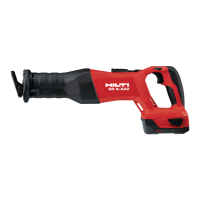
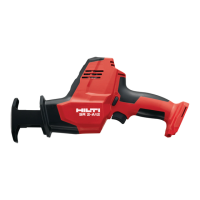
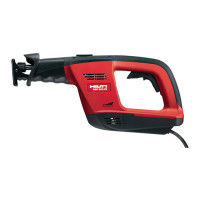
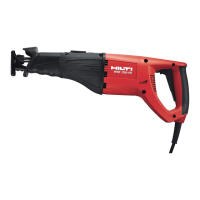
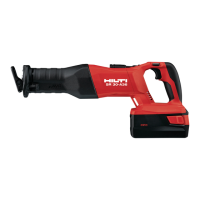
The Hilti SR 30-A36 is a cordless reciprocating saw designed for professional use, specifically for cutting wood, wood-like materials, metals, and plastics. It is intended for two-handed operation and is part of Hilti's B 36 series for Li-ion batteries and C4/36 series for battery chargers.
Function Description
The SR 30-A36 operates by reciprocating a saw blade to cut through various materials. It features a control switch for activation, speed preselection for adjusting the stroke rate, and a transport lock for safety during storage and transport. The tool is designed to be used with specific Hilti Li-ion batteries, and its operational status and battery charge are indicated by an LED display. An accessory cutting assist can be mounted for improved cutting guidance, and a folding scaffold hook is also available for convenience. For dust management, a dust removal adapter can be installed.
Important Technical Specifications
- Rated voltage: 36 V
- Weight (in accordance with EPTA procedure 01): 5.2 kg
- Stroke rate (Stage 1): 2,500/min
- Stroke rate (Stage 2): 2,800/min
- Stroke length: 32 mm
- Blade holder: 0.5 in
- Noise information (in accordance with EN 62841):
- Sound power level (LWA): 96 dB(A)
- Uncertainty for the sound power level (KWA): 5 dB(A)
- Sound pressure level (LPA): 85 dB(A)
- Uncertainty for the sound pressure level (KPA): 5 dB(A)
- Total vibration (in accordance with EN 62841):
- Vibration emission value for sawing chipboard (ah,B): 22.5 m/s²
- Uncertainty sawing chipboard (K): 3.7 m/s²
- Vibration emission value for sawing wooden beams (ah,wB): 20.5 m/s²
- Uncertainty sawing wooden beams (K): 3.3 m/s²
The Li-ion battery status display uses 4 LEDs to indicate the state of charge:
- 4 LEDs light: 75% to 100%
- 3 LEDs light: 50% to 75%
- 2 LEDs light: 25% to 50%
- 1 LED lights: 10% to 25%
- 1 LED blinks: < 10% (battery overheated or completely discharged)
- 4 LEDs blink: Power tool overloaded or overheated.
Usage Features
- Battery Insertion/Removal: The battery is inserted from the rear until it audibly engages and removed by pressing two release buttons and pulling it out.
- Saw Blade Insertion/Removal: The saw blade is inserted into the chuck from the front after pushing up the locking lever. Only saw blades with a 1/2" connection end should be used. Removal involves activating the transport lock or separating the battery, pushing the locking lever up, and pulling the blade forward.
- Contact Shoe Replacement: The contact shoe can be replaced by pulling the rectangular plastic pin forward, pulling out the old shoe, pressing the pin back, and inserting a new, lightly greased contact shoe.
- Dust Removal Adapter Installation: The dust removal adapter is installed by pulling out the contact shoe, setting the adapter on the contact shoe mount, and then inserting the lightly greased contact shoe fully into the guide.
- Scaffold Hook Installation: The scaffold hook is installed after engaging the transport lock.
- Operation: To operate, disengage the transport lock and press the control switch. Release the control switch to stop the cut and engage the transport lock when finished.
- Safety Precautions:
- Always wear eye protection, a dust mask, non-skid safety shoes, hard hat, or hearing protection.
- Keep hands away from the cutting area and blade.
- Hold the power tool firmly with both hands on the handles.
- Ensure the switch is in the off-position before connecting power or handling the tool.
- Remove any adjusting key or wrench before turning the tool on.
- Avoid overreaching and maintain proper footing and balance.
- Do not force the power tool; use the correct tool for the application.
- Disconnect power/remove battery before making adjustments, changing accessories, or storing.
- Store idle tools out of reach of children and untrained users.
- Keep cutting tools sharp and clean.
- Use the tool, accessories, and bits according to instructions and working conditions.
- Keep handles and grasping surfaces dry, clean, and free from oil/grease.
- When operating outdoors, use an extension cord suitable for outdoor use.
- If operating in a damp location, use an RCD-protected supply.
- Avoid body contact with earthed surfaces.
- Do not expose power tools to rain or wet conditions.
- Do not abuse the cord.
- Do not operate in explosive atmospheres.
- Keep children and bystanders away.
- Before cutting pipes, ensure they are empty and hold the tool above the pipe level.
- Never cut into unknown materials.
- Do not look directly into the LEDs.
- Wear protective gloves when changing accessory tools.
- Always remove the battery before maintenance, changing accessories, or transport.
- Engage the transport lock before storing or transporting.
- Ensure the saw blade projects past the workpiece throughout the entire stroke.
- Take breaks and perform finger exercises to improve blood circulation.
- If work involves break-through, secure the area on the opposite side.
- Do not use dull or damaged blades.
- Press the power tool against the workpiece until the contact shoe makes firm contact.
- Wear suitable protective clothing against hot particles.
- Do not use the tool to cut bricks, concrete, cellular concrete, natural stone, or tiles.
- Do not use the product to cut pipes containing liquids.
- Do not saw into unknown materials.
Maintenance Features
- General Tool Care:
- Carefully remove stubborn dirt.
- Clean air vents with a dry brush.
- Clean the casing with a slightly damp cloth; avoid silicone-containing cleaning agents.
- Li-ion Battery Care:
- Keep the battery free from oil and grease.
- Clean the casing with a slightly damp cloth; avoid silicone-containing cleaning agents.
- Avoid moisture ingress.
- Regular Checks:
- Check all visible parts and controls for damage and correct function at regular intervals.
- Do not operate if damaged or malfunctioning; have it repaired by Hilti Service.
- After cleaning and maintenance, ensure all guards or protective devices function correctly.
- Battery Disposal:
- Cover terminals with non-conductive material (e.g., electrical tape) to prevent short-circuiting.
- Dispose of batteries out of reach of children.
- Dispose of batteries at a Hilti Store or consult local governmental resources.
- Do not dispose of power tools, electronic equipment, or batteries as household waste.
- Do not send batteries through the mail.
- Troubleshooting: The manual provides a troubleshooting guide for common issues like the tool not starting or the saw blade not being removable, with recommended actions. If problems persist, contact Hilti Service.
- Transport and Storage:
- Always transport products with batteries removed.
- Transport the tool and batteries individually packaged, not in bulk.
- Check for damage after long periods of transport.
- Store in a cool, dry place, away from direct sunlight, heating units, or windows.
- Store out of reach of children or unauthorized persons.


 To Next Page
 General