SAFETY REGULATIONS | PAG. 6
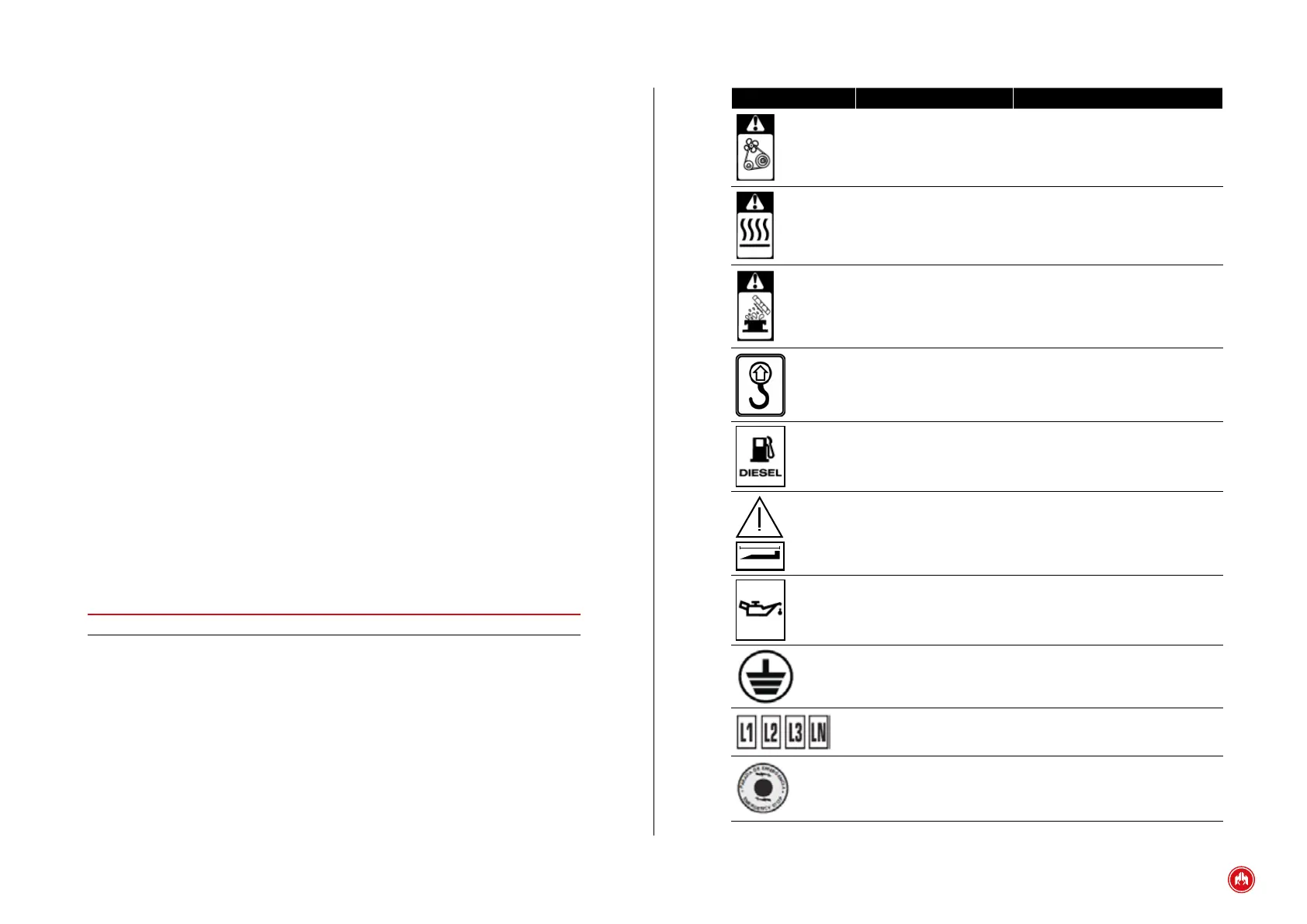
Picture Location Information
Located on the connections
from the alternator to the
engine. Whenever there are
timing belts or transmission
shafts.
They warn of the danger in case an alien
object collides with the timing belts or
with the components in motion that they
connect.
Located on the parts of the
genset that heat up during
operation.
They indicate those areas which must not
be touched while the set is in operation or
shortly after having stopped.
Placed on the coolant tank
cap.
They warn of the precautionary measures
to be taken when opening this cap. The
liquid is hot and may spout and cause
scald.
Located on the bonnet and
next to the lifting eye.
It indicates the point by which the set
must be lifted in order to move it.
Located next to the fuel cap.
Depending on the model, it can
be either on the bedplate or
next to the engine.
Indicates the location of the fuel tank and
the ller cap.
Located on both sides of the
bedplate skids.
It indicates the advisable area to move
the set by means of a forklift truck.
Located next to the oil ll
dipstick and oil ll cap.
Indicates the location of the oil ll
dipstick.
Next to the derivations of the
grounding protections.
They are the parts by means of which
the genset is protected against possible
electric shocks.
Next to the protective ther-
mal-magnetic switches of the
genset.
They protect the genset against possible
overcurrent that may occur during charge.
On the emergency stop.
It indicates the location of the emergency
stop button which allows the simultane-
ous stop of the genset.
Agency of your country to check the necessary licenses for your particular unit.
• Check that the hitch and coupling on the towing vehicle are rated
equal to, or greater than the trailer’s “gross vehicle weight rating”
(GVWR).
• Check the state of the tire on trailer, ination and tread wear.
• Check the hitch and coupling for wear or damage. DO NOT tow the
lighting tower using defective parts. Make sure that the hitch and
coupling are compatible. Make sure that the coupling is securely
fastened to the vehicle.
• Check that directional and brake light on the trailer are well
connected and working properly.
• The maximum recommended speed for road towing is80km/h.
Recommended off-road towing speed is not to exceed15km/h
depending on terrain.
• Always maintain an extra safety space between vehicles and avoid
verges, curbs and sudden lane changes. If you have not pulling
atrailer before, practice turns, stops and the reverse in a trafc-free
area.
• A lm of grease on the coupling will extend its life. Wipe the coupler
and apply fresh grease each time the trailer is towed.
• ALWAYS lower the mast before removing the hand brake.
• Before moving the tower, make sure ALWAYS that the mast is fully
folded and with the safety lock.
• Make sure that the spotlights are folded and locked in the transport
position.
• Make sure that the stabilizers are fully gathered and fastened.
IMPORTANT
NEVER move the lighting tower with the mast unfolded.
2.6 SAFETY STICKERS AND INFORMATION
There are some safety stickers and information all over the gen-set. Following
you can nd a brief explanation of their location and information on each of them.


 To Next Page
 Loading...