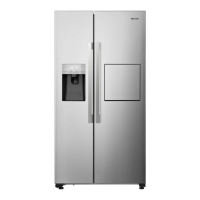
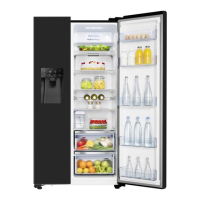
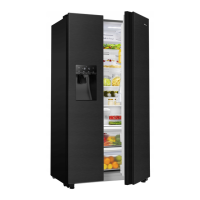
This document is an operation manual for a Hisense Refrigerator, models RS694N4BC1 and RS694N4BB1. It provides comprehensive instructions for installation, usage, and maintenance, ensuring safe and efficient operation.
Function Description
The Hisense Refrigerator is designed for domestic household use, providing compartments for both fresh food and frozen items. It utilizes isobutene (R600a) as a refrigerant, a natural gas known for its environmental compatibility. The appliance features a control panel that allows users to manage various settings, including temperature, ice production, and special modes like "Holiday" and "Energy Save."
The refrigerator compartment is ideal for storing vegetables, fruits, and other perishable items, with glass shelves and door racks that can be adjusted to different heights. The freezer compartment is designed for freezing foods such as meat, fish, and ice cream.
A key feature is the integrated ice maker and water dispenser. Users can select between "Cubed" or "Crushed" ice and dispense water directly from the appliance. The water for the ice maker and dispenser is supplied from a dedicated water storage box, which requires manual refilling with potable water.
The refrigerator also includes a "Home bar" feature, a small door on the main refrigerator door that allows access to frequently used items without opening the entire compartment, thus saving energy. This bar is designed to hold bottles, drinks, and wine cups, and it illuminates when opened.
Safety features include a "Child Lock" to prevent unintended changes to settings or dispenser use, and a "Door Alarm" that sounds if the refrigerator or freezer door remains open for an extended period.
Usage Features
Control Panel: The appliance is operated via a touch-sensitive control panel. Icons illuminate to indicate active functions. If no buttons are touched and doors are closed, the backlighting turns off after 60 seconds.
Temperature Control:
- Fridge Temperature: Users can adjust the refrigerator temperature in a sequence from 8°C down to 2°C.
- Super Cool: Holding the "Fridge" button for 3 seconds activates "Super Cool," rapidly lowering the fridge temperature to 2°C for 3 hours to quickly cool fresh food.
- Freezer Temperature: The freezer temperature can be adjusted in a sequence from -14°C down to -24°C.
- Super Freeze: Holding the "Freezer" button for 3 seconds activates "Super Freeze," rapidly lowering the freezer temperature to -24°C for 26 hours to quickly freeze food and preserve nutrients.
Ice and Water Dispenser:
- Ice Control: The "Ice Off" button controls the ice maker. When "Ice Off" is on, the ice maker is closed, but the dispenser remains functional for water.
- Ice Type: The "Cubed" and "Crushed" options allow users to choose the desired ice type.
- Water Dispenser: The "Water" button activates the water dispensing mode.
- Water Storage Box Alarm: An alarm sounds if the water storage box is not correctly installed or is empty, reminding users to check it. This alarm can be cleared by holding the "Eco" button for 3 seconds.
Special Modes:
- Holiday Mode: Activated by the "Holiday" button, this mode sets the fridge to 15°C and the freezer to -18°C to minimize energy consumption during long absences. The ice maker is automatically turned off in this mode.
- Energy Save Mode: Activated by the "Eco" button, this mode sets the fridge to 6°C and the freezer to -17°C to optimize energy efficiency.
Door Adjustment: The refrigerator door can be adjusted using a screwdriver to ensure proper alignment. The bottom feet can also be adjusted to tilt the appliance slightly backward, allowing the doors to self-close.
Food Storage:
- Refrigerator Compartment: Food should be packed to prevent moisture loss and flavor permeation. Glass shelves and door racks are provided for organized storage.
- Freezer Compartment: Food should be prepared in small portions for rapid freezing. Items should be wrapped in airtight foil or polyethylene to prevent partial defrosting of already frozen food. Bottles should not be left in the freezer for extended periods to prevent breakage.
Maintenance Features
Cleaning:
- Exterior Cleaning: The digital panel, display panel, doors, handles, and cabinet surfaces should be cleaned regularly with a soft cloth and mild detergent. Avoid abrasive cleansers, solvents, or sharp objects.
- Interior Cleaning: The interior should be cleaned regularly, especially when food stocks are low. Drawers and shelves can be removed for thorough cleaning. A weak solution of bicarbonate of soda and warm water is recommended for cleaning the freezer interior. All surfaces must be completely dry before replacing parts and switching the appliance back on.
- Door Seals: Door seals should be kept clean with a mild detergent and warm water to prevent stickiness and tearing.
- Water Storage Box Cleaning: The water storage box should be cleaned regularly. It can be removed, disassembled, and cleaned with a weak bicarbonate of soda solution, then rinsed with potable water and thoroughly dried.
Defrosting: The appliance features automatic defrosting. However, if a thick layer of frost accumulates in the freezer due to frequent door openings, manual defrosting is recommended. This involves removing food, unplugging the appliance, leaving the doors open, and ventilating the room. Sharp objects should not be used to remove frost.
LED Light Replacement: If the LED light is damaged, it must be replaced by a competent person. The process involves unplugging the appliance, removing the light cover, detaching the old LED light, and snapping a new one into place.
Troubleshooting: The manual provides a troubleshooting guide for common issues such as the appliance not working, odors, noise, temperature problems, door closure issues, water drips, and ice dispenser malfunctions. It advises users to perform simple checks before contacting service personnel.
Disposal: The appliance and its packaging materials should be disposed of responsibly at an authorized waste disposal center, following EU guidelines for environmental safety. The refrigerant circuit should not be damaged during disposal.



 To Next Page
 General