Need help?
Do you have a question about the Hisense U7G Series and is the answer not in the manual?
Terms and conditions for TV use, including warranty and disclaimer.
Disclaimer regarding third-party content and services accessed via TV.
Alerts for dangerous voltage, shock risks, and general electrical safety.
Guidelines for proper recycling and disposal of electronic waste.
Precautions against placing the TV in unstable locations to prevent falls.
Rules for cleaning the TV and ensuring proper ventilation.
Advice on using the correct power source and general settings.
Instructions on when to seek professional service for TV issues.
Guidance on routing power cords and protecting against lightning surges.
Advice on keeping the TV away from heat sources and open flames.
Using authorized parts and ensuring safety after repairs.
Important warnings before and during stand installation.
Different stand installation patterns for 65-inch TVs.
Different stand installation patterns for 75-inch TVs.
Steps for unpacking and handling the TV for stand installation.
Instructions for fixing stands to the TV using screws.
Two types of stand installation (L1R1 and L2R2).
Important cautions for mounting the TV on a wall.
Specifications for wall mount hole patterns and screw sizes.
Description of remote sensor and power indicator functions.
Functions of standby, source selection, volume, and channel controls.
Details on AV IN, Headphone, and Digital Audio Out jacks.
Description of various HDMI, USB, and LAN connectivity ports.
Identification of rear connection ports for 75" models.
Details on rear ports for 85-inch TV models.
Instructions for connecting a VHF/UHF antenna or cable.
Guide for connecting external devices via HDMI and AV inputs.
How to connect headphones for audio output.
Connecting to digital audio systems via Digital Audio Out and eARC.
How to connect USB drives and cameras for media playback.
Connecting the TV to a network using a LAN cable.
Steps to connect the TV to a wireless network.
Notes on wireless adapter compatibility and security systems.
Explanation of buttons for input, channels, navigation, and shortcuts.
Step-by-step guide for inserting batteries into the remote control.
Instructions for pairing a Bluetooth remote control with the TV.
Information on the effective range and angle for remote operation.
Guidelines for disposing of the remote control unit.
Steps for initial TV setup, including language, internet, and country selection.
Physical dimensions and weight for 55" and 65" models.
Details on screen resolution, audio power, and power consumption.
Physical dimensions and weight for 75" and 85" models.
Specs on screen size, audio, power, receiving systems, and environment.
Explanation of the Freeview Plus television service.
Guide on how to use the Freeview Plus service.
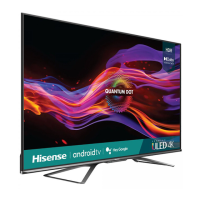
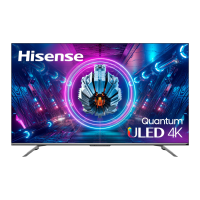
This document serves as a Quick Setup Guide for Hisense U7G series televisions, including models 55U7G, 65U7G, 75U7G, and 85U7G. It provides essential information for setting up and safely operating the TV, along with important disclaimers and safety precautions.
The Hisense U7G series televisions are designed to provide a high-quality viewing experience with various connectivity options and smart features. The TV allows users to access a wide range of content through antenna, cable, and external AV equipment, as well as via internet connectivity for streaming and smart TV functionalities. The included remote control facilitates easy navigation and control of the TV's features, including channel selection, volume adjustment, input source switching, and access to smart applications. Some models also support hands-free wake-up functionality and voice assistants for enhanced user interaction.
Upon first power-on, the TV guides the user through an installation process. This includes selecting the desired language, connecting to the internet (either via Ethernet or a wireless network), choosing the country of operation, and reviewing the End User License Agreement and Privacy Policy. Users can also opt for "Enhanced Viewing," which automatically adjusts picture and sound modes based on recognized content, and link their TV to a VIDAA account. The setup process concludes with naming the TV and selecting a voice assistant if available.
The TV comes with base stands that need to be securely attached. For 55-inch models, two stands are inserted into bottom slots and secured with four M5×12 screws. For 65-inch and 75-inch models, users can choose between different installation patterns for the base stands, depending on the size of the supporting surface, using M5×12 or M5×16 screws respectively. For 85-inch models, the installation involves carefully placing the TV on cushions and then attaching the stands with M5×16 screws. It is crucial to ensure the TV is stable after installation.
For wall mounting, the TV stand must be removed first. The wall mount bracket (optional and not supplied with all models) should support the TV's weight. Spacers are used between the TV and the bracket. For 55"/65"/75" models, the tilt angle between the TV screen and the vertical surface should not exceed 15 degrees, using M6 screws. For 85" models, the tilt angle should not exceed 5 degrees, using M8 screws.
The remote control provides comprehensive functionality. It includes buttons for power on/standby, input source selection, channel and number input, Electronic Program Guide (EPG), special functions, quick setup, navigation (Up/Down/Left/Right), OK/on-screen keyboard, exit, home screen, volume, channel up/down, microphone activation, subtitles, mute, and quick access to apps. The remote control has an operating range of up to 8 meters in front of the TV, with horizontal and vertical control angles of ±30° and ±15° respectively.
The manual emphasizes several critical safety precautions:
Pair the remote control to the TV after powering it on, keeping it within 3 meters. Press any button (except power and mic) to pair. If issues occur, press and hold the specific pairing button (indicated by an icon in the manual). If interference is suspected, remove the cause and re-pair. If the remote malfunctions with normal battery power, remove batteries, press any key for 1-2 seconds, then reinsert. The remote cannot be paired while the TV is in standby mode.
Packaging and electrical goods should be recycled appropriately, not treated as household waste. Dispose of equipment at applicable collection points for electrical and electronic waste. This helps prevent environmental and health hazards and conserves natural resources. Do not dispose of old equipment with household waste. For detailed recycling information, contact your local city office, waste disposal service, or the shop where the product was purchased. The product should not be damaged, dismantled, or thrown in municipal waste; it should be packed and handed over to an authorized re-cycler.
 General
| Display Type | ULED |
|---|---|
| Resolution | 4K UHD (3840 x 2160) |
| HDR | Dolby Vision, HDR10, HDR10+, HLG |
| Refresh Rate | 120Hz |
| Backlight Type | Full Array Local Dimming |
| Operating System | Android TV |
| Voice Assistant | Google Assistant |
| VRR | Yes |
| Processor | Hi-View Engine |
| USB Ports | 2 |
| Bluetooth | Yes |
| Wi-Fi | Yes (802.11ac) |
| Screen Sizes | 55", 65", 75" |
| Audio Output | 20W |
| Dolby Atmos | Yes |
| HDMI Ports | 4 |

 To Next Page