Need help?
Do you have a question about the Hitachi V-152B and is the answer not in the manual?
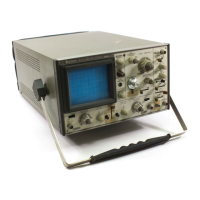
Provides an overview of the oscilloscope's features, bandwidth, sensitivity, and intended use.
Details the technical specifications of the oscilloscope, including CRT, amplifier, and input characteristics.
Lists the items included in the oscilloscope package, such as the unit, probes, and manual.
Explains the purpose and function of each control, knob, connector, and indicator on the oscilloscope's front panel.
Outlines important safety and operational warnings, including power source voltage and signal input limits.
Guides users through the basic steps for preparing and operating the oscilloscope for waveform observation.
Details how to correct slight tilting of the trace caused by external magnetic fields.
Explains the process for adjusting astigmatism to achieve a clear and round spot on the screen.
Covers adjustment of VOLTS/DIV balance to minimize trace shift when changing sensitivity settings.
Explains how to adjust the vertical gain for precise deflection based on CAL output.
Explains how to measure the time difference between two signals using the oscilloscope's dual trace feature.
Describes the method for measuring the rise or fall time of a pulse signal and considerations for accuracy.
Details methods for measuring phase shift using dual trace and X-Y operation, and calculating the phase angle.
Describes how to analyze video signals, including sync pulses, horizontal, and vertical components.
 General
| Bandwidth | 15 MHz |
|---|---|
| Channels | 2 |
| Display | 6-inch CRT |
| Type | Oscilloscope |
| Input Impedance | 1 MΩ ±2%, ~25 pF |
| Power Supply | 50/60 Hz |
| Dimensions | 400(D) mm |


 To Next Page