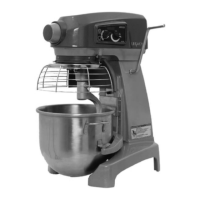
8
Item
number
Description Item
number
Description
1 Stop/start switches 8 Agitator
2 Splash shield 9 Beater shaft
3 Bowl lift handle 10 Guard
4 Rear bowl location pin (not shown). 11 Attachment hub cover.
5 Bowl support 12 Gear lever
6 Side bowl pin 13 Timer (if fitted).
7 Bowl
TABLE 1. MIXER COMPONENT IDENTIFICATION.
6. USING THE ATTACHMENT FACILITY
6.1 FITTING AN ATTACHMENT TO THE DRIVE HUB.
When installing the attachment ensure the electricity supply is isolated.
Loosen the thumbscrew situated on the attachment hub and remove the plastic
cover. Put the cover in a safe place to be refitted after use.
Offer the shaft of the attachment to the hub and ensure the square shank of the
attachment locates in the square drive of the mixer
Secure the attachment by tightening the thumbscrew.
Select the correct mixer speed for the type of attachment fitted.
• When manoeuvring or lifting a bowl and contents with a total weight in excess of
25kg a bowl truck must be used.
The machine should only be used for the design purposes and inline with the
supplied operating instructions
7. MIXING CAPACITY CHART
The following charts (Tables 1 and 2) show the maximum recommended capacities
for the mixer. With high gluten flour reduce the dough batch size by 10%.
Always ensure the correct agitator is selected for the mix.
Dough capacities are based on water at a temperature of 21
o
C, 12% protein content
and 12% flour moisture content. Flour with a lower moisture content will decrease
the moisture absorption, cause difficulty with correct gluten hydration and result in a
heavier load on the mixer. If colder water is used, the mixing capacity will need to be
reduced. Colder water temperatures result in a product which is harder to mix.
Ensure the correct speed is selected.
• With high gluten flour reduce the dough batch capacity by 25%
• Ensure the correct tool is selected
• Ensure the correct speed is selected
DO NOT EXCEED THE SPECIFIED MIX QUANTITY
Overloading the mix can be detrimental to the quality of the finished product
and affect the life expectancy of the machine. Always refer to the mixing
chart (table 2 and 3).



 To Next Page