92
o
zl
cs
12s
A.c
GENERA
TOR
cHARACTERrsncs
i
~
UNDER
NORMAL CONECTION
0~
>U
20
5
••
\
BATTERY
VOLTAGE
16
4 \
~---
. . _ _
12
3
_\
__
_
8 2
4
\
\
5.
ELECTRICAL
PARTS
1.
Performance
of
AC
generator
0
0
8,
00
The
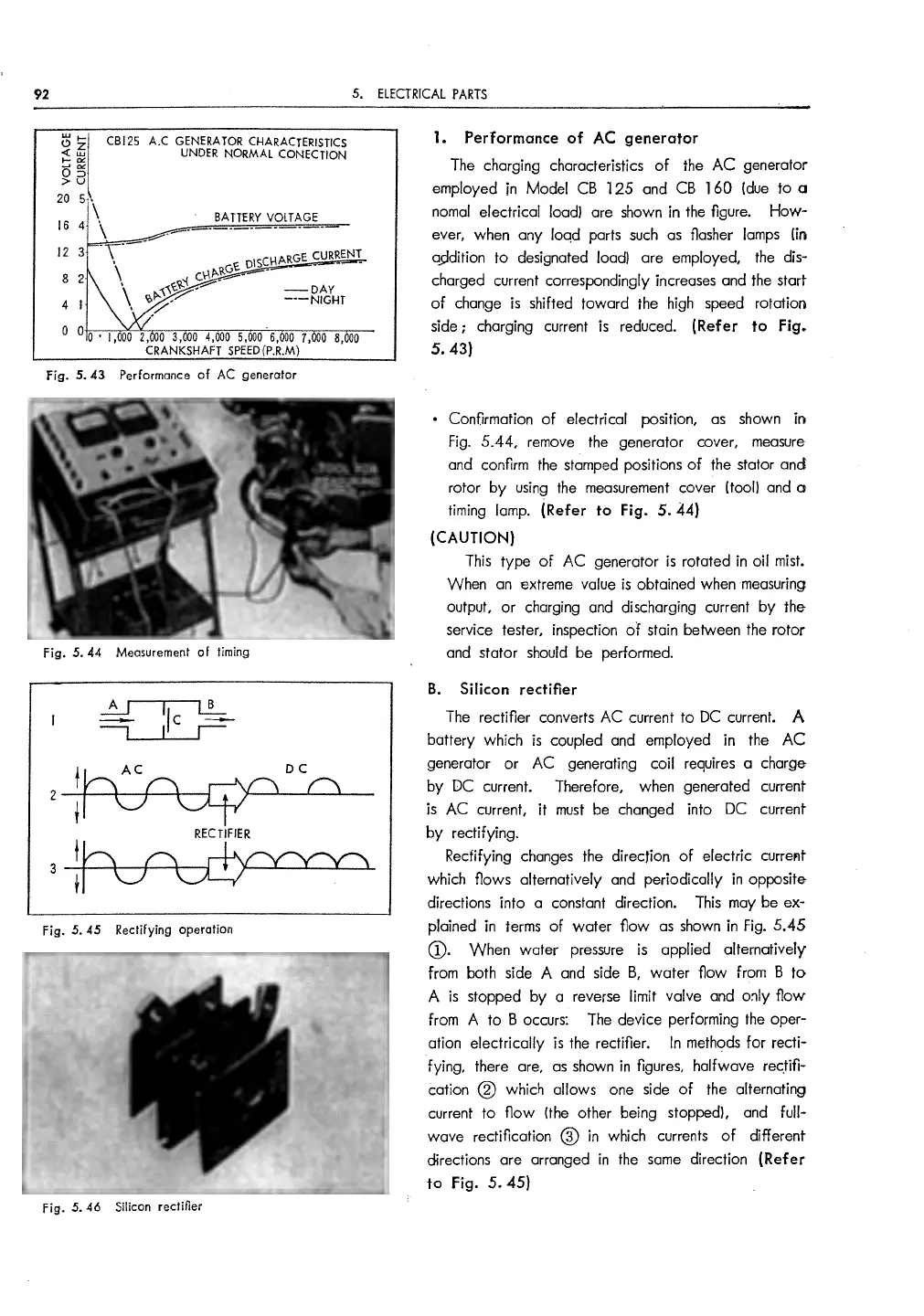
charging characteristics
of
the
AC
generator
employed
in
Model
CB
125 and
CB
160
(due
to a
nomal
electrical load) are
shown
in
the
figure.
How-
ever, when any loqd parts
such
as
flasher
lamps
lin
qpdition
to
designated load) are employed,
the
dis-
charged current correspondingly increases and
the
start
of
change
is
shifted toward the
high
speed rotation
side ; charging current
is
reduced. (Refer to Fig.
5.43}
fig.
5.
43
Performance
af
AC
generator
Confrrmation
of
electrical position,
as
shown
in
Fig.
5.44,
remove
the
generator cover,
measure
and
confirm
the
stamped positions
of
the stator and
rotor
by
using
the
measurement
cover (tool)
and
a
timing lamp.
(Refer to Fig. 5. 44)
(CAUTION)
This
type
of
AC
generator
is
rotated
in
oil mist.
When
an
extreme value
is
obtained when
measuring
output,
or
charging
and
discharging current
by
the
service tester, inspection
of
stain between the rotor
Fig. 5.
44
Measurement
of
timing
and
stator
should
be performed.
2
3
Fig. 5.
45
Rectifying operation
Fig. 5.
46
Silicon
rectifier
B.
Silicon
rectifier
The
rectifier converts
AC
current
to
DC
current. A
battery which
is
coupled
and
employed in the
AC
generator
or
AC
generating coil
requires
a charge
by
DC current. Therefore, when generated current
is
AC
current,
it
must
be
changed into DC current
by
rectifying.
Redifying
changes
the direction
of
electric curreflt
which flows alternatively
and
periodically
in
opposite
directions into a constant direction.
This
may
be ex-
plained
in
terms
of
water flow
as
shown
in
Fig.
5.45
(D.
When water
pressure
is
applied alternatively
from both side A
and
side
B,
water flow from B
to
A
is
stopped
by
a reverse limit valve
and
o:ily
flow
from A to B occurs:
The
device performing
the
oper-
ation electrically is
the
rectifier.
In
methods
for
recti-
fying, there are,
as
shown
in
figures, halfwave rec.tifi-
cation
® which allows one side
of
the
alternating
current
to
flow
{the
other being stopped),
and
full-
wave rectification
@
in
which currents
of
different
directions are arranged
in
the
same
direction (Refer
to
Fig. 5. 45)


 To Next Page