Need help?
Do you have a question about the Honda GP200H and is the answer not in the manual?
This document is a service manual for the Honda FQ650 tiller, providing comprehensive information for qualified, professional technicians. It covers various aspects of the device, from its function and technical specifications to detailed usage and maintenance procedures.
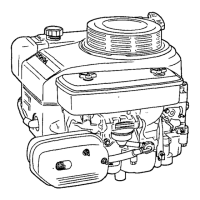
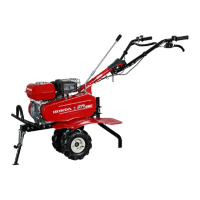
The Honda FQ650 tiller is a robust agricultural machine designed for soil cultivation. Its primary function is to prepare soil for planting by breaking it up, churning it, and mixing in amendments. The tiller is powered by a 4-stroke, overhead valve, single-cylinder engine, inclined at 25 degrees, ensuring efficient and reliable operation. It features a belt-tension type clutch and an oil bath transmission, which contribute to its durability and performance in demanding conditions. The tiller's design includes a handle column for operator control, a wheel/rotor/transmission system for mobility and tilling action, and various safety features to ensure safe operation.
Dimensions and Weights:
Engine:
Frame:
The Honda FQ650 tiller is designed for ease of use and control. The handle column offers adjustable height, allowing operators to customize it for comfort and efficiency. The manual lever clutch operation provides direct control over the tilling action. The tiller's various speeds (1st, 2nd, and Reverse) for both rotor shaft speed and vehicle speed enable it to adapt to different soil conditions and tasks. The recoil starting system ensures reliable engine ignition. The serial numbers for both the engine and frame are conveniently located for easy reference when ordering parts or making technical inquiries.
This manual emphasizes regular and thorough maintenance to ensure the safety of the operator and the longevity of the tiller. Key maintenance features include:
Maintenance Schedule: A detailed schedule outlines routine checks, cleaning, adjustments, and replacements for various components, categorized by usage intervals (before season, each use, first month/20 hrs, every 3 months/50 hrs, every 6 months/100 hrs, every year/300 hrs, and after every 500 hrs).
Engine Oil: Regular checks of engine oil level and timely oil changes are crucial. The manual specifies recommended oil types (SAE 10W-30, API service classification SE or higher) and capacity (0.6 liters).
Air Cleaner: Instructions for checking, cleaning, and replacing the dual element type air cleaner are provided, with a note to service more frequently in dusty conditions.
Nuts, Bolts, and Fasteners: Emphasis is placed on tightening all chassis nuts and bolts to specified torque values and ensuring all split pins, safety clips, hose clamps, and cable stays are properly secured.
Tires: Regular inspection for cuts and damage, along with tire pressure adjustment to the recommended range (137 – 157 kPa), is outlined.
Clutch and Belt: Procedures for checking and adjusting the clutch cable and V-belt tension are detailed, including specific free play and distance measurements.
Lubrication: A comprehensive list of lubrication points, including the recoil starter, clutch lever pins, tension arm shaft, and change lever holder/handle column pivot, is provided with recommended grease types.
Engine Idle Speed: Instructions for checking and adjusting the engine idle speed (1,250 – 1,600 min⁻¹) using a tachometer are included.
Spark Plug: Procedures for inspection, adjustment of the gap (0.70 – 0.80 mm), and replacement of the spark plug are covered.
Throttle Cable: Checks and adjustments for throttle cable free play (1 – 7 mm) are specified to ensure smooth operation.
Valve Clearance: Detailed instructions for checking and adjusting valve clearance (IN: 0.15 ± 0.02 mm, EX: 0.20 ± 0.02 mm) are provided, emphasizing that this should be done with a cold engine.
Combustion Chamber: Cleaning the combustion chamber is recommended after every 500 hours of operation.
Fuel System: Procedures for cleaning the fuel tank and filter, and inspecting the fuel tube for damage or leaks, are included.
Special Tools: The manual lists various special tools required for specific service procedures, such as float level gauges, seat cutters, valve guide drivers, and reamers, to ensure accurate and safe repairs.
Safety Precautions: The manual highlights critical safety messages, including warnings about improper service, hot parts, moving parts, and flammable fuels, to prevent injury and damage. It also emphasizes the use of Honda Genuine parts and metric tools.

 To Next Page
 General