
 Need help?
Do you have a question about the Honeywell Spyder BACnet PUB1012S and is the answer not in the manual?
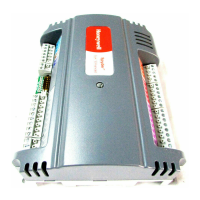
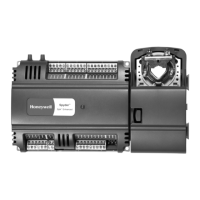
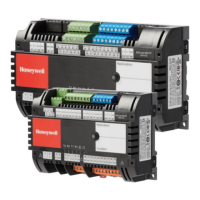
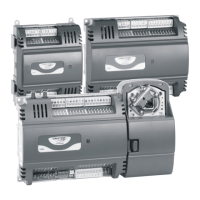
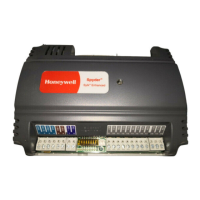
The Spyder® BACnet® Programmable Controllers are a series of BACnet MS/TP network devices designed for controlling HVAC equipment. These controllers offer a range of options and advanced system features, enabling state-of-the-art commercial building control. Each controller is fully programmable and configurable through software, making them adaptable to various applications.
The controllers are suitable for use in Variable Air Volume (VAV), Unitary, and advanced HVAC applications. They feature flexible universal inputs for connecting external sensors, as well as digital inputs. For outputs, they provide a combination of analog and digital Triac outputs, allowing for precise control of various HVAC components.
Communication is handled via an EIA-485 BACnet MS/TP network, supporting baud rates from 9.6 to 115.2 kilobits. This ensures robust and reliable communication within a building management system. The controllers are master devices on the MS/TP network, utilizing a high-quality EIA-485 transceiver and exerting a 1/4 unit load on the network.
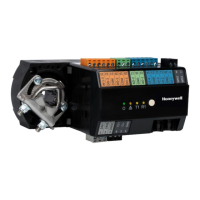
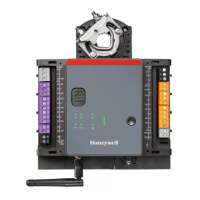
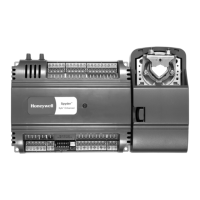
For VAV applications, some models include a direct-coupled actuator with a Declutch mechanism, which is hard-wired to the controller. This actuator mounts directly onto the VAV box damper shaft, providing up to 44 lb-in. (5 Nm) of torque with a 90-degree stroke and 90-second timing at 60 Hz. It is compatible with 3/8 to 1/2 inch (10 to 13 mm) square or round VAV box damper shafts, requiring a minimum shaft length of 1-9/16 inches (40 mm). The actuator's rotation can be controlled from 12° to 95° using two mechanical end-limit set screws, ensuring tight damper closing with a total rotation stroke of 95°.
The controllers also feature Sylk™ Bus technology, a two-wire, polarity-insensitive bus that provides both 18 VDC power and communications between Sylk-enabled sensors and the controller. This technology simplifies installation, reduces wiring, and improves speed compared to traditional sensor connections. Sylk sensors are configured using the Spyder Tool for WEBPro and WEBStation software.
The controllers are designed for field mounting, either to a panel or a DIN rail, offering flexibility in installation. They can be mounted in any orientation, with ventilation openings designed into the cover to ensure proper heat dissipation. The enclosure consists of a plastic base plate and a factory-snap-on cover, which does not need to be removed for mounting or wiring.
For DIN rail mounting, the controller is hooked onto the top of the DIN rail using two top tabs, then pushed down to snap the two bottom flex connectors onto the rail. To remove, the controller is pushed straight up from the bottom to release the top tabs, then rotated outwards and pulled down to release the bottom flex connectors.
Wiring connections are made to screw terminal blocks located on the top and bottom of the device. The terminal blocks are designed to accept up to one 14 AWG (2.0 sq mm) conductor or up to two 18 AWG (1.0 sq mm) conductors. For multiple 18 AWG wires, a wire nut can be used with a pigtail attached to the terminal block.
For VAV models, air flow pickups connect to two restrictor ports on the controller. It is recommended to use 1/4 inch (6 mm) outside diameter, plenum-rated tubing with a 0.040 inch (1 mm) wall thickness, and to ensure a fresh cut on the tubing end. The high-pressure tube connects to the restrictor port labeled (+) and the low-pressure tube to the restrictor port labeled (-). If twin tubing is used, it should be split to accommodate connections. For dusty environments, an inline 5-micron disposable air filter is recommended for the high-pressure line. The tubing length from the air flow pickup to the controller should not exceed three feet (0.914 m) to maintain flow sensing accuracy.
The MS/TP MAC address for each device must be unique, ranging from 0-127 (with 0, 1, 2, & 3 typically avoided). This is set using DIP switches on the controller, which are configured when the controller is powered down. The Device Instance Number, which uniquely identifies BACnet devices, is automatically set when added to a WEBStation-AX project but can be edited via the WEBStation-AX interface if needed.
When connecting power, it is crucial to disconnect the power supply before beginning any wiring or making connections to prevent electrical shock. The 24 Vac power from an energy-limited Class II power source should not exceed 100 VA. For multiple controllers powered by a single transformer, the same side of the transformer secondary must connect to the same power input terminal on each controller, and the earth ground terminal (terminal 3) must connect to a verified earth ground for each controller in the group. The earth ground connection wire run should be as short as possible.
For MS/TP cabling, shielded, twisted-pair cable with a characteristic impedance between 100 and 130 ohms is required. Distributed capacitance should be less than 100 pF per meter (30 pF per foot) between conductors and less than 200 pF per meter (60 pF per foot) between conductors and shield. Honeywell Cable 3322 (18 AWG, 1-Pair, Shielded, Plenum cable) or 3251 (22 AWG, 1-Pair, Shielded, Plenum cable) are recommended. The maximum bus segment length is 4,000 ft. (1,071 m), and repeaters are needed for longer runs, with a maximum of three repeaters between any two devices.
Matched terminating resistors (1/4W ±1% / 80 - 130 Ohms) are required at each end of a segment bus, matching the characteristic impedance of the installed cable. Proper MS/TP cabling shield grounding procedures are essential to minimize communication problems and equipment damage from capacitive coupling. The shield should be grounded on only one end of the MS/TP segment, typically at the router end, by tying it through the SHLD (terminal 4) on the Spyder BACnet Controller.
For controller replacement, all power must be removed. For models with hard-wired actuators, the complete assembly (controller and actuator) is replaced by loosening the actuator clamp bolts, removing mounting screws, and gently pulling the assembly clear of the shaft. For other models, the terminal blocks are removed, air flow pickup connections are disconnected, and the old controller is removed from its mounting before installing the new controller and reconnecting. When removing tubing from a connector, it should be pulled straight away or cut at the edge, never pulled at an angle.
 General
| Model | PUB1012S |
|---|---|
| Protocol | BACnet |
| Input Points | 10 |
| Output Points | 12 |
| Power Supply | 24 VAC |
| Supply Voltage | 24 VAC |
| Inputs | 10 Universal Inputs |


 To Next Page