EasyManua.ls Logo

Honeywell VS821 - User Manual

Honeywell VS821
8 pages
Print Icon
To Next Page IconTo Next Page
Loading...
APPLICATION
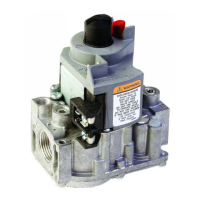
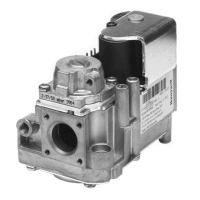
The VS820 and VS821 are used on gas fired, standing
pilot appliances with 750 mV self-powered control systems.
The gas controls include a manual gas valve, safety shutoff,
single millivoltage automatic operator and pressure regula-
tor. Refer to Table 1 for capacity ratings and Table 2 for
pressure regulators and temperature ratings. Separate
models are available for natural and LP gas; the controls
cannot be field converted.
Power for the gas control and the control system is
provided by a 750 mV Powerpile generator. We recom-
mend the Q313 Thermopile Generator or the CS82, CS893,
CS894, or CS897 Pilot Burner Generators.
TABLE 1—VS820 AND VS821 PIPE SIZE AND CAPACITY RATINGS.
INLET x OUTLET REDUCER FITTINGS
b
CAPACITY
a
CAPACITY
MODEL PIPE SIZE cfh m
3
/hr SIZE cfh m
3
/hr
VS821 1/2 x 3/8 110 3.1
VS820 1/2 x 1/2 225 6.4
1/2 x 3/4 250 7.1 3/4 x 1/2 225 6.4
1/2 x 3/8 110 3.1
3/4 x 3/4 335 9.5 3/4 x 1/2 250 7.1
3/4 x 1/2 225 6.4
VS820 1 x 1 600 17.0 1 x 3/4 503 14.2
High Capacity 1 x 3/4 450 12.7
a
Capacity is based on 1000Btuh/ft
3
, 0.64 sp gr natural gas at 1 in. wc pressure drop [37.3 MH/m
3
, 0.64 sp gr natural gas
at 0.25 kPa pressure drop]. Use conversion factors in Table 3 to convert for other gases.
b
Reducer fittings must be obtained locally.
TABLE 2—PRESSURE REGULATOR AND TEMPERATURE RATINGS.
MODEL PRESSURE REGULATOR TEMPERATURE RATING
TYPE MODEL °F °C
VS820A,H Standard V5306A 32 to 175 0 to 79
VS821A
VS820C, VS821C Step V5307A
VS820D Hi-Low V5308A
VS820P Step V5307B -40 to 175 -40 to 79
VS820V Standard V5306A
WARNING
FIRE OR EXPLOSION HAZARD
CAN CAUSE PROPERTY DAMAGE, SEVERE IN-
JURY, OR DEATH
Follow these warnings exactly:
1. Disconnect power supply before wiring to pre-
vent electrical shock or equipment damage.
2. To avoid dangerous accumulation of fuel gas,
turn off gas supply at appliance service valve
before starting installation and perform Gas
Leak Test following installation.
3. Do not bend pilot tubing at control or at pilot
after compression fitting has been tightened.
Gas leakage at the connection fitting may
result.
4. Always install sediment trap in gas supply line
to prevent contamination of gas control.
5. Do not force gas control knob. Use only your
hand to turn gas control knob. If the knob will
not operate by hand, the control should be
replaced by a qualified service technician.
Force or attempted repair may result in fire or
explosion.
INSTALLATION
WHEN INSTALLING THIS PRODUCT…
1. Read these instructions carefully. Failure to follow
them could damage the product or cause a hazardous
condition.
2. Check the ratings given in these instructions and on
the product to make sure the product is suitable for your
application.
3. Make sure installer is a trained, experienced service
technician.
4. After completing installation, use these instructions to
check product operation.
TABLE 3—GAS CAPACITY CONVERSION FACTORS.
SPECIFIC MULTIPLY
TYPE OF GAS GRAVITY LISTED CAPACITY BY
Manufactured 0.60 0.516
Mixed 0.70 0.765
Propane 1.53 1.62
D.T. Form Number 95-6994—8
Rev. 4-89 ©Honeywell Inc. 1989
VS820A,C,D,H,P,V AND VS821A,C
MILLIVOLTAGE COMBINATION
GAS CONTROLS

Question and Answer IconNeed help?

Do you have a question about the Honeywell VS821 and is the answer not in the manual?

Overview

The Honeywell VS820 and VS821 are millivoltage combination gas controls designed for use in gas-fired, standing pilot appliances equipped with 750 mV self-powered control systems. These controls integrate several key functions: a manual gas valve, a safety shutoff mechanism, a single millivoltage automatic operator, and a pressure regulator. They are available in models specifically for natural gas or LP gas and cannot be field-converted between gas types. Power for the gas control and the overall control system is supplied by a 750 mV Powerpile generator. Honeywell recommends using the Q313 Thermopile Generator or CS82, CS893, CS894, or CS897 Pilot Burner Generators for optimal performance.

Important Technical Specifications:

Capacity Ratings (Table 1):

  • VS821 (Natural Gas):
    • 1/2 x 3/8 in. pipe size: 110 cfh (3.1 m³/hr)
  • VS820 (Natural Gas):
    • 1/2 x 1/2 in. pipe size: 225 cfh (6.4 m³/hr)
    • 1/2 x 3/4 in. pipe size: 250 cfh (7.1 m³/hr)
    • 3/4 x 3/4 in. pipe size: 335 cfh (9.5 m³/hr)
    • 1 x 1 in. pipe size (High Capacity): 600 cfh (17.0 m³/hr)
  • Reducer Fittings (Natural Gas):
    • 3/4 x 1/2 in.: 225 cfh (6.4 m³/hr)
    • 1/2 x 3/8 in.: 110 cfh (3.1 m³/hr)
    • 3/4 x 1/2 in.: 250 cfh (7.1 m³/hr)
    • 3/4 x 1/2 in.: 225 cfh (6.4 m³/hr)
    • 1 x 3/4 in.: 503 cfh (14.2 m³/hr)
    • 1 x 3/4 in.: 450 cfh (12.7 m³/hr)
    • Note: Capacity is based on 1000 Btuh/ft³, 0.64 specific gravity natural gas at 1 in. wc pressure drop [37.3 MH/m³, 0.64 specific gravity natural gas at 0.25 kPa pressure drop]. Reducer fittings must be obtained locally.

Pressure Regulator and Temperature Ratings (Table 2):

  • VS820A,H; VS821A (Standard Regulator):
    • Regulator Model: V5306A
    • Temperature Rating: 32 to 175 °F (0 to 79 °C)
  • VS820C, VS821C (Step Regulator):
    • Regulator Model: V5307A
    • Temperature Rating: -40 to 175 °F (-40 to 79 °C)
  • VS820D (Hi-Low Regulator):
    • Regulator Model: V5308A
    • Temperature Rating: -40 to 175 °F (-40 to 79 °C)
  • VS820P (Step Regulator):
    • Regulator Model: V5307B
    • Temperature Rating: -40 to 175 °F (-40 to 79 °C)
  • VS820V (Standard Regulator):
    • Regulator Model: V5306A
    • Temperature Rating: -40 to 175 °F (-40 to 79 °C)

Gas Capacity Conversion Factors (Table 3):

  • Manufactured Gas (0.60 specific gravity): Multiply listed capacity by 0.516
  • Mixed Gas (0.70 specific gravity): Multiply listed capacity by 0.765
  • Propane (1.53 specific gravity): Multiply listed capacity by 1.62

Pressure Regulator Specification Pressures (Table 5):

  • VS820A,H,V; VS821A (NAT):
    • Nominal Inlet Pressure Range: 5.0-7.0 in. wc (1.2-1.7 kPa)
    • Factory Set Nominal Outlet Pressure (Full Rate): 3.5 in. wc (0.9 kPa)
    • Setting Range (Full Rate): 3-5 in. wc (0.7-1.2 kPa)
  • VS820A,H,V; VS821A (LP):
    • Nominal Inlet Pressure Range: 12.0-14.0 in. wc (2.9-3.9 kPa)
    • Factory Set Nominal Outlet Pressure (Full Rate): 11.0 in. wc (2.7 kPa)
    • Setting Range (Full Rate): 8-12 in. wc (2-3 kPa)
  • VS820C,P; VS821C (NAT):
    • Nominal Inlet Pressure Range: 5.0-7.0 in. wc (1.2-1.7 kPa)
    • Factory Set Nominal Outlet Pressure (Step): 0.9 in. wc (0.2 kPa)
    • Factory Set Nominal Outlet Pressure (Full Rate): 3.5 in. wc (0.9 kPa)
    • Setting Range (Full Rate): 3-5 in. wc (0.7-1.2 kPa)
  • VS820C,P; VS821C (LP):
    • Nominal Inlet Pressure Range: 12.0-14.0 in. wc (2.9-3.9 kPa)
    • Factory Set Nominal Outlet Pressure (Step): 2.2 in. wc (0.5 kPa)
    • Factory Set Nominal Outlet Pressure (Full Rate): 11.0 in. wc (2.7 kPa)
    • Setting Range (Full Rate): 8-12 in. wc (2-3 kPa)
  • VS820D (NAT):
    • Nominal Inlet Pressure Range: 5.0-7.0 in. wc (1.2-1.7 kPa)
    • Factory Set Nominal Outlet Pressure (Low): 1.0 in. wc (0.2 kPa)
    • Factory Set Nominal Outlet Pressure (Hi): 3.5 in. wc (0.9 kPa)
    • Setting Range: Nonadjustable
  • VS820D (LP):
    • Nominal Inlet Pressure Range: 12.0-14.0 in. wc (2.9-3.9 kPa)
    • Factory Set Nominal Outlet Pressure (Low): 2.75 in. wc (0.7 kPa)
    • Factory Set Nominal Outlet Pressure (Hi): 11.0 in. wc (2.7 kPa)
    • Setting Range: Nonadjustable

NPT Pipe Thread Length (Table 4):

  • 3/8 in. pipe size: Thread this amount: 9/16 in. (Maximum depth pipe can be inserted: 3/8 in.)
  • 1/2 in. pipe size: Thread this amount: 3/4 in. (Maximum depth pipe can be inserted: 1/2 in.)
  • 3/4 in. pipe size: Thread this amount: 13/16 in. (Maximum depth pipe can be inserted: 3/4 in.)

Usage Features:

Installation:

  • Location: Controls should be installed in a well-ventilated area, high enough to avoid flooding, and protected from steam cleaning, high humidity, dripping water, corrosive chemicals, dust, grease, and excessive heat. Ambient temperature must remain within component ratings.
  • Mounting: The control can be mounted 0-90 degrees from the upright position of the gas control knob, including vertically. The gas inlet should be on the end with the projecting wrench boss.
  • Piping: All piping must comply with local codes and ordinances (e.g., National Fuel Gas Code ANSI Z223.1 NFPA No. 54). Use new, properly reamed pipe free from chips. Tubing bends must be smooth. A sediment trap must be installed in the supply line to prevent contamination of the gas control.
  • Adapters: If adapters are needed, apply a moderate amount of good quality pipe compound to the adapter, leaving two end threads bare. For LP installations, use LP gas-resistant compound. Do NOT use Teflon tape.
  • Pilot Gas Tubing: Cut tubing to the desired length, avoiding sharp bends or deformation. Do not bend tubing at the control after the compression nut has been tightened to prevent gas leakage. Always use a new compression fitting when replacing a control.
  • Wiring: All wiring must comply with local electrical codes and ordinances (e.g., National Electrical Code ANSI/NFPA 70). Never connect millivoltage controls to line voltage or a transformer. Disconnect power before wiring. Clean and scrape all wires before connecting. Solder and tape all necessary splices using rosin flux. Control circuit cable length must not exceed 30 ft [9.2 m] of 2-wire, 18 gauge cable, or 50 ft [15.3 m] of 2-wire, 16 gauge cable.

Startup and Checkout:

  • Gas Control Knob Settings:
    • OFF: Prevents pilot and main gas flow.
    • PILOT: Permits gas flow to the pilot burner as long as the knob is held down or generator current is above the dropout value.
    • ON: Permits gas flow into the control body. Pilot gas is controlled as in PILOT. Main burner gas is controlled by the thermostat and automatic valve operator.
  • Lighting Pilot: Turn the knob to OFF, wait five minutes, then turn to PILOT. Push down and hold the knob while lighting the pilot burner. Hold for about one minute after the pilot lights. If it goes out, repeat the process. Once lit, release the knob and turn to ON.
  • Pilot Flame Adjustment: The pilot flame should envelop 3/8 to 1/2 in. [10 to 13 mm] of the tip of the generator. Adjustment is made by turning an inner screw (clockwise to decrease, counterclockwise to increase) after removing the pilot adjustment cover screw.
  • Main Burner Adjustment: Check and adjust the gas input to the main burner according to appliance nameplate ratings. This involves checking outlet pressure with a manometer or flow rate with a meter. Pressure regulator adjustment is done by turning an inner screw (clockwise to increase, counterclockwise to decrease) after removing the adjustment cap screw. For VS820D models, the HI or LOW flame setting is selected by positioning a white knob on the regulator, as it is not field adjustable.

Maintenance Features:

Gas Leak Test:

  • Perform a gas leak test with a soap and water solution any time work is done on the gas system. Apply the solution to pipe connections upstream of the gas control, then to pipe joints, adapters, and control inlet/outlet after the main burner is operating. Tighten connections if bubbles indicate a leak.

Safety Shutdown Performance Check:

  • Place the gas control knob in PILOT position; the main burner should go out, and the pilot should remain lit.
  • Extinguish the pilot flame; pilot gas flow should stop within 2-1/2 minutes. This confirms complete shutdown.
  • Relight the pilot burner and turn the gas control knob to ON.
  • Set the thermostat to call for heat and observe the appliance through one complete cycle to ensure proper operation.

Troubleshooting (Service):

  • Pilot Will Not Light: Check if the main gas supply valve is open and the line is purged of air. Readjust the pilot flame if the adjustment screw is closed. Replace or tighten the compression fitting if there's a leak. Replace the combination gas control if the pilot burner tubing or orifice is clogged.
  • Pilot Goes Out When Knob is Released: Ensure the knob is held in for at least one minute. Check pilot flame adjustment and wiring between the generator and the valve operator. Ensure connections are clean and secure. Measure generator circuit output voltages and check power unit resistance (replace if above 11 ohms).
  • Main Burner Will Not Come On: Ensure the gas control knob is ON. Adjust the thermostat. Disconnect leadwires to the TH and PP terminals to isolate the valve operator coil. Measure coil resistance (replace if not 2 ohms ±10 percent). Measure generator circuit output voltages (replace if outside acceptable range).
  • Burner Overfiring: Adjust the pressure regulator to correct pressure. If the regulator cannot be adjusted and supply pressure is normal, replace the complete gas control.

Warnings and Cautions:

  • Fire or Explosion Hazard: Always disconnect power, turn off gas supply, perform gas leak tests, do not bend pilot tubing after tightening, install a sediment trap, and do not force the gas control knob.
  • Electrical Shock/Equipment Damage: Never apply a jumper across (or short) valve coil terminals, as this may burn out the thermostat heat anticipator.
  • Gas Control Knob: Do not force the gas control knob. Use only your hand. If it won't operate by hand or stays depressed after release, the control should be replaced by a qualified service technician.
  • Contamination: Do not remove protective seals over inlet and outlet tappings until ready to connect piping.
  • Wiring: Never connect millivoltage controls to line voltage or a transformer.
  • Control Replacement: The control must be replaced if it has been flooded with water or shows any physical damage, tampering, bent terminals, missing/broken parts, stripped threads, or evidence of exposure to heat.

Honeywell VS821 Specifications

General IconGeneral
BrandHoneywell
ModelVS821
CategoryController
LanguageEnglish

Related product manuals