Need help?
Do you have a question about the Hover-1 TITAN and is the answer not in the manual?
Ensure helmet covers forehead for optimal safety and protection.
Exposed forehead indicates improper fit, increasing risk of serious injury.
Read manual thoroughly; failure to follow can cause damage, injury, or death.
Use specified charger, note temp range, avoid slippery surfaces, read labels, store dry.
Cold affects lubrication, discharge, and battery capacity, increasing operational risks.
Keep away from heat, water; use manufacturer repairs; avoid punctures; maintain cleanliness.
Consult doctor for conditions; not recommended for pregnant, heart issues, or certain physical ailments.
Defines NOTE, CAUTION, and WARNING symbols for user understanding of manual content.
Lists all items included in the box: Hoverboard, charger, and operation manual.
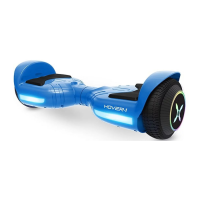
Identifies key components like fenders, foot mats, indicators, ports, and tires.
Explains use of gyroscopes, sensors, and inertia stabilization for balance and motion control.
Details model, weight, speed, range, voltage, tire size, and certifications for the Titan.
Instructions for turning the hoverboard on and off using the power button.
Describes the function of foot mat sensors for operation and stability.
Explains LED indicators for battery charge status and charging.
Details the LED for operational status and error alerts.
Ensure proper working order; contact support if any part malfunctions.
Ensure full charge, wear appropriate safety gear, and comfortable clothing/shoes.
Check local laws; wear CPSC/CE compliant helmet for protection.
Obey traffic laws, ride with traffic, yield to pedestrians, be cautious at intersections.
Ride within skill level, check indicators, avoid modifications, keep safe distance from others.
Avoid drugs/alcohol, fatigue, curbs, ramps, spinning, abuse; use on flat surfaces, avoid bad weather.
Step off on unsure terrain, avoid bumps, be aware of surroundings, avoid crowded areas, use indoor caution.
No phone use, no unauthorized areas, no hills, single rider only, no carrying items, age 8+.
Be aware of increased height, avoid sharp turns at high speeds, do not step on fenders.
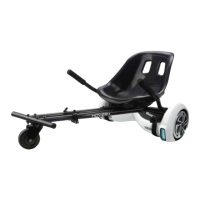
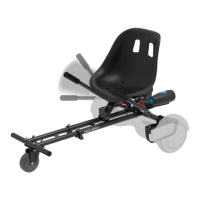
Avoid flammable areas, water bodies. Kart attachment uphill is not advised; adult supervision is required.
Instructions on how to step onto the hoverboard safely and find initial balance.
Notes on staying relaxed, stepping evenly, and finding center of gravity for stability.
Use center of gravity to move forward, backward; focus on direction for speed.
Turn by applying pressure to foot mats; avoid sharp turns; bend knees for bumps.
Instructions for stepping off the hoverboard correctly to avoid falls.
Details maximum speed and supported weight limits for safe operation.
Discusses terrain, weight, temperature, and riding style's impact on travel distance.
Steps to recalibrate the hoverboard for balance and proper turning.
Explains how the device alerts users to errors or improper operation with lights and sounds.
Lists situations causing alerts: unsafe surfaces, low battery, overheating, tilt, blocked tires.
Instructions for connecting the charger, indicator lights, and charging time.
Warning about forcing the charger and system halt during safety alerts.
Details battery type, charge time, voltage, and initial capacity.
Instructions on battery care, use of original charger, and recycling/disposal.
Avoid using emitting/leaking batteries; keep away from children/animals; do not open.
Seek medical assistance if exposed to battery substances due to fire/explosion risk.
Avoid liquid/moisture, use non-abrasive cleaners, avoid extreme temperatures, sharp objects.
Do not disassemble, dispose in fire, or fall from height. Use only approved charger.
Device complies with Part 15 of FCC Rules; outlines conditions and instructions for interference.
Provides website for warranty info and manufacturer contact details.
Steps to connect the hoverboard speaker to a Bluetooth device.
Instructions for streaming music wirelessly and controlling playback.
Details app capabilities for LED control, speed settings, and download instructions via QR codes.
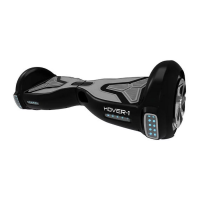
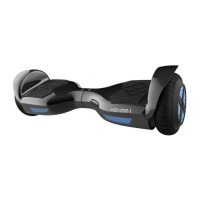
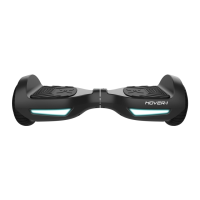
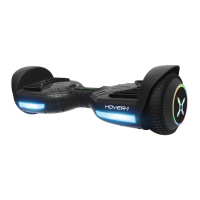
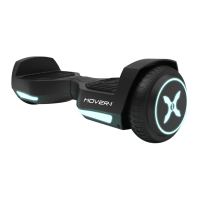
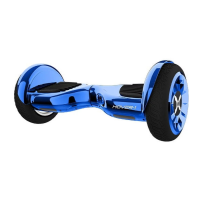
The Hover-1 Titan is an electric hoverboard designed for personal transportation, offering a blend of intuitive control, safety features, and customizable options. It's built to provide an engaging riding experience while prioritizing user safety and ease of use.
The Titan hoverboard operates using digital electronic gyroscopes and acceleration sensors to maintain balance and control motion, responding to the user's center of gravity. Its built-in inertia dynamic stabilization system assists with balance when moving forward and backward. The hoverboard is propelled by motors located within the wheels, which are controlled by the internal system. To enhance stability, especially during turns at higher speeds, users are encouraged to shift their weight to counteract centrifugal force.
The device is turned on by placing it flat on the floor and pressing the power button once. A lit LED indicator in the center of the hoverboard confirms it's powered on. To turn it off, the power button is pressed once more. The Titan features four mat sensors under the foot mats, which detect user presence and pressure. For proper operation, users must ensure they are stepping directly on these foot mats. Applying weight or pressure to only one foot mat may cause the hoverboard to vibrate or spin in one direction.
A battery indicator, located in the middle of the Titan, provides crucial information about its charge status: a green LED indicates a full charge, a red flashing LED with beeping signals low battery, and a yellow flashing LED signifies that the hoverboard is currently charging. When the LED turns red, recharging is necessary. A running indicator LED lights up when the foot mats are triggered, indicating the hoverboard has entered its operational state. In case of an error during operation, this running LED will turn red, alerting the user to a safety issue.
The Titan is also equipped with a powerful built-in wireless Bluetooth® speaker, allowing users to play music while riding. The speaker announces its pairing mode with a "ping" sound. To pair, users activate Bluetooth® on their device, select "H1-TTN" from the available devices, and enter "000000" if prompted. The speaker confirms successful pairing with a "paired" announcement. If no device is paired within two minutes, the speaker returns to standby mode. The hoverboard can remember previously paired devices and can connect with up to two multi-point devices simultaneously. Music playback is controlled entirely through the user's music device.
Furthermore, the Titan is an app-enabled hoverboard, compatible with Apple iOS and Android devices. The free Hover-1 app allows users to customize LED lighting colors, synchronize color changes to music, and adjust riding difficulty settings (beginner, intermediate, or expert) to limit top speed and modify the hoverboard's sensitivity to movement. The app can be downloaded by scanning a QR code or searching for "Hover-1 Hoverboards" in the respective app stores.
Before riding, it is essential for users to fully understand all functions of the Titan. Practicing at slower speeds in a flat, open area is recommended before venturing into public spaces. A pre-ride checklist includes ensuring the battery is fully charged and all parts are functioning correctly. Any damaged parts should be replaced before riding. Users should always wear appropriate safety gear, including a helmet that meets CPSC or CE safety standards, and comfortable, flat, closed-toe shoes.
To mount the Titan, users stand directly behind it, place one foot on a corresponding foot mat, keeping weight on the ground foot to prevent movement. Once ready, weight is shifted to the foot on the Titan, and the second foot is quickly and evenly placed on the other mat. Staying relaxed and focusing on finding a center of gravity is key. The hoverboard is highly sensitive, and even slight movements or anxiety can trigger unwanted motion. To move, users focus in the desired direction, which subtly shifts their center of gravity and propels the device. Standing straight up brings the hoverboard to a complete stop. Turning is achieved by applying pressure to the right foot for a right turn and the left foot for a left turn. Sharp turns at high speeds or riding quickly along slopes should be avoided to prevent injury.
Dismounting involves lifting the dominant leg and placing the foot on the ground behind the hoverboard (stepping back), then stepping off with the other foot. It's crucial to lift feet completely off the foot mats to avoid sending the hoverboard into a tailspin.
The Titan has speed and weight limitations for safety: a maximum speed of 7 mph, a maximum supported weight of 264 lbs, and a minimum supported weight of 44 lbs. Exceeding the weight limit can increase the risk of injury or product damage. When the maximum speed is reached, the Titan will beep and slowly tilt the rider back to prevent injury.
Operating range, which is up to 8 miles on a full charge under ideal conditions, is affected by several factors: terrain (smooth, flat surfaces yield higher range; uphill or rough terrain reduces it), user weight (lighter users get more range), ambient temperature (recommended temperatures increase range and battery life), and riding style (moderate, consistent speed maximizes range; high speeds, frequent stops, and idling decrease it).
Safety alerts are triggered by system errors or improper operation. These alerts include a red running indicator light and a beep sound, prompting the user to take precaution. Common triggers for safety alerts include unsafe riding surfaces, low battery voltage, charging status, platform tilt due to excess speed, overheating, continuous rocking for over 30 seconds, entering protection mode (often due to low battery), platform tilt exceeding 10 degrees (which can cause sudden power-off), blocked tires (leading to a stop after 2 seconds), battery depletion below protection mode (power-off after 15 seconds), or high discharge current (power-off after 15 seconds). When a safety alert causes the Titan to turn off, all systems halt, and the device must be turned off and back on to unlock it from a safety lock.
Battery care is crucial for the Titan's longevity and safety. The hoverboard uses a rechargeable lithium-ion battery with a charge time of up to 5 hours. Only the supplied Hover-1 charger and charging cable should be used; other chargers may cause damage, overheating, fire risk, and void the warranty. The Titan or its battery should not be connected to a power supply plug or a car's cigarette lighter. It should be kept away from fire and direct sunlight, as heat can damage or ignite the battery. If the battery does not recharge within the specified time, charging should be stopped immediately to prevent overheating, rupture, or ignition. Batteries should be recycled or disposed of properly, as lithium-ion batteries are subject to local, state, and federal disposal regulations. Users should not attempt to modify, change, or replace the battery. If the battery emits odor, overheats, or leaks, the Titan should not be used, and any leaking materials or fumes should not be touched or breathed. Children and animals should be kept away from the battery. If exposed to any substance emitted from the battery, immediate medical assistance should be sought.
For general care and maintenance, the Titan should be kept away from liquids, moisture, and humidity to protect its internal circuitry. Abrasive cleaning solvents should not be used. Exposure to extremely high or low temperatures should be avoided, as this can shorten component life, damage the battery, and distort plastic parts. The Titan should not be disposed of in fire, as it may explode or combust. Contact with sharp objects should be prevented to avoid scratches and damage. Dropping the Titan from high places can damage internal circuitry. Disassembly of the Titan is not recommended and will void the warranty.
If the Titan becomes unbalanced, vibrates, or doesn't turn properly, it can be calibrated. To do this, place the hoverboard on flat ground with foot mats even and not tilted. Ensure the charger is unplugged and the hoverboard is off. Press and hold the power button for 10-15 seconds until the battery indicator lights up and flashes 5 times consecutively. Release the button, turn the hoverboard off, then back on. Calibration is then complete.
 General
| Range | 8 miles |
|---|---|
| Motor Power | 250W x 2 |
| LED Lights | Yes |
| Bluetooth Speaker | Yes |
| Battery | 36V 4.0Ah lithium-ion |
| Charging Time | Up to 5 hours |

 To Next Page