Need help?
Do you have a question about the Hover-1 REBEL and is the answer not in the manual?
Demonstrates proper helmet fit covering the forehead and incorrect fit leaving it exposed.
Stress the importance of reading and understanding the manual to prevent serious injury or death.
Guidelines for safe operation, including skill assessment, proper mounting, and avoiding unauthorized modifications.
Step-by-step instructions for safely mounting, balancing, and operating the hoverboard.
Describes common alerts indicating system errors or improper operation, and potential causes.
Step-by-step instructions for charging the hoverboard and understanding the charging indicator lights.
Critical warnings about battery handling, exposure to leaking materials, and seeking medical help.
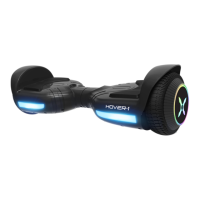
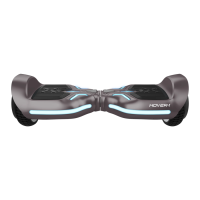
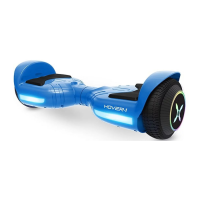
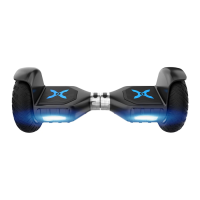
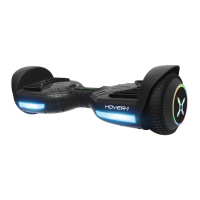
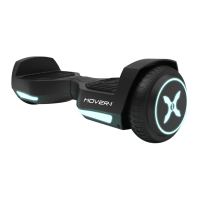
The Hover-1 Rebel is an electric hoverboard designed for personal transportation. It utilizes digital electronic gyroscopes and acceleration sensors to maintain balance and control motion based on the user's center of gravity. The hoverboard features a built-in inertia dynamic stabilization system to assist with balance when moving forward and backward.
The Rebel hoverboard serves as a personal transporter, allowing users to move by shifting their weight. It is equipped with foot mats that detect pressure and weight distribution, translating these inputs into movement commands for the motors located within the wheels. The device is powered by a rechargeable lithium-ion battery, and its operation is managed by a control system that ensures stability and responsiveness. The hoverboard includes a battery indicator to show charge status and a running indicator to signal operational readiness or errors.
Before operating the Rebel, users must ensure the battery is fully charged and the hoverboard is placed flat on level ground with the power on and the running indicator light green. To power on, the user presses the power button once. The battery indicator light will illuminate, confirming the device is on. To power off, the power button is pressed once again.
Riding the Rebel involves stepping onto the foot mats quickly, confidently, and evenly, keeping weight distributed correctly to maintain balance. The hoverboard is sensitive to subtle movements; users can propel themselves forward or backward by tilting their center of gravity in the desired direction. To turn, pressure is applied to the right foot for a right turn and the left foot for a left turn. Maintaining a relaxed posture and focusing on the intended direction aids in control. When encountering bumps or uneven surfaces, bending the knees helps absorb shock and vibrations, assisting in balance.
Dismounting is performed by lifting the dominant leg and placing the foot on the ground behind the hoverboard, then stepping off with the other foot. It is crucial to lift feet completely off the foot mats to prevent unintended movements.
The Rebel is intended for use by a single individual and is recommended for riders aged 8 and older. It should be operated on flat, even paved surfaces. Users are advised to practice at slower speeds in open areas before riding in public. When riding near others, maintaining a safe distance is important to avoid collisions.
Safety precautions are paramount. Users should always wear a properly fitted helmet that complies with CPSC or CE safety standards. Adherence to all local traffic laws, including obeying traffic lights, stop signs, and pedestrian crosswalks, is required. Riders should ride with traffic, not against it, and be defensive, expecting the unexpected. Giving pedestrians the right-of-way and alerting them when passing from behind are good practices. Slowing down at street intersections and looking left and right before crossing is also advised. The hoverboard is not equipped with reflectors, so riding in low-visibility conditions is not recommended without bright, reflective clothing.
Users should avoid riding off curbs, ramps, or in skate parks, and should not continuously spin in place to prevent dizziness. Operating the hoverboard under the influence of drugs or alcohol, or when restless or sleepy, is prohibited. It should not be operated in crowded areas, near motor vehicles, on public roads, or up or down steep hills. Carrying anything while riding is also discouraged.
The hoverboard may produce safety alerts in various situations, such as unsafe riding surfaces, low battery voltage, overheating, or if the platform tilts excessively. These alerts are indicated by a red running indicator light and a beep sound, prompting the user to cease operation. If the system enters protection mode, the alarm indicator will light up, and the hoverboard will vibrate. If the platform tilts more than 10 degrees, the Rebel will power off suddenly. If tires are blocked or the battery level depletes below protection mode, the hoverboard will also stop.
Proper care and maintenance are essential for the longevity and safe operation of the Rebel. The hoverboard should be stored in a dry, ventilated environment, away from heat sources, direct sunlight, humidity, water, and other liquids. It should not be exposed to extremely high or low temperatures, as this can shorten the life of electronic components and damage the battery or plastic parts.
Cleaning the Rebel should be done without abrasive cleaning solvents, water, or other liquids, as these can cause permanent damage to internal components. The device should be kept free from dust and lint. Users should avoid dropping the hoverboard from high places or allowing it to come into contact with sharp objects, which can cause scratches and internal damage.
Battery maintenance is critical. Only the charger and charging cable supplied by Hover-1 should be used. Using unauthorized chargers can lead to damage, overheating, fire, and voids the warranty. The Rebel or its battery should not be connected to a power supply plug or a car's cigarette lighter, nor should it be placed near fire or left in direct sunlight. If the battery does not recharge within the specified time, charging should be stopped to prevent overheating or rupture. Batteries should be recycled or disposed of properly according to local, state, or federal laws, as they contain lithium-ion. Users should not attempt to modify, change, or replace the battery. If the battery emits odor, overheats, or leaks, the device should not be used, and any leaking materials or fumes should not be touched or breathed. Immediate medical assistance should be sought if exposed to substances emitted from the battery.
If the hoverboard is unbalanced, vibrating, or not turning properly, it can be calibrated. This involves placing the Rebel on flat ground, ensuring the foot mats are even, and the charger is unplugged. The power button is then pressed and held for 10-15 seconds until the battery indicator light flashes 5 times consecutively. After releasing the button, the hoverboard is turned off and then back on to complete the calibration.
Disassembling the Rebel without permission from Hover-1 will void the warranty.
 General
| Wheel Size | 6.5 inches |
|---|---|
| LED Lights | Yes |
| Bluetooth Speaker | No |
| Range | 3 miles |
| Battery | 25.2V/2.0Ah |
| Charging Time | 5 hours |

 To Next Page