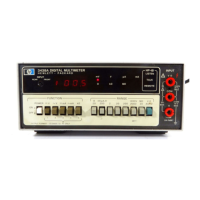
Model 3438A
Section VlII
condition.
The input voltage
@
must obviously be
amplified or attenuated to keep the voltage at
@)
within
these limits. This is accomplished by the combined gains
of the lnput and Post amplifiers. Figure 8-4 shows the
gain configuration for each of the five dc ranges.
8-31.
The input voltage at
@
is applied to the input
amplifier during integrator run-up only. Consequently,
the input voltage to the lnput Amplifier is a square wave
as shown in Figure
8-4.
8-32.
AC
Voltmeter.
The AC Voltmeter circuit
configuration is shown in the Analog Simplified
Schematic (Figure 8-12). Figure
8-5
shows the gain
configuration for each of the five ac ranges.
8-33. In the AC Voltmeter configuration the output of
the Post Amplifier
@)
is the input to the Ac to Dc
Converter. This signal will be ac in the ac volts or ac
milliamps function.
8-34. U6 and its associated components comprise the Ac
to Dc Converter. The output is a dc voltage equal to the
rms value of the input. The output of the Ac to Dc
Converter becomes the run-up voltage for the A to D
Converter.
8-35.
Ohmmeter.
Refer to the Simplified Analog
Schematic for a simplification of the Ohmmeter circuit
configuration. Figure 8-6 is a block diagram of the
Ohmmeter circuit.
8-36. U8 functions as a low impedance voltage source to
Rref.
It outputs
.5
V
in all ohmmeter ranges. This output
voltage is dropped across
Kref
to a virtual ground
provided by the Input Amplifier
(-).
The resultant
current is the current thru the unknown resistance
(Rr).
Figure 8-7 further simplifies the gain configuration
combining the lnput Amplifier. associated
compensation, and protection circuitry as an inverting
Op Amp with
Krer
as the input resistor and
Rx
as the
feedback resistor.
I'he output
of
the Input Amplifier is
the run-up voltage to the A to
1)
Converter.
Flgure 8-4. DC Galn Conflguratlon.


 To Next Page
 Loading...