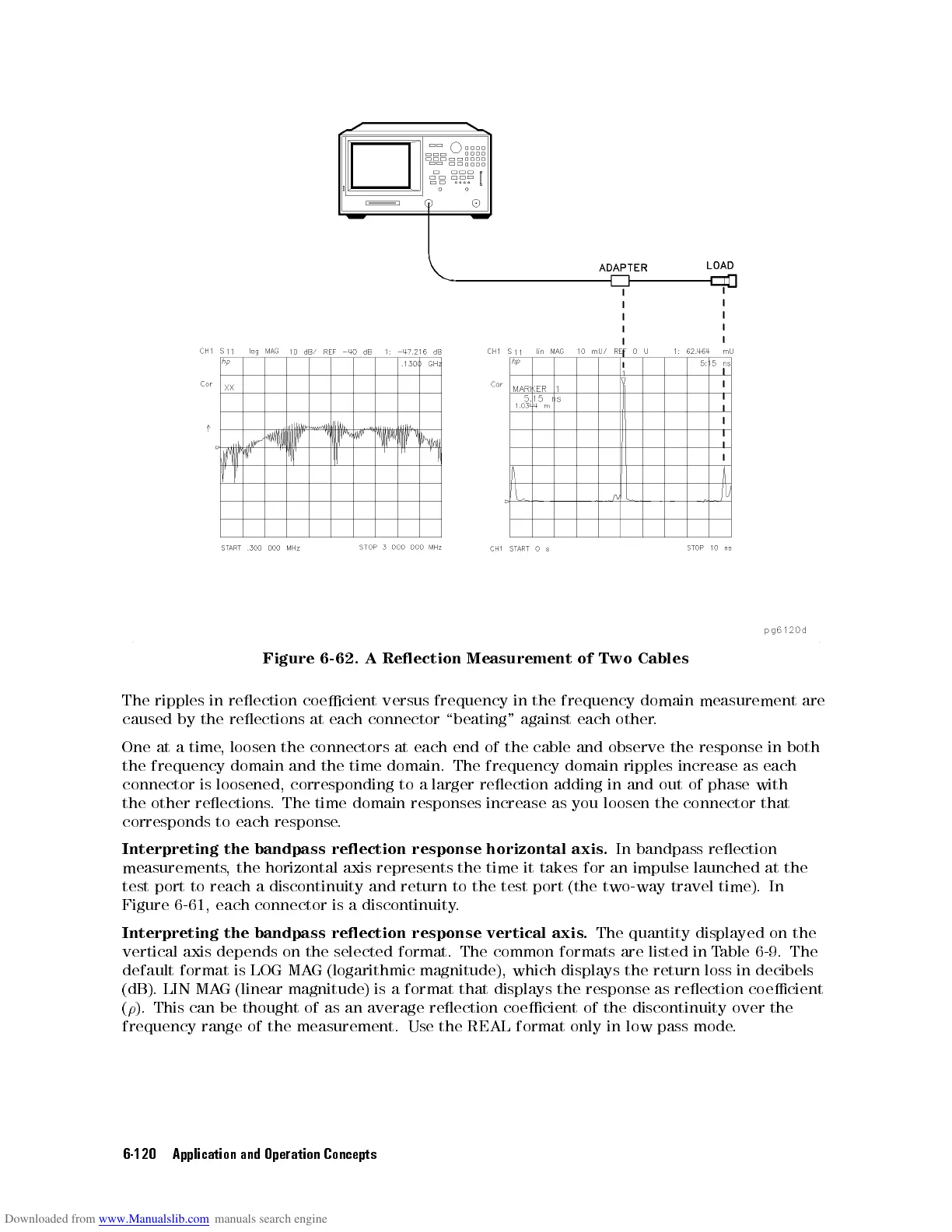
Figure
6-62.
A
Reection
Measurement
of
Two
Cables
The
ripples
in
reection
coecient
versus
frequency
in
the
frequency
domain
measurement
are
caused
by
the
reections
at
each
connector
\beating"
against
each
other
.
One
at
a
time
,
loosen
the
connectors
at
each
end
of the
cable and
observe the
response
in
both
the
frequency
domain
and
the
time
domain.
The
frequency
domain
ripples
increase as
each
connector
is
loosened,
corresponding
to
a
larger
reection
adding
in
and
out of
phase with
the
other
reections
.
The
time
domain
responses
increase
as
you
loosen the
connector that
corresponds
to
each
response
.
Interpreting the bandpass reection response horizontal axis
.
In bandpass reection
measurements, the horizontal axis represents the time it takes for an impulse launched at the
test port to reach a discontinuity and return to the test port (the two-way travel time). In
Figure 6-61, each connector is a discontinuity
.
Interpreting the bandpass reection response vertical axis
.
The quantity displayed on the
vertical axis depends on the selected format. The common
formats are listed in T
able 6-9. The
default format is LOG MA
G (logarithmic magnitude), which displays
the return loss in decibels
(dB). LIN MA
G (linear magnitude) is a format that displays
the response as reection coecient
(
). This can be thought of as an average reection coecient of the discontinuity over the
frequency range of the measurement. Use the REAL format only in low pass mode.
6-120 Application and Operation Concepts


 To Next Page