Need help?
Do you have a question about the HP OMEN 32c and is the answer not in the manual?
Essential precautions for minimizing personal injury risk during service operations.
Guidelines and precautions for professional service personnel performing maintenance.
Overview of the monitor's display characteristics and capabilities.
Details of the various input and output ports available on the monitor.
Information regarding the monitor's stand and mounting options.
Information on obtaining replacement power boards, including part numbers.
Details on distributors and part numbers for replacement capacitors.
Information on obtaining replacement connectors and their identifiers.
Steps and materials needed for safely disassembling the monitor.
Step-by-step instructions for removing the monitor's rear cover.
Procedure for removing the monitor's power board.
Procedure for repairing the HDMI 1 connector (CN501).
Procedure for repairing the HDMI 2 connector (CN502).
Procedure for repairing the DisplayPort connector (CN503).
Procedure for repairing the Phone Jack connector (CN601).
This document serves as a comprehensive Maintenance and Service Guide for the OMEN 32c model, providing essential information for trained service personnel to effectively manage and repair the device. It outlines procedures for disassembly, part replacement, diagnostic testing, and troubleshooting, ensuring the safe and reliable operation of the monitor. The guide emphasizes adherence to safety precautions and service best practices throughout all maintenance operations.
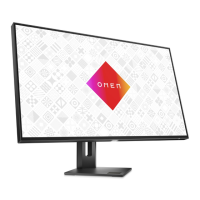
The OMEN 32c model is a high-performance monitor designed for an immersive visual experience. Its primary function is to display high-resolution visual content from various source devices, such as computers and game consoles. The monitor is equipped with a range of features aimed at enhancing user experience and display quality.
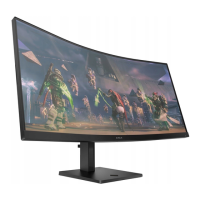
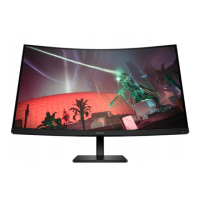
The OMEN 32c model boasts a large 80.0 cm (31.5-inch) curved screen, offering a wide and engaging viewing area. It supports a QHD resolution of 2560 × 1440 at a refresh rate of 165 Hz, providing crisp and fluid visuals. The monitor also includes full-screen support for lower resolutions, with custom scaling to maintain maximum image size while preserving the original aspect ratio.
Depending on the specific model, the display technology may include a liquid crystal display (LCD) with active matrix and in-plane switching (IPS) or VA panel technology. These technologies contribute to excellent color reproduction and wide viewing angles, allowing for comfortable viewing from various positions. The monitor features a wide color gamut, ensuring coverage of sRGB/DCI-P3 color spaces for vibrant and accurate colors. A nonglare panel with an LED backlight further enhances viewing comfort by reducing reflections.
For ergonomic flexibility, the OMEN 32c model offers tilt, swivel, and height adjustment capabilities. Select models also include pivot capability, allowing the monitor head to rotate from landscape to portrait orientation, which can be beneficial for specific tasks like document editing or coding.
User interaction and display optimization are facilitated by on-screen display (OSD) adjustments, available in several languages. These adjustments allow users to fine-tune various settings for optimal performance and personal preference. The monitor also incorporates an energy saver feature, designed to meet requirements for reduced power consumption, contributing to environmental sustainability.
Connectivity options are robust, including a DisplayPort™ video input (with an included cable) and two High-Definition Multimedia Interface® (HDMI) video inputs, enabling connection to multiple source devices. An audio-out (headphone) jack is also provided for connecting external audio devices such as powered stereo speakers, headphones, earbuds, or a television audio cable. The monitor supports Plug and Play capability, simplifying setup with compatible operating systems.
The monitor stand is designed for versatility and ease of use. It is removable, allowing for flexible mounting solutions, such as wall mounts or swing arms. The HP Quick Release 2 device enables quick attachment and removal of the monitor head from the stand with a simple click and a sliding tab release. The monitor is also compatible with VESA® mounting brackets (100 × 100 mm), offering broad compatibility with third-party mounting solutions. Additionally, it supports a mounting bracket to attach the monitor to a workstation, further enhancing its adaptability in various professional environments.
The Maintenance and Service Guide is specifically tailored for professional service technicians, providing detailed instructions for repair and maintenance. It emphasizes the importance of safety, outlining critical safety information and precautions that must be observed before, during, and after any service operation. Only trained service personnel familiar with HP products are authorized to perform service or maintenance. A crucial safety measure highlighted is the disconnection of the power cord from the main power supply before opening the monitor to prevent component damage.
The guide details the proper preparation for disassembly, including cleaning the work area, identifying the disassembly zone, and preparing for material flow. It also lists necessary equipment and materials, such as a press fixture, working table, screwdriver, knife, gloves, cleaning cloth, ESD protection, and a scraper bar of specific dimensions. Electrostatic discharge (ESD) safety procedures are mandatory when handling electrical components to prevent damage.
The manual provides a detailed illustrated parts catalog, identifying major components and their quantities, which is essential for accurate part replacement. It also includes information on how to order spare parts, specifying HP spare part numbers and manufacturer part numbers for key components like the power board, capacitors, and connectors. The guide directs technicians to authorized EU distributors for purchasing capacitors and connectors, and to the HP part store for cables and power supplies.
Specific removal and replacement procedures are outlined for various components. For instance, the guide provides step-by-step instructions for removing the rear cover, including the removal of screws, splitting the frame, and disconnecting connectors. It also covers the disassembly of the key board and connector board from the rear cover, and the main frame from the panel. Instructions for removing the mylar, tape, and screws to access the main board and power board are also provided, along with warnings about discharging capacitors on the power board before handling.
For connector repair, the guide provides detailed instructions for HDMI, DisplayPort, and Phone Jack connectors. These procedures involve using a soldering iron and de-soldering pump to remove solder, a hot air gun to melt solder, lifting the old connector, placing a new component, and soldering it in place. It stresses the importance of matching specifications and part numbers with the Bill of Materials (BOM) and ensuring correct polarity for capacitors. The use of lead-free solder wire is mandated to comply with RoHS requirements. Technicians are advised to work quickly to avoid overheating the circuit board and to perform a close inspection after repair to confirm good condition.
After any repair, a function test is required to confirm that all monitor functions are working correctly. The guide includes a function test table, detailing items such as HDMI, DP, and audio tests, along with their operating descriptions and necessary tools. This ensures that the repaired product meets operational standards before being returned to the customer.
Troubleshooting information is also provided, listing common problems, possible causes, and recommended solutions. This section helps technicians diagnose and resolve issues efficiently, covering scenarios like a blank screen, blurred images, or OSD lockout.
The guide also addresses ERP Lot5 requirements, emphasizing that professional repairers must possess technical competence, comply with regulations, and have insurance covering repair liabilities. This ensures that all service operations are performed to a high standard and in accordance with legal and safety guidelines. Firmware updates, if available, are directed to the HP support website, ensuring the monitor can be kept up-to-date with the latest software enhancements.
 General
| Color | black |
|---|---|
| Screen Type | led |
| Tiltable | yes |
| Touch Screen | no |
| Webcam | no |
| OS Compatibility | windows |
| Screen Size | 32 inches |
| Panel Type | not applicable |
| Aspect Ratio | 16:9 |
| Resolution | 2560 x 1440 |
| Native Resolution | 2560 x 1440 |
| Refresh Rate | 75hz |
| Horizontal Viewing Angle | 178 degrees |
| Vertical Viewing Angle | 178 degrees |
| Response Time | 5 milliseconds |
| Brightness | 300 candela per square meter |
| Contrast Ratio | 3000:1 |
| Synchronization | freesync (amd adaptive sync) |
| HDR | no |
| Built-In Speakers | no |
| HDMI Ports | 2 |
| Power Saving Mode | 0.5 watts |
| Power Consumption | 72 watts |
| Depth with Stand | 7 inches |
| Width with Stand | 29.1 inches |
| Net Weight without Stand | 21.56 pounds |

 To Next Page