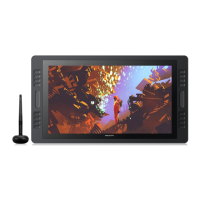
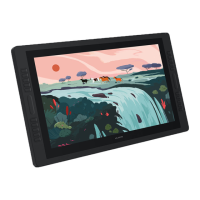
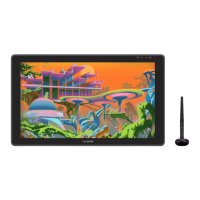
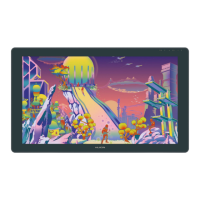
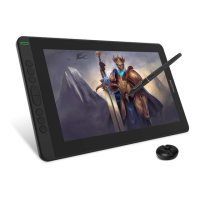
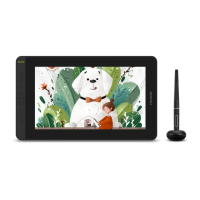
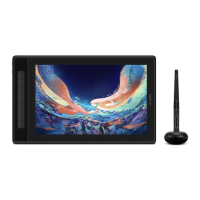
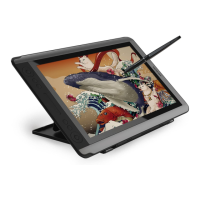
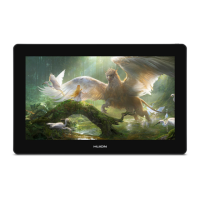
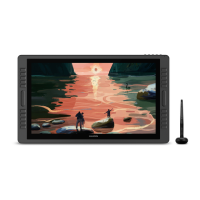
The HUION KAMVAS® Pro 22 Pen Display (Model: GT2201) is a professional-grade drawing display designed to enhance work efficiency for artists and creators. This device allows for freehand painting and writing, replicating the experience of a pen on paper with various line types and colors. It is compatible with both Windows (7 or later) and macOS (10.12 or later) operating systems.
Function Description
The KAMVAS Pro 22 is a desktop-level pen display that serves as an interactive canvas for digital art and design. It features a large active area where users can draw, paint, and manipulate digital content directly with a stylus. The display is equipped with programmable press keys and touch bars on both sides, offering customizable shortcuts to streamline workflows. These keys can be assigned to various functions, allowing users to execute commands quickly without needing to access the computer keyboard. The touch bars provide a convenient way to zoom in and out of the canvas, further enhancing the user experience.
The device supports pressure sensitivity, enabling artists to create lines with varying thickness and opacity based on the pressure applied to the stylus. This feature is crucial for achieving natural and expressive strokes in digital art. The pen itself is battery-free, eliminating the need for charging and ensuring uninterrupted creative sessions.
The KAMVAS Pro 22 also integrates with Microsoft Windows Ink features, providing extensive support for pen input in various applications such as Microsoft Office, Windows Journal, Adobe Photoshop CC, and SketchBook 6. This broad compatibility ensures that users can seamlessly incorporate the pen display into their existing creative software ecosystem.
Usage Features
Setting up the KAMVAS Pro 22 involves assembling the adjustable stand to the back of the display using the provided screwdriver. Once assembled, the display connects to a computer via a power adapter, HDMI cable, and USB cable. The power button, located at the bottom of the display, turns the device on.
Before using the display, it is essential to install the appropriate driver, which can be downloaded from the HUION website. The driver icon in the system tray indicates successful installation and device recognition. It is recommended to uninstall any other similar product drivers, including older versions of the KAMVAS driver, and close all graphics and anti-virus software before installation to prevent conflicts.
The stylus is held like a normal pen or pencil, with an emphasis on adjusting the grip to easily toggle the side switch without accidental presses during drawing or positioning. The pen's side buttons are customizable and can be set to two different functions, accessible when the pen tip is within 10mm of the display's active area, even without touching the screen.
Positioning the cursor is achieved by moving the pen slightly above the active area. To make a selection or register a click, the pen tip is pressed onto the screen. Tapping once highlights or selects an item, while double-tapping opens it. Objects can be moved by selecting them and then sliding the pen tip across the screen.
The display offers comprehensive OSD (On-Screen Display) settings for image and color adjustments. Users can control brightness, contrast, and choose from various ECO modes (STANDARD, TEXT, GAME, MOVIE). Dynamic Contrast Ratio (DCR) can also be toggled on or off. Image settings include horizontal and vertical position adjustments, clock and phase adjustments for vertical and horizontal blinking, and aspect ratio selection (WIDE or 4:3). Color temperature settings allow users to choose between WARM, COOL, and USER modes.
OSD settings also include language selection (12 options), OSD position adjustment (horizontal and vertical), OSD timer to control the display duration of the menu, and transparency adjustment. A reset option is available to restore all settings to default, and automatic image and color adjustments can be performed.
For multi-monitor setups, the driver allows users to define the working area of the KAMVAS Pro 22. In extended display mode, users can map a specific portion of the display screen to the KAMVAS. Options include "Full Area" (the entire active area), "Same Ratio with LCD," or "Customized Area," where users can input coordinate values or drag graphic corners to select the desired screen area. The working area can also be rotated by 0°, 90°, 180°, or 270° to accommodate left or right-hand operation.
The press keys and touch bars are highly customizable. Users can assign various functions to these keys through a pop-up dialog box in the driver software. The press keys on both sides of the display share the same functions, simplifying configuration. The touch bar enables zoom functionality and can also be customized. Users have the option to enable or disable both the press keys and touch bar.
The pressure sensitivity of the pen can be adjusted by dragging a slider in the driver interface; a smaller value indicates higher sensitivity. A pen pressure test feature allows users to gradually apply pressure to the stylus on the screen to test the pressure level, with a "Clear" button to erase the ink.
Screen calibration is performed by clicking red points at the cross centers appearing on the screen. Factory settings can be restored, and calibration can be canceled by clicking "Cancel calibration" or pressing ESC.
The driver also supports data export and import of customized configuration data, which is useful for users who switch between different software or devices, avoiding the need for repeated settings.
Maintenance Features
Regular maintenance is crucial for the longevity and optimal performance of the KAMVAS Pro 22. Before cleaning the display, it is important to unplug the USB cable. The display should be wiped with a soft, damp cloth, and no detergents should be used.
The pen nibs are subject to wear and tear over time and will need replacement. The manual provides instructions on how to replace the nibs.
To prevent overheating, the display's back case has grooves and holes for ventilation. It is important not to place the display on soft surfaces like beds, sofas, or carpets, or in embedded devices that could obstruct airflow.
The display should be kept away from water sources such as bathtubs, washbasins, sinks, washing machines, damp basements, or swimming pools. It should also be placed on a stable surface and out of reach of children to prevent accidents. Magnetic fields should be avoided as they can interfere with the display and digital pen.
Only power supplies specified on the nameplate should be used. If there are questions about the power supply, users should consult the distributor. To protect the display, it should be switched off when not in use. During blackouts or extended periods of disuse, the display should be unplugged from the socket. Overloading sockets or lengthening power wires should be avoided to prevent electric shocks.
Foreign objects should be prevented from entering the monitor through the grooves, and liquids should not be splashed on the display to prevent short-circuits or fire.
In case of a breakdown, users should not attempt to open the main case or repair the display themselves. Professional service for proper repair and maintenance should be sought. If the power wire or plug is damaged, liquid is splashed inside, the display falls, the LCD is broken, or other obvious abnormalities occur, the power adapter should be unplugged, and the device should be serviced. When replacing components, it is essential to ensure that the repairman uses substitute components specified by the manufacturer to avoid risks such as fire or electric shocks.
The manual also includes a troubleshooting section for common issues related to the display and its functions, offering solutions such as checking power connections, verifying cable integrity, adjusting display modes, reinstalling drivers, restarting the computer, re-inserting USB cables, and performing calibration.


 To Next Page
 General
 Weight and Dimensions