EasyManua.ls Logo

Huskylock 340D - Fabric and Thread Selection; Fabric Considerations; Thread Selection for Overlocking

Default Icon
42 pages
Print Icon
To Next Page IconTo Next Page
To Previous Page IconTo Previous Page
Loading...
01/23/2008
FABRIC
Your
Huskylock
will
sew
most
materials
available
on
today’s
market,
tricot
to
denims.
It
may
be
necessary
to
adjust
tensions,
cutters
and
stitch
length
to
make
a
good
stitch.
Select
the
stitch
width
suitable
for
the
specific
fabric
by
sewing
test
samples
on
the
same
material
you
plan
to
overlock.
Some
materials
may
need
prewashing
to
remove
backing,
dirt
gathering
protectors,
or
other
additives
to
prevent
skip
stitches.
ALWAYS
TEST
THE
MATERIAL
TO
BE
OVERLOCKED
BY
SEWING
SAMPLES.
THREAD
SELECTION
-
CONVENTIONAL
SEWING
Select
threads
of
one
type
only
when
using
your
Huskylock.
Example:
All
three
threads
should
be
mercerized
cotton,
spun
polyester,
or
cotton
covered
polyester,
etc.
Different
threads
on
the
machine
may
cause
time
consuming
thread
tension
adjustments.
It
should
be
borne
in
mind
that
the
lower
and
upper
loopers
will
use
about
twice
the
amount
of
thread
than
the
needle
thread.
When
purchasing
thread
for
sewing,
especially
if
it
is
an
unusual
color,
you
should
buy
sufficient
for
your
requirements.
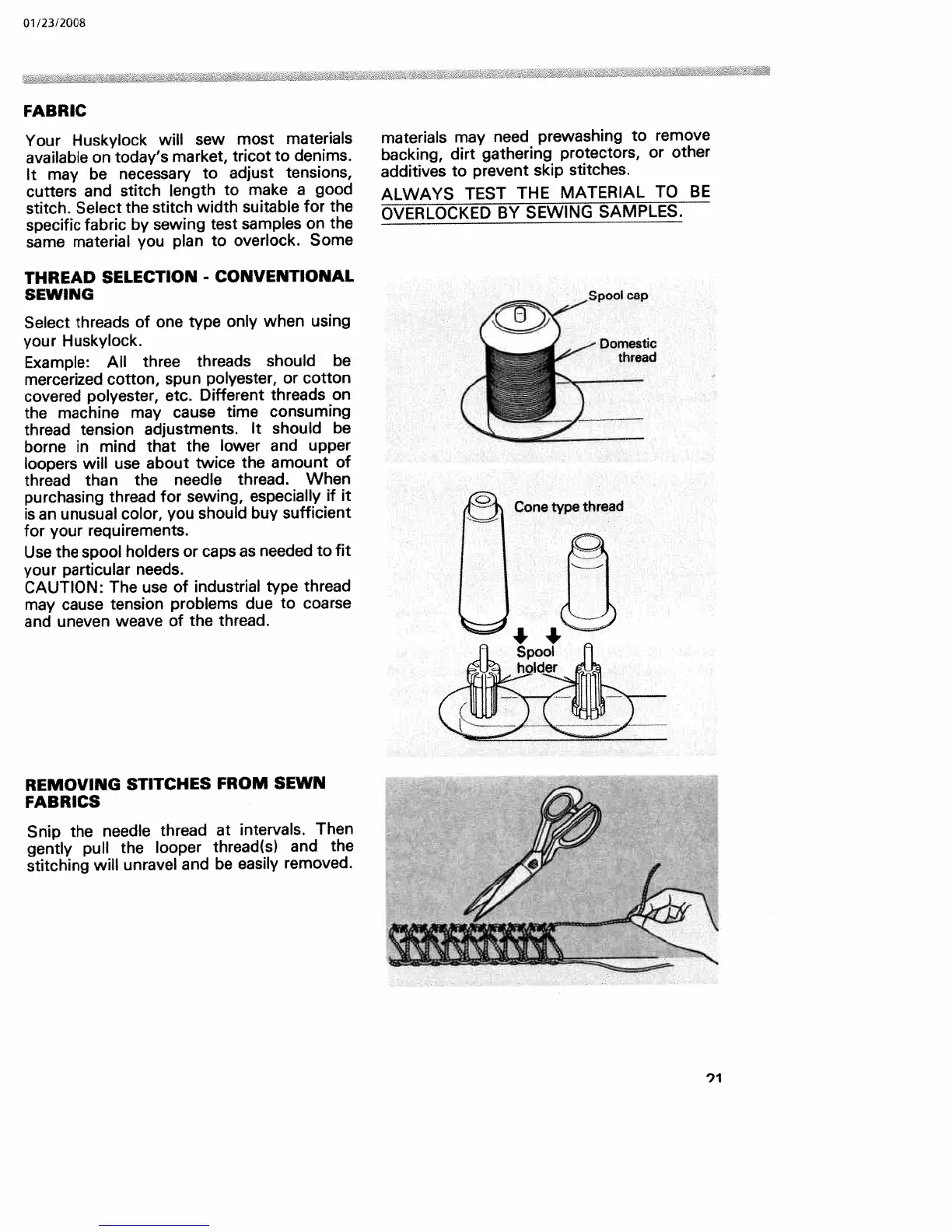
Use
the
spool
holders
or
caps
as
needed
to
fit
your
particular
needs.
CAUTION:
The
use
of
industrial
type
thread
may
cause
tension
problems
due
to
coarse
and
uneven
weave
of
the
thread.
REMOVING
STITCHES
FROM
SEWN
FABRICS
Snip
the
needle
thread
at
intervals.
Then
gently
pull
the
looper
thread(s)
and
the
stitching
will
unravel
and
be
easily
removed.
Spool
cap
(í,
Domestic
z
Cone
type
thread
91

Related product manuals