EasyManua.ls Logo

Husqvarna DM220 - User Manual

Husqvarna DM220
25 pages
Print Icon
To Next Page IconTo Next Page
Loading...
HUSQVARNA CONSTRUCTION PRODUCTS
Workshop manual
DM 220
Question and Answer IconNeed help?

Do you have a question about the Husqvarna DM220 and is the answer not in the manual?

Summary

Literature

Workshop Manual Overview

Details the scope and purpose of the workshop manual.

Manual Structure and Layout

Explains the arrangement of text and illustrations within the manual.

Spares Information Availability

Covers the content and purpose of the spares folder.

Components, Work Tips

DM220 Component Identification

Lists and identifies the main components of the DM220.

DM220 Model Type Differentiation

Explains the differences between Type A and Type B models.

Workshop Positioning Guidance

Provides advice on positioning the machine for service work.

Electrical Safety Precautions

Warns about electrical hazards and proper handling.

Water;Dust Unit

Functionality of Water;Dust Unit

Explains the unit's role in water cooling or dust extraction.

Construction and Seals

Describes the unit's construction and O-ring seals.

Service: Replacing Seals

Details the procedure for replacing casing and O-ring seals.

Dismantling in Basic Modules

Separating Gear Housing and Motor

Outlines steps to separate the gear housing from the electric motor.

Removing Handle Halves

Details the process of removing the machine's handle halves.

Earth Wire Connection

Describes locating and removing the earth wire from the connector.

Motor Housing Cover Removal

Steps to remove the cover for the stand mount and motor housing.

Gear Housing to Gear Box Cover Separation

Details the separation of the gear housing from the gear box cover.

Gearbox Oil Drainage Procedure

Explains how to drain the gearbox oil and its specifications.

Model-Specific Gear Housing Attachment

Differentiates screw locations for Type A and Type B gear housing attachment.

Gear Housing - Intermediate Shaft

Function of Intermediate Shaft Transmission

Explains the transmission's role and components like slip clutch.

Intermediate Shaft Service Procedure

Outlines the necessity of dismantling the intermediate shaft first.

Dismantling the Intermediate Shaft

Provides steps for removing the intermediate shaft using a puller.

Slip Clutch Operation and Adjustment

Describes the slip clutch and the initial steps for adjustment.

Spring Washer Installation and Function

Details the importance of correctly installing spring washers for clutch force.

Friction Washer Replacement Guidance

Explains when and how to replace the friction washer.

Gear Wheel and Bushing Inspection

Guides on checking the condition of the gear wheel and its bushing.

Type A Slip Clutch Torque Adjustment

Provides steps for adjusting the slip clutch torque on Type A models.

Type B Slip Clutch Torque Adjustment

Details the slip clutch adjustment procedure for Type B models using specific tools.

Gear Housing - Spindle Shaft

Spindle Shaft Function and Issues

Explains the spindle shaft's role and potential damage from mishandling.

Spindle Shaft Removal Prerequisites

States that the intermediate shaft must be removed first.

Removing Spindle Shaft Components

Details steps for removing circlips, gear wheels, and the gear knob.

Wedge and Lock Ring Removal

Explains how to remove the wedge and lock ring using specific pliers.

Gear Housing After Shaft Component Removal

Shows the gear housing after intermediate and spindle shaft parts are removed.

Gear Housing - Bearing Replacement

Bearings and Seal Cylinder Description

Describes the bearings and the seal cylinder in the spindle shaft.

Spindle Shaft Bearing Removal Steps

Details removing circlips, pressing out the shaft and bearing.

Seal Cylinder and Bearing Refitting

Explains replacing the seal cylinder and fitting the bearing.

Tools for Bearing Replacement

Lists required tools like bearing extractors, counter stay devices, and slide hammers.

Needle Bearing Replacement Procedure

Details the process for fitting needle bearings into the gear box cover.

Ball Bearing Replacement Procedure

Describes the procedure for fitting ball bearings into the gear housing.

Carbon Brushes

Replacing Carbon Brushes

Provides step-by-step instructions for replacing worn carbon brushes.

Checking Carbon Brush Wear

Explains how to check brush wear using a slide gauge.

Carbon Brush Holder Replacement

Details how to remove and replace the carbon brush holder.

Wiring Diagram - Cabling, 110 V

Handle Wiring Connections (110 V)

Illustrates the wiring within the handle for the 110V model.

Mains Cable Terminal Block (110 V)

Explains the terminal block connections for the mains cable.

Cable Damage Prevention (110 V)

Advises on routing cables to prevent damage during reassembly.

Wiring Diagram - Cabling, 230 V

Handle Wiring Connections (230 V)

Shows the wiring within the handle for the 230V model.

Mains Cable Terminal Block (230 V)

Details terminal block connections for the 230V mains cable.

230 V Capacitor Troubleshooting

Guidance on checking the capacitor if the mains fuse blows.

Cable Protection During Reassembly (230 V)

Emphasizes care in routing cables to avoid crushing.

Circuit Board - Cabling

Circuit Board Core Functions

Explains the circuit board's functions like Softstart and Elgard.

Circuit Board Functionality Testing

Advises testing other components before replacing the circuit board.

Sensor Unit Alignment for Spirit Level

Guides on correct sensor unit orientation for the spirit level.

Level Guiding System Overview

Describes the electronic spirit level feature and its connections.

Flat Cable Connection and Removal

Details how to connect and disconnect the flat cable.

Circuit Board Wiring Details

Illustrates specific cable connections to the circuit board and breaker.

Circuit Breaker Functional Testing

Explains how to test the circuit breaker's interrupt and Smartstart functions.

Smartstart Function Resistance Check

Details how to test the Smartstart feature's resistance.

Mains Cable and Interference Suppression

Discusses mains supply issues, cord replacement, and interference suppression.

Rotor

Rotor Functional Test Preparation

Steps for accessing and preparing the rotor for testing.

Inductance Measurement for Rotor Testing

Explains how to measure rotor inductance using a multimeter.

Rotor Bearing Replacement Procedure

Details removing and replacing bearings on the rotor.

Collector Side Bearing Replacement

Specific instructions for replacing the bearing on the collector side.

Gear Box Cover Bearing Replacement

Steps for replacing bearings in the gear box cover.

Rotor Shaft Press Fitting Guidance

Guidance on pressing the rotor shaft into bearings, avoiding knocking.

Speed Sensor Mounting with Thread Locker

Instructions for refitting the speed sensor with thread locker.

Stator

Stator Functional Testing Methods

Explains how to check stator winding integrity using various measurements.

Stator Resistance and Inductance Tests

Describes Ohm and Henry measurements for stator testing.

Stator Dismantling and Reassembly

Steps for removing and reinstalling the stator in the motor housing.

Tools

Husqvarna Supplied Service Tools

Lists specific tools available from Husqvarna for service operations.

Recommended Non-Husqvarna Tools

Lists specialized tools not sold by Husqvarna but needed for service.

Summary

Literature

Workshop Manual Overview

Details the scope and purpose of the workshop manual.

Manual Structure and Layout

Explains the arrangement of text and illustrations within the manual.

Spares Information Availability

Covers the content and purpose of the spares folder.

Components, Work Tips

DM220 Component Identification

Lists and identifies the main components of the DM220.

DM220 Model Type Differentiation

Explains the differences between Type A and Type B models.

Workshop Positioning Guidance

Provides advice on positioning the machine for service work.

Electrical Safety Precautions

Warns about electrical hazards and proper handling.

Water;Dust Unit

Functionality of Water;Dust Unit

Explains the unit's role in water cooling or dust extraction.

Construction and Seals

Describes the unit's construction and O-ring seals.

Service: Replacing Seals

Details the procedure for replacing casing and O-ring seals.

Dismantling in Basic Modules

Separating Gear Housing and Motor

Outlines steps to separate the gear housing from the electric motor.

Removing Handle Halves

Details the process of removing the machine's handle halves.

Earth Wire Connection

Describes locating and removing the earth wire from the connector.

Motor Housing Cover Removal

Steps to remove the cover for the stand mount and motor housing.

Gear Housing to Gear Box Cover Separation

Details the separation of the gear housing from the gear box cover.

Gearbox Oil Drainage Procedure

Explains how to drain the gearbox oil and its specifications.

Model-Specific Gear Housing Attachment

Differentiates screw locations for Type A and Type B gear housing attachment.

Gear Housing - Intermediate Shaft

Function of Intermediate Shaft Transmission

Explains the transmission's role and components like slip clutch.

Intermediate Shaft Service Procedure

Outlines the necessity of dismantling the intermediate shaft first.

Dismantling the Intermediate Shaft

Provides steps for removing the intermediate shaft using a puller.

Slip Clutch Operation and Adjustment

Describes the slip clutch and the initial steps for adjustment.

Spring Washer Installation and Function

Details the importance of correctly installing spring washers for clutch force.

Friction Washer Replacement Guidance

Explains when and how to replace the friction washer.

Gear Wheel and Bushing Inspection

Guides on checking the condition of the gear wheel and its bushing.

Type A Slip Clutch Torque Adjustment

Provides steps for adjusting the slip clutch torque on Type A models.

Type B Slip Clutch Torque Adjustment

Details the slip clutch adjustment procedure for Type B models using specific tools.

Gear Housing - Spindle Shaft

Spindle Shaft Function and Issues

Explains the spindle shaft's role and potential damage from mishandling.

Spindle Shaft Removal Prerequisites

States that the intermediate shaft must be removed first.

Removing Spindle Shaft Components

Details steps for removing circlips, gear wheels, and the gear knob.

Wedge and Lock Ring Removal

Explains how to remove the wedge and lock ring using specific pliers.

Gear Housing After Shaft Component Removal

Shows the gear housing after intermediate and spindle shaft parts are removed.

Gear Housing - Bearing Replacement

Bearings and Seal Cylinder Description

Describes the bearings and the seal cylinder in the spindle shaft.

Spindle Shaft Bearing Removal Steps

Details removing circlips, pressing out the shaft and bearing.

Seal Cylinder and Bearing Refitting

Explains replacing the seal cylinder and fitting the bearing.

Tools for Bearing Replacement

Lists required tools like bearing extractors, counter stay devices, and slide hammers.

Needle Bearing Replacement Procedure

Details the process for fitting needle bearings into the gear box cover.

Ball Bearing Replacement Procedure

Describes the procedure for fitting ball bearings into the gear housing.

Carbon Brushes

Replacing Carbon Brushes

Provides step-by-step instructions for replacing worn carbon brushes.

Checking Carbon Brush Wear

Explains how to check brush wear using a slide gauge.

Carbon Brush Holder Replacement

Details how to remove and replace the carbon brush holder.

Wiring Diagram - Cabling, 110 V

Handle Wiring Connections (110 V)

Illustrates the wiring within the handle for the 110V model.

Mains Cable Terminal Block (110 V)

Explains the terminal block connections for the mains cable.

Cable Damage Prevention (110 V)

Advises on routing cables to prevent damage during reassembly.

Wiring Diagram - Cabling, 230 V

Handle Wiring Connections (230 V)

Shows the wiring within the handle for the 230V model.

Mains Cable Terminal Block (230 V)

Details terminal block connections for the 230V mains cable.

230 V Capacitor Troubleshooting

Guidance on checking the capacitor if the mains fuse blows.

Cable Protection During Reassembly (230 V)

Emphasizes care in routing cables to avoid crushing.

Circuit Board - Cabling

Circuit Board Core Functions

Explains the circuit board's functions like Softstart and Elgard.

Circuit Board Functionality Testing

Advises testing other components before replacing the circuit board.

Sensor Unit Alignment for Spirit Level

Guides on correct sensor unit orientation for the spirit level.

Level Guiding System Overview

Describes the electronic spirit level feature and its connections.

Flat Cable Connection and Removal

Details how to connect and disconnect the flat cable.

Circuit Board Wiring Details

Illustrates specific cable connections to the circuit board and breaker.

Circuit Breaker Functional Testing

Explains how to test the circuit breaker's interrupt and Smartstart functions.

Smartstart Function Resistance Check

Details how to test the Smartstart feature's resistance.

Mains Cable and Interference Suppression

Discusses mains supply issues, cord replacement, and interference suppression.

Rotor

Rotor Functional Test Preparation

Steps for accessing and preparing the rotor for testing.

Inductance Measurement for Rotor Testing

Explains how to measure rotor inductance using a multimeter.

Rotor Bearing Replacement Procedure

Details removing and replacing bearings on the rotor.

Collector Side Bearing Replacement

Specific instructions for replacing the bearing on the collector side.

Gear Box Cover Bearing Replacement

Steps for replacing bearings in the gear box cover.

Rotor Shaft Press Fitting Guidance

Guidance on pressing the rotor shaft into bearings, avoiding knocking.

Speed Sensor Mounting with Thread Locker

Instructions for refitting the speed sensor with thread locker.

Stator

Stator Functional Testing Methods

Explains how to check stator winding integrity using various measurements.

Stator Resistance and Inductance Tests

Describes Ohm and Henry measurements for stator testing.

Stator Dismantling and Reassembly

Steps for removing and reinstalling the stator in the motor housing.

Tools

Husqvarna Supplied Service Tools

Lists specific tools available from Husqvarna for service operations.

Recommended Non-Husqvarna Tools

Lists specialized tools not sold by Husqvarna but needed for service.

Overview

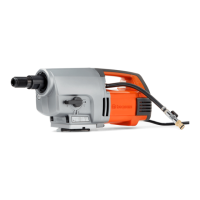
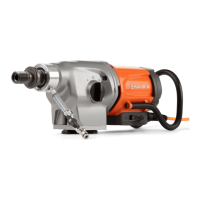
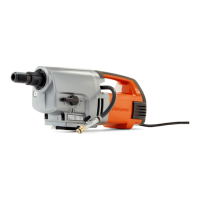
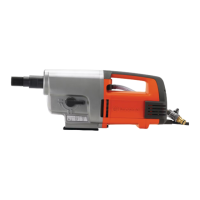
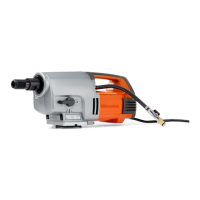
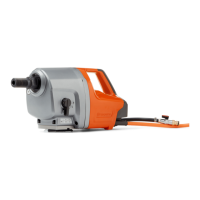
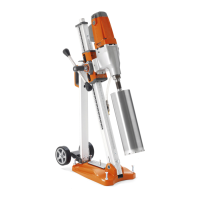
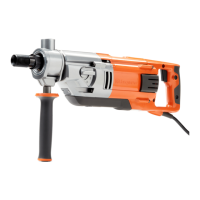
The Husqvarna DM 220 is a versatile drilling machine designed for both wet drilling with water cooling and dry drilling with dust extraction. It is primarily intended for professional use in construction and similar environments, offering robust construction and various features to enhance performance, safety, and ease of maintenance.

Function Description:

The DM 220's core function is drilling, facilitated by an electric motor that drives a spindle shaft through a multi-speed gear housing. The transmission system reduces the high speed of the electric motor to a lower speed suitable for the spindle shaft, with three gear selection positions controlled by a knob. An important safety feature is the slip clutch integrated into the intermediate shaft, which protects the operator in case of jamming. The machine also incorporates an electronic spirit level for guiding, a Softstart™ electronic current limiter for smoother starting, SmartStart® for reduced speed when the circuit breaker is pressed halfway, and Elgard™ as an electronic overload protection device.
Important Technical Specifications:

  • Power Supply: The machine is available in two versions, 110 V and 230 V, with corresponding wiring diagrams.
  • Gearbox Oil: Refilling volume is 0.25 liters. Recommended oil quality is Mobil Lube 1 SHC 75W-90, Shell Spirax ASX 75W-90, or equivalent.
  • Slip Clutch Torque: The slip clutch must have a slipping torque of at least 16 Nm (12 lbf·ft). If the value is not reached, the spring and friction washers must be replaced.
  • Carbon Brush Wear Limit: Carbon brushes should be replaced when the distance from the brush holder to the top level of the brush exceeds 10 mm (0.4 in).
  • Rotor Inductance (Typical): Approximately 12 mH. Values below 9 mH indicate a defective winding.
  • Stator Inductance (Typical): Approximately 60 mH. Values below 45 mH indicate an unusable stator, and below 6 mH, a defective stator.
  • Stator Resistance (Typical): Approximately 1.6 – 1.8 ohm.
  • Circuit Breaker Resistance (Smartstart™): Non-activated: approximately 220 kOhm; Fully pressed: 0 Ohm.
  • Spindle Shaft Worm Gear Height: 15.5 mm above the gear box cover when fully seated.

Usage Features:

  • Water/Dust Unit: The casing is rotatable with the front handle, allowing connection of either a water hose for cooling or a sleeve for dust extraction. This adaptability makes the DM 220 suitable for various drilling conditions.
  • Electronic Spirit Level: An integrated electronic spirit level with five LEDs indicates the machine's angle, aiding in precise drilling.
  • Ergonomic Design: The machine features a rear handle and a front handle for comfortable and secure operation.
  • Stand Mount: The DM 220 includes a stand mount, which can be removed for service.
  • Gear Selection: Three gear selection positions allow the operator to choose the appropriate speed for different drilling tasks. Gear changes should only be made when the motor is idle.
  • Safety Features: Earth fault breaker, circuit breaker with lock, Softstart™ for smooth starts, SmartStart® for controlled low-speed operation, and Elgard™ for overload protection enhance user safety and machine longevity.

Maintenance Features:

  • Modular Design: The machine is designed for easy dismantling into basic modules (water/dust unit, gear housing, electric motor), simplifying service and repair.
  • Accessible Components: Inspection covers for carbon brushes and easily removable handle halves provide access to internal components.
  • Seal Replacement: The casing seals (O-rings) can be replaced from the outside. The seal cylinder between the spindle shaft and gear housing requires removal of the spindle shaft.
  • Gearbox Oil Drain: A drain plug allows for easy draining of gearbox oil.
  • Carbon Brush Inspection and Replacement: Carbon brushes are wear parts that should be checked regularly (weekly for daily use) and replaced when worn beyond the 10 mm limit. They are easily accessible via an inspection cover.
  • Bearing Replacement: The manual provides detailed procedures for replacing various bearings (spindle shaft, needle, ball bearings) using specialized tools like pullers and presses.
  • Slip Clutch Adjustment: The slip clutch can be adjusted to ensure the correct slipping torque, requiring a special socket and torque wrench.
  • Rotor and Stator Testing: The manual outlines functional tests for the rotor and stator, including inductance and resistance measurements, to diagnose winding issues.
  • Circuit Board Diagnostics: While functional tests of the circuit board require specialized expertise, the manual suggests checking other components (stator, rotor, cables, contacts) first before replacing the circuit board.
  • Cable Management: Emphasis is placed on careful cable routing during reassembly to prevent damage.
  • Special Tools: A list of available Husqvarna tools and recommended third-party tools (e.g., lock ring pliers, counter stay devices, multimeters) is provided to facilitate maintenance.

Husqvarna DM220 Specifications

General IconGeneral
BrandHusqvarna
ModelDM220
CategoryDrill
LanguageEnglish

Related product manuals