Installation Manual 5.1.2
16
7.0 Open Loop Systems
A well of sufficient capacity and good water quality are
the only acceptable water sources for Open loop
Systems.
Caution: To prevent unreliable operation and
component damage, do not pump pond or lake water
directly through the units.
7.1 Open Loop System Plumbing
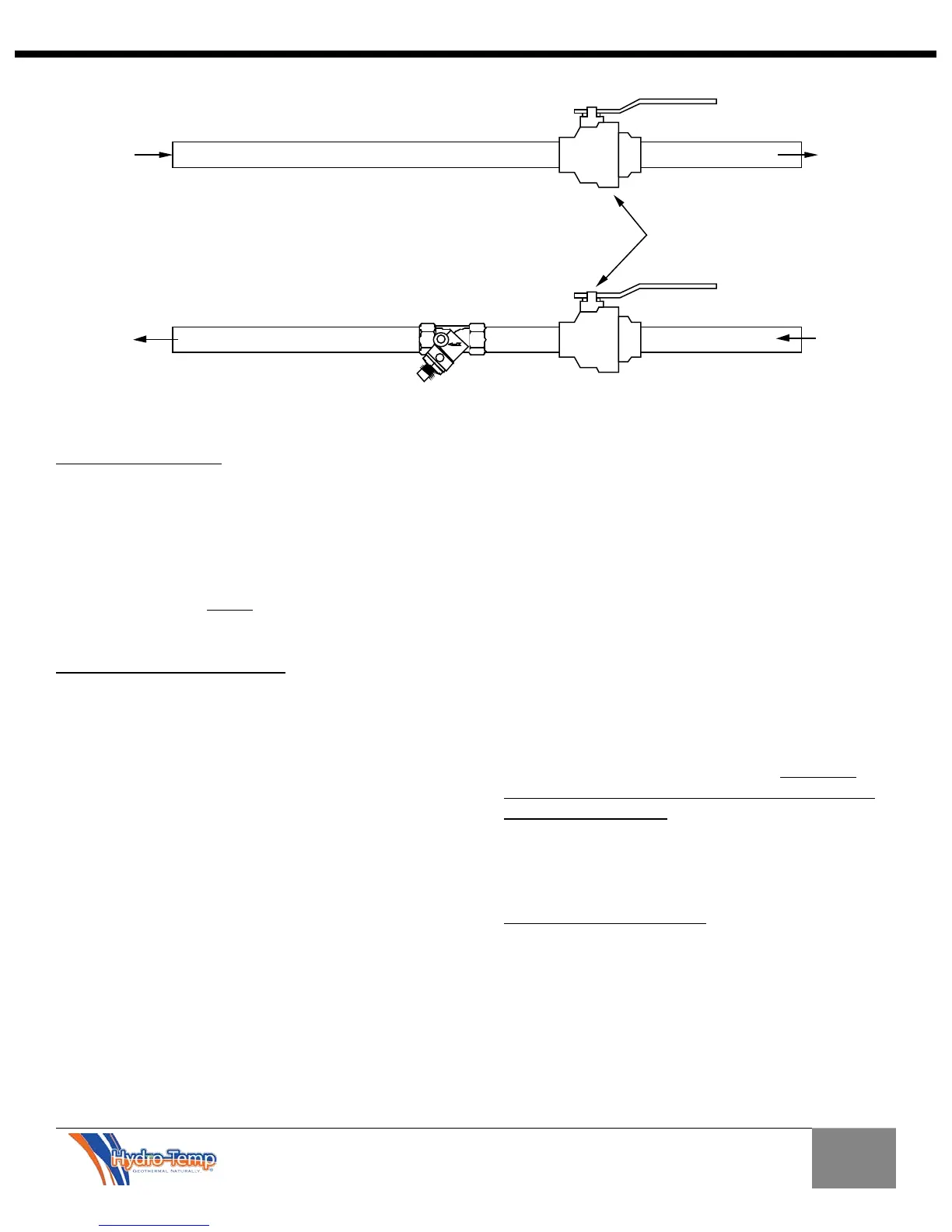
Assemble well water components in the same order as
shown in fig. 7.1. A 18 to 20 mesh strainer is
recommended. Use a water strainer to keep debris out
of water regulating valves and heat exchanger. Ensure
strainer is situated to provide easy access and
maintenance. Provide isolation valves and instruct end
user on how to isolate the system and clean strainer.
Some wells have excess debris which can restrict the
unit’s strainer in a short period of time. If this is the
case replace the existing strainer with a larger capacity
18-20 mesh strainer. A strainer with more surface area
will have to be cleaned less often.
Ensure the water flows through the unit and out the
discharge with no leaks.
Discharge water should run outside with no restrictions,
to a discharge well, creek, pond or where ever water is
needed. Never connect the discharge water line
directly to a sprinkler as this will restrict the water flow
and lower the unit’s efficiently, and possible cause
damage to the unit. Check local state and county codes
for proper discharge of water. Discharge tubing must
be prepared in a manner that will not freeze.
Normally 1 to 2.5 US G.P.M. per heating or cooling ton
(in high speed) is required for open loop systems.
Water flow is regulated with pressure regulated water
control valves. On all well water systems a Belimo
motorized water valve is also provided to turn off the
water flow when the unit shuts down. In installations
where the groundwater temperature is expected to fall
below 50°F during any part of the heating season,
perform a calculation to anticipate higher flow rate
requirements. A higher water flow rate results in a
lower temperature drop through the liquid to
refrigerant heat exchanger. This prevents the Freeze
stat from activating unnecessarily. The Freeze stat
helps protect the liquid to refrigerant heat exchanger
from freezing internally. Freeze protection is
accomplished by measuring the refrigerant temperature
exiting the water coil in the heating mode. If this
temperature drops below the freeze set point the
system will activate the freeze / defrost routine then
lock out until manually reset.
T
o Unit
From Unit
To Discharge
From Well
Ball Valve
Strainer
Figure 7.1 Typical Open loop plumbing Components


 To Next Page