
 Need help?
Do you have a question about the IAME GR-3 040/EM/12 and is the answer not in the manual?
Details on piston replacement criteria and cylinder bore matching for optimal clearance.
Details replacement intervals for conrods, big end cage, crankpin, and washers based on fuel consumption and ovalization.
Standard configuration details for the Dellorto PHBG 18 carburetor.
Example racing setup for the Dellorto PHBG 18 carburetor.
Diagram illustrating fuel pump connections, including inlet and breather.
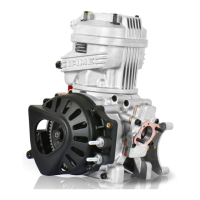
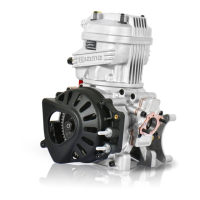
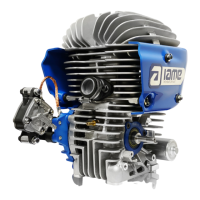
The IAME GR-3 - 040/EM/12 - 60cc is a kart engine designed for competitive racing, emphasizing performance, reliability, and ease of maintenance. It is a two-stroke engine that requires a specific fuel mixture and careful setup to achieve optimal performance on the track.
The primary function of the IAME GR-3 - 040/EM/12 - 60cc engine is to provide propulsion for a racing kart. It operates on a two-stroke cycle, which is common in karting for its high power-to-weight ratio. The engine's design incorporates a digital ignition system, ensuring precise spark timing for efficient combustion and power delivery. The carburettor system is responsible for mixing fuel and air in the correct proportions, which is crucial for the engine's performance across various RPM ranges. The engine is designed to be mounted onto a kart chassis, with specific mounting dimensions provided to ensure proper fitment and alignment.
Fueling: The engine requires a specific fuel mixture for operation. It runs on 98 RON fuel mixed with 4% CIK homologated motor oil. This precise mixture is vital for the engine's lubrication and combustion efficiency, directly impacting its performance and longevity. Recommended oil brands include WLADOIL K 2T, ELF HTX 909, ELF HTX 976, and EXCED RSK M, all of which are CIK homologated, ensuring they meet the stringent standards for kart racing.
Engine Mounting: To integrate the engine with a kart chassis, specific holes must be drilled into the motor mount. Detailed dimensions (102mm length, 80mm width, 15x26mm bolt pattern, and ⌀8.25±0.5mm holes) are provided to guide this process, ensuring secure and accurate installation. The design also accounts for angular adjustments (3° and 4°) and specific bolt sizes (M8 x 1.25) for the mounting hardware, highlighting the precision required for optimal setup.
Electric System: The engine is equipped with a homologated digital ignition system. A critical aspect of its setup is the ignition advance, which must be set to 2.60mm before Top Dead Center (TDC), corresponding to 26° of crank angle. The spark point is determined by aligning markings on both the rotor and stator, ensuring accurate ignition timing. A crucial detail for the electrical system's reliability is the ground connection between the coil's steel body and a specific screw on the clutch cover, which must be carefully secured to prevent electrical issues. The system also includes a stop and start switch for operational control.
Carburettor Setting: The engine utilizes a DELLORTO PHBG 18 carburettor, which comes with a standard factory setup. This setup includes specific components like the conical needle (W23 - 2nd notch from top), gas throttle (40), atomizer (AU 262), maximum jet (68), idle jet (60), starter jet (60), and idle mixture screw (1 turn). Users can adjust these settings based on track conditions and weather to optimize engine performance. The idle RPM can be fine-tuned using the "M" screw: turning it counter-clockwise decreases RPM, while turning it clockwise increases it. An example racing setup is also provided, suggesting alternative components like a W1 conical needle, 50 gas throttle, 64 maximum jet, 65 minimum jet, and 2 turns for the idle mixture screw, demonstrating the flexibility in tuning for different racing scenarios.
Fuel Pump Connections: The fuel system includes a fuel pump with specific connections. The "Inlet" connects to the fuel tank, drawing fuel into the pump. The "Breather" connects to the crankcase, allowing for pressure equalization. The "Delivery to carburettor" line supplies fuel to the carburettor, and this particular setup is designed without a fuel return to the tank, simplifying the fuel system.
Piston/Cylinder Matching: Regular inspection and replacement of the piston are essential for maintaining engine performance. The piston should be replaced when the measured clearance exceeds 0.11mm. As a general guideline, replacement is recommended after approximately 60 litres of fuel consumption. The piston's top surface indicates the cylinder bore diameter for proper installation. New pistons come with a prescribed clearance of 0.07-0.08mm. This clearance is achieved by honing the cylinder to the diameter marked on the piston top (for green selection) or by adding 0.01mm to that diameter (for red selection). The effective piston diameter can be verified by measuring perpendicularly to the piston pin, 15mm from the piston base.
Piston Ring Gap: The gap between the piston ring tips, when installed in the cylinder, must be within 0.05±0.15mm. This gap is critical for proper sealing and can be checked using a feeler gauge.
Main Bearings: The roller bearings are designed to last for a full sporting season, indicating their durability under racing conditions.
Conrod Big End Cage, Crankpin, and Washers: These components require replacement after approximately 120 litres of fuel consumption. This interval ensures that critical moving parts are refreshed before they can significantly degrade performance or cause failure.
Conrod Small End Cage: Similar to the big end components, the conrod small end cage should be replaced after approximately 120 litres of fuel consumption, maintaining the integrity of the connecting rod assembly.
Conrod: The connecting rod itself should be replaced if the ovalization of its big end bore exceeds 0.01mm. This ovalization is determined by measuring the difference between diameters at points "A" and "B" on the conrod. A general recommendation for conrod replacement is after approximately 240 litres of fuel consumption, ensuring the structural integrity of this highly stressed component.
Axial Shaft Clearance (End Float): The axial shaft clearance, or end float, must be maintained within 0.40-0.50mm. This clearance is important for the smooth operation of the crankshaft and to prevent excessive wear.
Spark Plug: The manual specifies different spark plugs for varying weather conditions. For standard weather, an NGK BR 10 EG spark plug is recommended. For rain conditions, an NGK BR 9 EG spark plug is advised. This distinction highlights the importance of adapting components to environmental factors for optimal engine performance and reliability.
 General
| Manufacturer | IAME |
|---|---|
| Model | GR-3 040/EM/12 |
| Ignition | Electronic |
| Type | 2-stroke |
| Cooling System | Air-cooled |
| Starter | Pull start |



 To Next Page