Need help?
Do you have a question about the iCharger 406DUO and is the answer not in the manual?
Essential safety guidelines and precautions for operating the iCharger 406DUO device.
Highlights the advanced features and technologies incorporated into the iCharger 406DUO model.
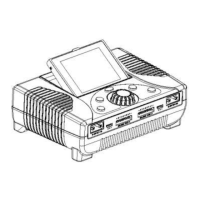
Details the physical dimensions and specifications of the iCharger 406DUO unit.
Provides comprehensive technical specifications, including input/output ranges and power capacities.
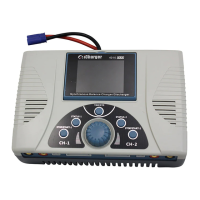
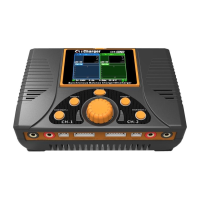
Identifies and explains the various parts and interface elements of the iCharger 406DUO.
Details the functions of buttons and the meaning of icons on the iCharger 406DUO interface.
Lists and describes the standard accessories included with the iCharger 406DUO charger.
Lists and describes optional accessories available for purchase to enhance iCharger 406DUO functionality.
Emphasizes the critical safety rule of not connecting the power input ground to the output ground.
Outlines the correct sequence for connecting power and battery to the iCharger 406DUO.
Provides essential notes and rules for connecting batteries to the dual channels of the charger.
Explains how to configure and use the synchronous mode for dual-channel operation.
Guides users on configuring the power supply source for the iCharger 406DUO.
Explains how to add, edit, and manage battery charge/discharge programs.
Details the process of selecting and running a charge or discharge program on the charger.
Describes how to monitor the real-time status and data during program execution.
Lists and explains potential error messages and their corresponding solutions.
Provides instructions on how to edit existing charge/discharge programs in the charger's memory.
Accesses the main charger setup menu for various operational parameters.
Configures temperature monitoring and fan speed settings for optimal operation.
Customizes the audible alerts and beep tones for different events.
Adjusts the brightness and contrast of the charger's LCD screen.
Sets the power limits for individual channels and manages power distribution.
Configures the power supply source and its voltage/current limits.
Manages saving and loading charger configuration settings to/from an SD card.
Configures serial or USB communication ports for data transfer and control.
Selects the user interface language, offering English and German options.
Guides through the process of calibrating the charger for accurate measurements.
Accesses additional features like log file management and servo testing.
Details how to perform pulse measurement using the J2 port for signal analysis.
Step-by-step guide for upgrading the charger's firmware using a USB connection.
Instructions for updating the charger's firmware using an SD card.
Details the steps to establish communication between the charger and Logview software.
Guides on starting and configuring the Logview software for data monitoring.
Explains the charging principle behind the Reflex Charge Mode for NiMH and NiCd batteries.
Describes how the charger utilizes power regenerative mode to recover energy during discharge.
Explains the feature of transferring regenerative energy between charger channels.
Details how to expand discharge capacity using external resistance for lithium batteries.
Provides a reference for status indications during channel operation.
Lists and explains status indications related to channel control parameters.
A comprehensive list of error codes and their descriptions for troubleshooting.
 General
| Discharge Power per Channel | 50W |
|---|---|
| Maximum Discharge Power | 100W |
| Max Charge Current per Channel | 40A |
| Battery Types Supported | LiPo, LiIo, LiFe, NiCd, NiMH, Pb |
| Pb Battery Voltage | 2-24V |
| Balancing Current | 1.2A |
| USB Port | Yes |
| Maximum Regenerative Discharge Power | 1400W |
| Charge Current Range | 0.1-40A |
| Discharge Current Range | 0.1-20A |
| Cell Count | 1-6 |
| Display | LCD |
| LiPo/LiIo/LiFe Cell Count | 1-6 series |

 To Next Page