
 Need help?
Do you have a question about the Ideal Boilers INSTINCT 24 and is the answer not in the manual?
Legal and safety requirements for installation and use.
Electrical specifications and safety requirements for the appliance.
Crucial operational precautions and safety warnings for users.
Step-by-step instructions for initial boiler startup and operation.
Explanation of the preheat function for faster hot water delivery.
How to adjust domestic hot water and central heating temperatures.
Tips for optimizing boiler efficiency and reducing gas consumption.
How to use weather compensation for automatic room temperature control.
Information on the boiler's frost protection feature and how it works.
Procedure for resetting the boiler after a fault or lockout.
Instructions on how to turn off the main power supply to the boiler.
Instructions for identifying and clearing frozen condensate pipe blockages.
Information on the boiler's self-check pump operation.
Required space around the boiler for installation and servicing.
Emergency procedure to follow if a gas leak is suspected.
Guidance on how to clean the boiler casing and components.
Recommended servicing schedule and who should perform it.
Instructions for setting the correct time on the 24-hour timer.
How to set ON/OFF periods for heating and hot water control.
How to operate the timer manually (ON/OFF or TIMED).
Guide to diagnosing and resolving common boiler operational issues.
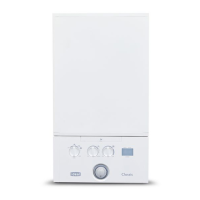
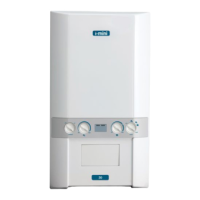
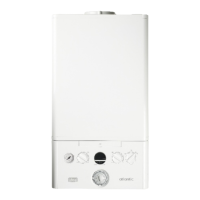
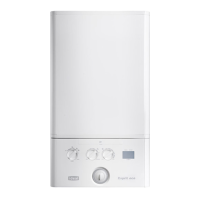
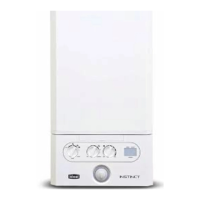
This document is a user manual for the Ideal Instinct combination boiler, which provides both central heating and instantaneous domestic hot water. The boiler features a full-sequence automatic ignition and fan-assisted combustion system. Due to its high efficiency, it produces condensate from flue gases, which is drained through a plastic waste pipe at the base of the boiler. A condensate 'plume' may also be visible at the flue terminal.
The manual emphasizes that the boiler must be installed by a Gas Safe Registered Engineer in the UK, or a Registered Gas Installer (RGII) in Ireland, in accordance with current regulations. It is crucial to follow the instructions strictly for safe and economical operation. The appliance must be earthed, and the electricity supply should be 230 V ~ 50 Hz with a 3A fuse. The boiler must not be operated without its casing correctly fitted and forming an adequate seal. If installed in a compartment, the compartment must not be used for storage. If a fault is suspected, the boiler must not be used until it has been corrected by a qualified engineer. Tampering with sealed components is strictly prohibited. The appliance can be used by children aged 8 years and above, and by persons with reduced physical, sensory or mental capabilities, or lack of experience and knowledge, provided they receive supervision or instruction concerning safe use and understand the hazards involved. Children should not play with the appliance, and cleaning or user maintenance should not be performed by children without supervision.
To start the boiler, users need to ensure the electricity supply is off, set the mode knob to 'off', and set both the Domestic Hot Water and Central Heating temperature knobs to 'max'. All hot water taps must be turned off. After switching on the electricity and external controls (timer, room thermostat), the mode knob should be set to the 'winter' position. The boiler will then commence its ignition sequence, supplying heat to the central heating if required. The boiler status display shows various codes: 'Standby' (no demand), 'Central Heating being supplied', 'Domestic hot water being supplied', 'P' (domestic hot water preheat), and 'F' (boiler frost protection). The burner on indicator illuminates when the burner is lit. If the boiler fails to light after five attempts, a fault code 'L-2' will be displayed.
For winter conditions (central heating and domestic hot water), the mode knob should be set to 'winter'. The boiler will fire, supplying heat to radiators and prioritizing domestic hot water on demand. The domestic hot water preheat will operate if enabled. For summer conditions (domestic hot water only), the mode knob should be set to 'summer', and the central heating demand on external controls set to OFF. The domestic hot water preheat will also operate if enabled. To turn the boiler off, the mode knob should be set to 'off', but the mains power supply must be left on to enable frost protection.
The boiler's domestic hot water heat exchanger can be preheated for faster hot water delivery. Preheat is enabled when the preheat indicator is lit. To switch preheat on or off, users should move the domestic hot water preheat knob fully clockwise and then return it to the desired temperature setting. The boiler will periodically operate for a few seconds to maintain the preheated condition, with an average interval of 90 minutes, which can vary based on ambient temperature. The boiler will also operate whenever there is a demand for domestic hot water. If standard hot water delivery is satisfactory, the knob can be turned to 'off'.
The domestic hot water temperature is limited to a maximum of 64°C, adjustable via the domestic hot water temperature knob. Approximate temperatures range from 40°C (104°F) at minimum to 64°C (147°F) at maximum. Flow rates and temperature rise may vary, requiring adjustment at the tap. For central heating, the boiler controls radiator temperature up to a maximum of 80°C, adjustable via the central heating temperature knob. Approximate temperatures range from 45°C (113°F) at minimum to 80°C (176°F) at maximum. For economy settings, users should refer to the "Efficient Heating System Operation" section.
The Ideal Instinct is a high-efficiency condensing appliance that automatically adjusts its output to match heat demand, reducing gas consumption. The boiler condenses water from flue gases most efficiently. To operate efficiently, users should turn the central heating temperature knob to the 'e' position or lower. In winter, it may be necessary to turn the knob towards 'max' for sufficient heating. Reducing the room thermostat setting by 1°C can reduce gas consumption by up to 10%.
If the weather compensation option is fitted, the central heating temperature knob becomes a method of controlling room temperature. Turning the knob clockwise increases room temperature, and anti-clockwise decreases it. Once the desired setting is achieved, the system will automatically maintain the room temperature for all outside weather conditions.
The boiler includes frost protection that operates in all modes, provided the power supply is on. If the water in the boiler falls below 5°C, frost protection activates to prevent freezing. This process does not guarantee protection for all other parts of the system. If a system frost thermostat is installed, the boiler must be set in 'winter' mode for the system frost protection to run. If no system frost protection is provided and frost is likely during a short absence, it is recommended to leave heating controls or the programmer on at a reduced temperature setting. For longer periods, the entire system should be drained.
To reset the boiler, as directed in the fault codes section, turn the mode knob to 'reset' position and immediately return it to the required setting. The boiler will repeat its ignition sequence. If it still fails to start, a Gas Safe Registered Engineer or RGII should be consulted.
To remove all power to the boiler, the mains power switch must be turned off.
The system pressure gauge indicates the central heating system pressure. If the pressure falls below the original 1-2 bar over time, it may indicate a water leak. In this event, the system should be repressurized. If unable to do so or if the pressure continues to drop, a Gas Safe Registered Engineer or RGII should be consulted. The boiler will not operate if the pressure reduces to less than 0.3 bar.
The appliance is fitted with a siphonic condensate trap system to reduce the risk of freezing. If the condensate pipe freezes, users should follow specific instructions. If not competent, a Gas Safe Registered installer should be called. If competent, users can apply a hot water bottle, microwaveable heat pack, or warm damp cloth to the frozen blockage area. Warm water can also be poured onto the pipe, but boiling water should not be used. Caution is advised when using warm water as it may freeze and cause other localized hazards. Once the blockage is removed, the appliance should be reset. If it fails to ignite, a Gas Safe Registered engineer should be called. For preventative solutions during cold weather, set the central heating temperature knob to maximum, place heating on continuous, and turn the room thermostat down to 15°C overnight or when unoccupied.
The boiler pump operates briefly as a self-check once every 24 hours. Minimum clearances for servicing are 165mm (6 1/2") above, 100mm (4") below, 2.5mm (1/8") at the sides, and 450mm (17 3/4") at the front of the boiler casing. Bottom clearance after installation can be reduced to 5mm with a removable panel to make the pressure gauge visible and provide the 100mm clearance for servicing.
Should a gas leak or fault be suspected, contact the National Gas Emergency Service without delay. Users must extinguish all naked flames, not operate electrical switches, and open all windows and doors.
For normal cleaning, simply dust with a dry cloth. For stubborn marks and stains, wipe with a damp cloth and finish with a dry cloth. Abrasive cleaning materials must not be used.
The appliance should be serviced at least once a year by a Gas Safe Registered Engineer or RGII.
The timer control allows users to set ON and OFF periods. To set up, rotate the outer dial clockwise until the current hour aligns with the arrow. The outer dial is printed with 24hr clock. Do not rotate the dial anti-clockwise. To program switching times, set tappets to the outer edge for ON periods and to the inner edge for OFF periods. Manual switch operation allows setting the timer to "TIMED" for timed operation, "MANUAL ON" for continuous operation, or "MANUAL OFF" for continuous off. If the boiler does not light in "timed on" or "manual on" position, increase the temperature on the room thermostat.
The manual provides a troubleshooting guide for common issues like "NO HOT WATER," "NO CENTRAL HEATING," or "NO HOT WATER OR CENTRAL HEATING." Users are advised to check mains power, mode knob settings, timer settings, and room thermostat. If issues persist, users are directed to the "Fault Codes" section or to contact Ideal Customer Services Helpline if under warranty, or a Gas Safe Registered Engineer/RGII if out of warranty.
The display codes indicate the boiler's current status:
The manual lists various fault codes and their corresponding actions:
For any queries, users are directed to ring the Ideal Instinct Consumer Helpline. The boiler reset procedure involves turning the mode control knob to the reset position and immediately turning it back to the required setting.
 General
| Boiler Type | Combi |
|---|---|
| Mounting | Wall-mounted |
| ERP Rating | A |
| CH Output (kW) | 24 |
| DHW Output (kW) | 24 |
| Output | 24 kW |
| Central Heating Flow Temperature Range | 30-80°C |
| Hot Water Flow Rate at 35°C Rise | 9.8 l/min |

 To Next Page