Page 18
Theory of Operation
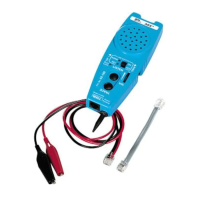
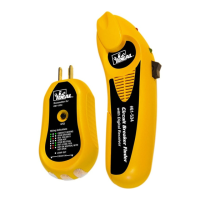
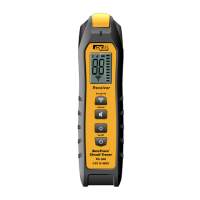
The tracer consists of a transmitter and a receiver.
The transmitter produces a unique signal onto the circuit
to be traced. The receiver detects this unique signal when placed in the proper orientation to
the wires being traced or breakers being identified. The receiver provides a numeric value and a
variable pitch/tone that increase as the signal becomes stronger.
The transmitter sends a 32.768 kilohertz, fixed-amplitude, time-modulated signal that injects a
voltage onto the circuit to be traced, which then induces an electromagnetic field onto the circuit.
Whether the circuit is open or closed greatly affects the strength of the electromagnetic field.
In an open circuit, no current can flow, so the electromagnetic field produced is much weaker.
However, in a closed circuit, the injected voltage induces a current flow, which produces a much
stronger electromagnetic field. This is the optimal method for tracing as this much stronger
signal allows the receiver to detect it from a greater distance away from the circuit being traced.
The 61-946 and 61-948 do not include the inductive clamp. We will add an updated version
of this paragraph once the clamp design and functionality is confirmed. That paragraph will be
included in the manual that covers the 61-950.
Here are some examples of Open/Closed Circuits:
Breaker
Energized
Breaker
Energized
Breaker
Energized
Light On
(Load)
Breaker
De-Energized
Closed Loop
Closed Loop Closed Loop
Closed Loop Open Loop
Open Loop Open Loop
Stronger
Stronger Stronger
Stronger
Weaker
Weaker Weaker


 To Next Page