Page 20
If unsure that the remote return path chosen is a good one, use a multimeter to measure the
resistance between the circuit neutral and the remote return path. If >100Ω, a different return path
should be selected.
Applications
Pre-test Operation
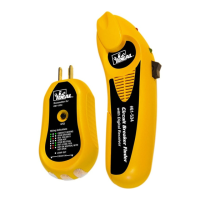
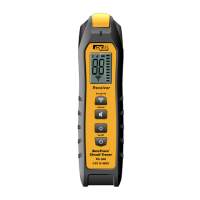
Prior to finding a breaker or tracing a circuit, it is good practice to test the receiver by holding it
near the powered transmitter or inductive clamp. A numeric indication of “99” and strong audible
sound ensures that it is working properly.
Locating Circuit Breakers and Fuses
Applications include identifying the breaker that protects the circuit under test, finding the correct
breaker to de-energize the circuit, and labeling a breaker panel.
1) Connect the transmitter to the circuit that needs to be identified and power it on. The
procedure is the same whether the circuit is energized or de-energized. But, a much
stronger signal is produced using an energized (closed) circuit.
2) Turn on the receiver and go to the panel.
a) If more than one panel exists, set the receiver to mode and touch the nose to each
panel cover until the panel with the strongest signal is identified. Should be set at max
sensitivity setting to start finding the panel.
b) If the receiver is detecting more than one panel with a strong signal, reduce the
sensitivity range and repeat the step above.
3) Open the panel cover, set the receiver to Breaker mode. The receiver should be
positioned on its side to orientate the antenna properly.
4) Orient the receiver 90° to the panel with the display facing sideways. Keep this orientation
as you scan all breakers on the panel. Slide the nose of the receiver down each breaker in
the panel. The breaker with the highest numeric reading is the correct breaker.
If two or more breakers have the same numeric values, tip the nose of the receiver up
and then down at 45º angles and note the numeric values on each of the questionable
breakers. Only the correct breaker will show a strong signal in all positions. Or,
pull the panel cover, and place the nose on each of the individual hot wires for a more
certain determination.
5) When the correct breaker is tripped (opened), the signal will drop significantly. And, the
will disappear from the receiver’s display. The LED on the transmitter will also turn off.


 To Next Page