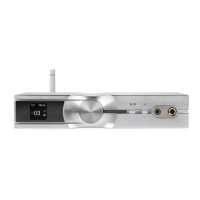
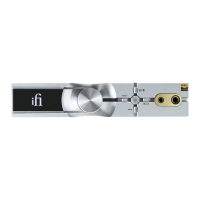
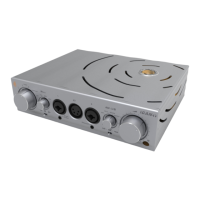
The Pro iCAN circuit is fully-balanced with completely equal circuit sections for Positive (Hot) and Negative (Cold) signal
phase of each channel. The Volume control is a 6-way motorized ALPS type, 4 Tracks are used to adjust the volume for the
balanced signal, the other two are used for monitoring the volume control operation.
Maximum Output is > 20V in balanced mode, > 10V in single ended mode, maximum peak current is 1.4A for
Single-Ended Headphone connections and 0.7A for Balanced Headphone connections. The continuous output current is
limited by protection circuitry that only engages in case of sustained overload. A short term sustained output of around
14,000mW (14 VA) is possible in Balanced operation.
The amplier audio circuit is a development of iFi’s revolutionary ‘TubeState’ design. It is fully discrete, fully-balanced with
either tube or J-FET input switchable, bipolar second stage and MOSFET-buered bipolar class A Power stage (with Class AB
for low impedance headphones at very high levels). The resulting circuit may be best described as ‘tri-brid’ where each
device is used to greatest sonic advantage while minimising any drawbacks. Furthermore, the circuit is pure DC coupled to
avoid using any sonically-degrading coupling capacitors.
Frequency response (0.5Hz -500kHz @ 0dB), noise (-142dB @ 0dB) and distortion (0.0008% @ 0dB) depend on gain and on
which input device is selected. However (generally speaking), the levels of noise and distortion, especially in balanced
operation challenge the limits of the Audio Precision test system.
The XLR and RCA outputs on the back oer full preamplier function, but are not switched o if headphones are connect-
ed. Nonetheless, the Pro iCAN should be used either as preamplier or headphone amplier, as generally a mixed use
setup is not recommended.
The Holographic matrices are tightly integrated into the signal circuit. Not only is there no use of DSP and the linked
AD/DA conversion, there are also no additional active elements.
If disabled, the passive elements (resistors, capacitors and inductors) that form the analogue matrix are completely
removed from the circuit, so the delity of the signal in ‘OFF’ remains unaected.
Design Notes from the AMR/iFi Research & Development department:
12


 To Next Page
 Loading...