Need help?
Do you have a question about the Immergas CAESAR 14 Star and is the answer not in the manual?
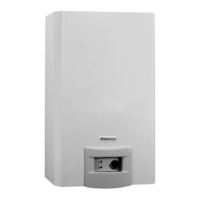
The IMMERGAS CAESAR Star is an instantaneous wall-hung room sealed fan-assisted water heater, designed for domestic hot water production. It features a compact size and is equipped with advanced control and safety systems.
The CAESAR Star operates as a room-sealed water heater, meaning combustion air is drawn from outside and exhaust gases are expelled externally, ensuring safety and preventing the release of combustion products into the living space. The electronic flame modulation system regulates the temperature, thanks to a microprocessor-controlled modulation board and flow and temperature sensors. It features a standard electronic burner ignition and a wet combustion chamber copper exchanger.
The device has a power output of 21,000 Kcal/h (24.4 kW), corresponding to a flow of 14 l/min with a ΔT 25°C. The CAESAR 14 Star model is specifically designed for connection to a broad range of couple-on aspiration and exhaust kits, which include silicone seals. A special cover kit is also available as an optional accessory. An important feature is its antifreeze safety device, which protects it against temperatures as low as -15°C.
Dimensions:
Connections:
Hydraulic Circuit Components:
Gas Circuit: The CAESAR Star utilizes an atmospheric burner and a modulating type valve for gas combustion and gas flow adjustment. The main coils are energized, allowing gas to flow towards the burner. The flow rate/outlet pressure is regulated by means of the gas valve stabilizer and the modulation coil. The gas mixture is obtained by the spark from the ignition electrode.
Modulating Gas Valve (SIT 845): This valve features two main coils and a modulation coil, controlling the modulation board. The maximum and minimum outlet pressure settings can be made on this valve.
Main Electrical Coils: Two coils of the ON-OFF type (230V AC) are energized by the adjustment board when the burner has to be ignited. These are electrically connected in parallel and energized by mains power through a special connector.
Modulation Coil: This is a low-voltage coil controlled by the modulation board. It controls the gas valve stabilizer and permits changing the outlet pressure in a way proportionate to the DC signal that runs through it.
Gas Adjustments: Max and minimum gas pressure adjustments can be made by means of the gas valve, with tables provided for corresponding gas types. Measurements are made using a U-shaped differential pressure gauge connected to a "Y" to be placed between the small silicone tube connecting the gas valve to the sealed chamber and to the gas valve outlet pressure point.
Valve Sit 845:
Fume Circuit: The products of combustion, after investing the water-gas exchanger, are conveyed to a draught diverter (5), on top of which the fume extractor (fan) (1) is fitted. This fan creates a vacuum in the sealed chamber, allowing combustion air to be extracted from outside. Correct fume extraction is controlled by a special pressure switch (4), located on top of the sealed chamber. This switch causes a microswitch (S3) to close, affecting the adjustment board and enabling or preventing burner ignition.
Fan (1): The extractor operates downstream of the combustion chamber and is fitted vertically in the top part of the draught diverter (5). It extracts the fumes and conveys them into the exhaust pipes.
Extraction and Exhaust Systems: The CAESAR Star is compatible with coupling extraction/exhaust ducts in sealed chamber fan-assisted configuration (type C) or, thanks to a special kit, in open chamber fan-assisted version (type B). Load losses relating to each accessory and the various possible configurations of the ducts must be fitted according to the length of the pipes. Accessories (bends, extensions, and end pieces) are joined by coupling and seal is provided by special silicone lip seals.
Open Chamber and Fan-Assisted (Type B22) Configuration: For installation outdoors in a partially protected area. Using a special cover (4) to be placed on the top part of the sealed chamber, the CAESAR Star appliance can be fitted in a partially protected place. This works in open chamber and fan-assisted (B22) configuration.
Extraction: To fit the cover (4), the two caps (1) that close the holes in the top part of the sealed chamber must be removed. The extraction of comburent air is done directly from the environment exploiting the free space between the lower part of the cover (4) and the upper part of the boiler.
Exhaust: The 80 mm diameter union to the exhaust ducts is obtained by means of a flange (3) used in doubled systems. The use of special accessories permits horizontal type (A) or vertical type (B) exhaust. To avoid condensation problems, the exhaust duct must be restricted to 5 metres for normal pipes and 12 metres for insulated pipes.
Sealed Chamber Fan-Assisted Configuration (Type C): Exhaust: Connection to the exhaust pipes is by means of a flange (1) to be fitted on the centre hole (6) on the top section of the sealed chamber, placing in between a special shaped seal (5). This flange differs according to whether the doubled or concentric system is used. In the former case, the duct for the combustion air (8) is closed while in the latter case it is used. To ensure correct boiler operation, a diaphragm (7) must be fitted on the exhaust pipe (6) between the flange and (1). Diaphragms are envisaged of different diameter which must be fitted according to the type of duct and its length.
Extraction: Using the doubled system, connection to the extraction ducts is done in the same way as for the exhaust pipes, linking up to one of the two holes with diameter 80 mm (2) on the top section of the sealed chamber. The hole which is not used is closed using one of the caps (3), placing in between the relevant seal (4) featured on the appliance. In coaxial pipes are used, extraction is done by exploiting the concentric hole outside the exhaust pipe (8).
Extraction and Exhaust Kits: The kits with the relevant accessories make it possible to use two concentric systems and a doubled system. As regards flow resistance relating to each accessory, the various possible combinations and use of the diaphragms to be installed according to the length of the ducts, see the instructions relating to the extraction and exhaust ends. The accessories (bends, extensions and end pieces) are connected by means of slot-in couplings and seal is ensured by means of silicone-lip seals.
Horizontal Concentric Slot-in Kit Ø 60/100: The exhaust pipe (Ø 60 mm) is fitted inside the extraction pipe (Ø 100 mm). Connection to the boiler is by means of a 90° (2) fully adjustable bend which, by means of the necessary extensions, must be connected to the extraction and exhaust end piece (3). The maximum overall length allowed beyond the first bend (2) is 3 straight horizontal metres.
Vertical Concentric Slot-in Kit Ø 60/100: The exhaust pipe (Ø 60 mm) is fitted inside the extraction pipe (Ø 100 mm). Connection to the boiler is by means of a flange (2) which, by means of the necessary extensions, must be connected to the extraction and exhaust end piece 60/100 (5) with aluminium tile. The maximum overall length allowed is 4.7 straight vertical metres.
Ø 80/80 Slot-in Separator Kit: The pipes both have a diameter of 80 mm. Connections to the boiler are by means of two special flanges for exhaust (4) from central union and extraction (3) from one of the two side holes. The maximum length allowed (extraction + exhaust) is 33 straight horizontal metres and 41 straight vertical metres. To avoid problems of condensation, the exhaust pipe should be restricted to a max of 5 m.
Operation: The CAESAR Star is fully controlled by an electronic modulation board which controls all generator functions and which are connected to the electrical devices of the appliance. The adjustment board provides means of LEDs, showing the operating condition of the appliance, indicating any tripping of safety devices.
Power On: Master switch (S4) in ON position.
Power Circuit Adjustment: The closing of master switch (S4) powers the modulating board and enables operation.
Detection of D.h.w. Request: Flow measuring device (B2) detects running of d.h.w.
Ignition Circuit Power: If the temperature of the d.h.w. is below that set, the adjustment circuit of the board powers the ignition circuit.
Exhaust Flue Pressure Switch Contact Control: The board determines the correct position of the exhaust flue pressure switch (contact normally open N.O.).
Power to Fan: The board powers the fan.
Exhaust Flue Pressure Switch Contact Control (following fan operation): The board determines the closing of the exhaust flue pressure switch following fan operation (contact normally closed N.C.).
Ignition Electrode Power: The ignition circuit of the board powers the ignition electrode (E1).
Gas Valve Coil Power: The board powers the gas valve coils (Y1) and sends the slow ignition signal to the modulating board.
Burner Ignition (slow ignition): The board conveys slow ignition power to the modulating board (Y2).
Flame Detection: By means of the ionisation electrode (E1) the unit detects burner ignition and ends the ignition cycle.
Appliance Working: The burner operates at a power that varies according to the adjustments made and the temperature and flow detected by the sensors.
Changing Type of Gas: Adaptation to a type of gas different to that for which the boiler is intended can be done by using the special kits (natural gas or LPG). The changeover consists in replacing the burner nozzles and in moving to the modulation board of the "NATURAL GAS- LPG (S1) bridge". The minimum and maximum pressures are then set on the gas valve in the way described above. The burner ignition pressure is not adjusted because the type of board operation does not require such setting.
Safety Devices and Controls:
Safety Devices:
Indicators:
 General
| Brand | Immergas |
|---|---|
| Model | CAESAR 14 Star |
| Category | Water Heater |
| Language | English |

 To Next Page