TR
SI
CZ
HU
RO
PL
RU
UA
SK
ES
IE
2
INSTRUCTIONS FOR USE
AND MAINTENANCE
2.1 CLEANING AND MAINTENANCE.
Important: the heating systems must undergo
periodical maintenance (regarding this, see in
the section dedicated to the technician, relative
to “yearly control and maintenance of the appli-
ance”) and regular checks of energy eciency
in compliance with national, regional or local
provisions in force.
is ensures that the optimal safety, performance
and operation characteristics of the boiler remain
unchanged over time.
We recommend stipulating a yearly cleaning
and maintenance contract with your zone
technician.
2.2 VENTILATION OF THE ROOMS.
In the room in which the boiler is installed it
is necessary that at least as much air ows as
that requested for by normal combustion of the
gas and ventilation of the room. e provisions
relative to ventilation, the ue pipes, chimneys
and caps are stated in Par. 1.6, 1.7 and 1.8. If
in doubt regarding correct ventilation, refer to
professional, qualied sta.
2.3 GENERAL WARNINGS.
Never expose the wall-mounted boiler to direct
vapours from a cooking surface.
Use of the boiler by unskilled persons or children
is strictly prohibited.
If temporary shutdown of the boiler is required,
proceed as follows:
a) drain the heating system if anti-freeze is not
used;
b) shut-off all electrical, water and gas sup-
plies.
In the case of work or maintenance to structures
located in the vicinity of ducting or devices for
ue extraction and relative accessories, switch
o the appliance and on completion of opera-
tions ensure that a qualied technician checks
eciency of the ducting or other devices.
Never clean the appliance or connected parts
with easily ammable substances.
Never leave containers or ammable substances
in the same environment as the appliance.
It is prohibited and dangerous to obstruct the air
intake, even partially, for the ventilation of the
room in which the boiler is installed.
Due to the danger, functioning is also prohibited
in the same room as suction devices, chimneys
or similar at the same time as the boiler unless
there are additional openings dimensioned in a
way to satisfy the further necessity for air. For the
dimensioning of these additional openings, refer
to qualied technical sta. In particular, an open
re must have its own air supply.
On the contrary, the boiler cannot be installed
in the same room.
• Important: the use of components that employ
electrical power requires some fundamental
rules to be observed:
- do not touch the appliance with wet or moist
parts of the body; do not touch when bare-
foot;
- never pull electrical cables or leave the ap-
pliance exposed to atmospheric agents (rain,
sunlight, etc.);
- the appliance power cable must not be re-
placed by the user;
- in the event of damage to the cable, switch o
the appliance and contact exclusively quali-
ed sta for replacement;
- if the appliance is not to be used for a certain
period, disconnect the main power switch.
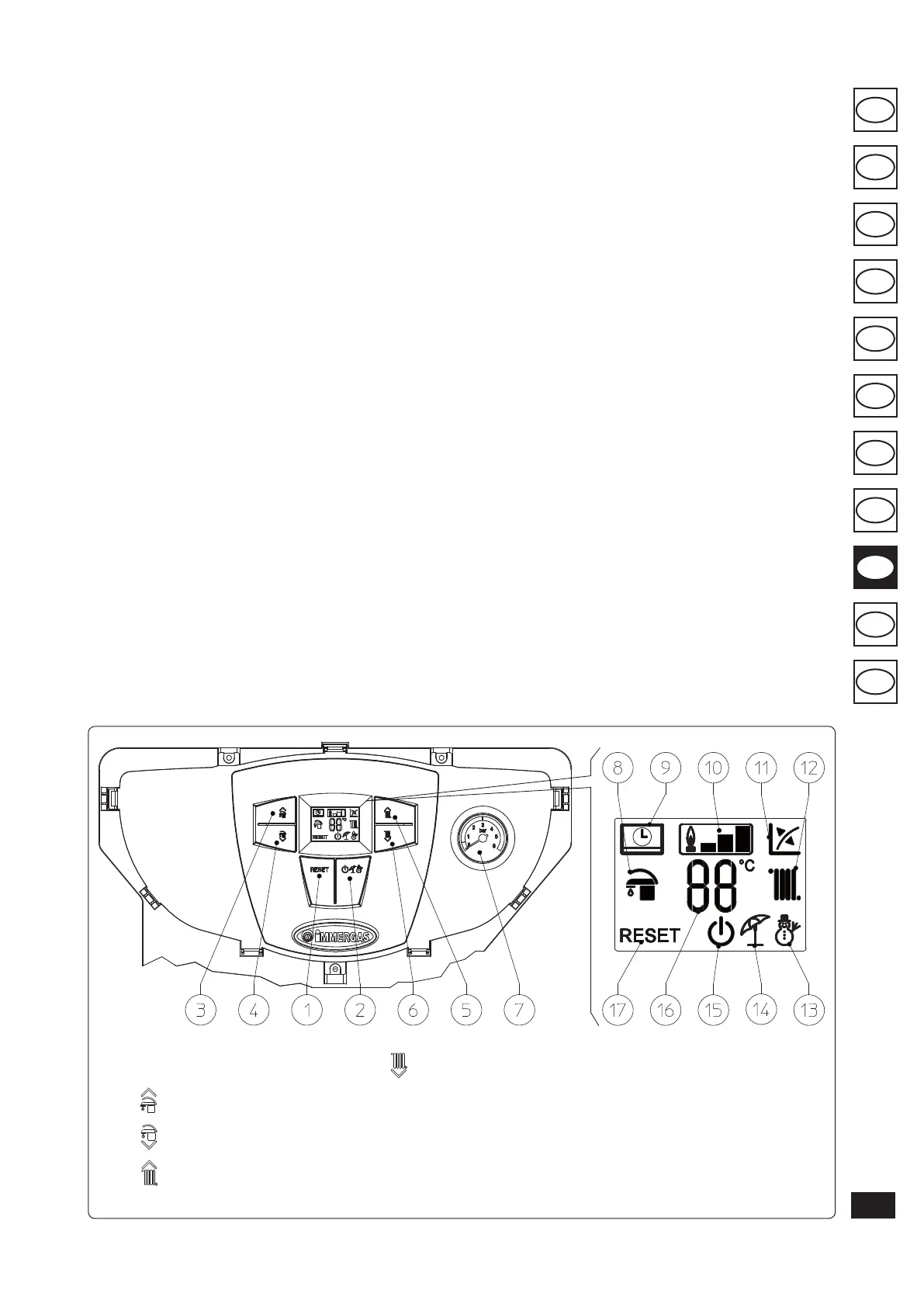
2.4 CONTROL PANEL.
Fig. 2-1
Key:
1 - Reset button
2 - Stand-by/O/Summer/Winter button
3 - ( ) button to increase
the domestic hot water temperature
4 - ( ) button to decrease
the domestic hot water temperature
5 - ( ) button to increase the system
water temperature
6 - ( ) button to reduce the system water
temperature
7 - Boiler manometer
8 - DHW production phase functioning*
active
9 - Boiler connected to remote control
(optional)
10 - Flame presence symbol and relative
power scale
11 - Functioning with external temperature
probe active (optional)
12 - Room central heating active phase
functioning
13 - Functioning in winter mode
14 - Functioning in summer mode
15 - Boiler in Stand-by mode
16 - Temperature and error code display
17 - Boiler in block does not require release
via “Reset” button


 To Next Page
 Loading...