EasyManua.ls Logo

Ingersoll-Rand 1000 - User Manual

Ingersoll-Rand 1000
32 pages
Print Icon
To Next Page IconTo Next Page
Loading...
80442791
Revision E
September 2012
Save These Instructions
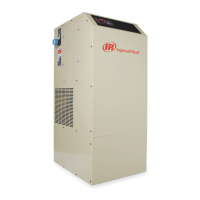
Nirvana Cycling Refrigerated Dryer
Models 1000-1600
Operators Manual
Manual Del Operador
ES
Manual do Operador
PT
Manuel De Lopérateur
FR
Operator’s Manual
EN
INTERNAL SALES ORDER# 81730430
DRYER PART NUMBER: NVC1000W400
PROJECT: Niagara Bottling,LLC_Kenosha, WI

Questions and Answers

  • A
    Aaron FosterAug 4, 2025
    Why is there a high pressure drop across my Ingersoll-Rand Dryer?
    • K
      Kelli SmithAug 5, 2025
      A high pressure drop across the dryer can occur for several reasons: * Ensure that both the inlet and outlet valves are completely open. * Blocked inlet and outlet filters can cause this issue, so change the filter elements. * A stuck compressor relay or contactor can be the problem. Replace the relay or contactor. * A bad Microprocessor Control relay can cause a high pressure drop. Replace the relay. * Inspect the probe and check readings against an independent source (e.g., temperature analyzer/pyrometer/ice bath) both in the exchanger well and to ambient if the probe is not completely in the thermal well.
  • J
    John WalkerAug 8, 2025
    How to troubleshoot a controller display malfunction on an Ingersoll-Rand Dryer?
    • L
      lbarnettAug 8, 2025
      If the controller display appears to be malfunctioning, try the following: * Check the fuses, as a blown fuse can cause this issue. * Inspect the probe cable and terminal connection. Replace the probe if it's loose, off connection, or defective. * Ensure the probe is completely in the thermal well, and check readings against an independent source (e.g. temperature analyzer/pyrometer/ice bath) both in temperature well and to ambient. * Replace the probe if it's defective. * Inspect the transducer cable and terminal connection if the transducer is loose, off connection, or defective. * Replace the transducer.
  • A
    Amanda ReillyAug 13, 2025
    What to do if the condensate drain does not fire on my Ingersoll-Rand Dryer?
    • M
      Matthew LeblancAug 13, 2025
      If the condensate drain isn't firing, consider the following: * Ensure the installation is in accordance with this manual, and revise the installation accordingly. * If the inlet/outlet pipe internal diameter is too small, causing an air-lock or back pressure, replace it with larger diameter piping. * Reduce the amount of bends and elbows if there is excessive use of them in the inlet/outlet pipe work, which may cause an air-lock or back pressure. * Reconfigure the condensate piping if the outlet pipe is too long or too high, causing back pressure. * Reroute the condensate to eliminate any secondary paths and install check valves as required if more than one condensate source is connected, providing an alternative path for condensate.
  • K
    Karen NelsonAug 17, 2025
    Why is there air bleeding from the condensate drain outlet port on my Ingersoll-Rand 1000 (Optional- No Air Loss Drain)?
    • A
      Angela HardingAug 17, 2025
      If you notice air bleeding from the condensate drain outlet port, it could be due to debris trapped under the seal or damage to the seal. Try pressing and holding the test button to clear any debris (the drain valve will open). If that doesn't work, replace the seal with a Service Kit.
  • L
    Linda RamirezAug 21, 2025
    What should I do if the condensate drain LED is off on my Ingersoll-Rand Dryer (Optional-No Air Loss Drain)?
    • N
      Natalie HumphreyAug 21, 2025
      Check the power supply. Press the test button for a minimum of 2 seconds and observe. Locate and eliminate any supply fault.
  • E
    erinbaileyAug 26, 2025
    What to do if the condensate drain bowl doesn't fill and the drain doesn't work due to air locking on my Ingersoll-Rand 1000 (Optional-No Air Loss Drain)?
    • C
      Chelsey LoveAug 27, 2025
      If the bottom inlet is used, the top port must be used as an air bleed. Connect the top inlet to a higher point in the system, which will function as an air bleed for the drain.
  • O
    ooneillOct 30, 2025
    What to do if there is moisture downstream from my Ingersoll-Rand Dryer?
    • B
      Brooke PopeOct 30, 2025
      If you're experiencing moisture downstream, here are a few things to check: * A defective service unit can cause condensate drain failure, so replace the service unit. * Excessive flow can be a problem, so check the inlet and outlet pressure and the system design capacity, and correct the cause of the excessive flow. * Ensure the dryer by-pass valve is completely closed. * Verify the dryer is receiving power by checking the power supply, fuses, and circuit breakers. * High suction pressure or the compressor may not be running, in which case you should check and clean the condenser. * A refrigerant leak could be the cause. If the suction pressure gauge reads 0 psig, turn off the dryer and contact your distributor. * If the compressor and fan are not running but the controller...

Summary

2.0 INTRODUCTION

3.0 WARRANTY

4.0 REFRIGERATED DRYER NOMENCLATURE

5.0 RECEIVING AND INSPECTION

5.1 UNPACKING

Proper procedures for unpacking the air dryer unit.

5.2 UNPACKING AND HANDLING

Guidelines for safe unpacking and handling of the dryer unit.

6.0 SAFETY AND OPERATION PRECAUTIONS

General Safety Precautions

Essential safety rules for operating and maintaining the air dryer.

Specific Warning Labels

Explains various warning labels and their meanings.

7.0 PRINCIPLES OF OPERATION

7.1 INTRODUCTION

Overview of the Nirvana Cycling dryers and their function.

7.2 AIR SYSTEM

Components of the dryer's air system and air flow.

7.3 MOISTURE REMOVAL SYSTEM

How the dryer removes moisture from the air.

7.3.1 SOLENOID DRAIN (STANDARD)

Operation and adjustment of the standard solenoid drain.

7.3.2 NO AIR LOSS DRAIN (OPTIONAL)

Operation of the optional zero-air-loss drain system.

7.4 REFRIGERATION SYSTEM

How the refrigeration circuit cools the air.

7.5 THERMAL MASS CIRCULATING SYSTEM

Function of the thermal mass fluid circulation.

7.6 CONTROLS

Explanation of the dryer's microprocessor control system.

7.6.1 BASIC USER INTERFACE

Overview of the control panel and keypad functions.

7.6.2 DISPLAY PARAMETERS

List and explanation of system parameters displayed.

7.6.3 DRYER SET POINTS AND ALARMS

User-adjustable set points and alarm configurations.

7.6.4 ADJUSTING SET POINTS

Step-by-step guide to adjusting dryer set points.

7.6.5 ALARMS AND THEIR FUNCTIONS

Descriptions and actions for various dryer alarms.

7.6.6 START MODES

Explains the three available dryer start modes.

8.0 INSTALLATION AND INITIAL START-UP

8.1 LOCATION AND MOUNTING

Guidelines for selecting the dryer's installation location.

8.2 PIPING AND VALVES

Instructions for connecting piping and valves.

8.3 FILTRATION

Importance and selection of pre-filters and post-filters.

8.4 ELECTRICAL CONNECTION

Procedures for making electrical connections.

8.5 INITIAL START-UP

Steps for preparing and starting the dryer for the first time.

8.5.1 START-UP SEQUENCE

Detailed sequence for initial dryer startup.

9.0 SCHEDULED MAINTENANCE

9.1 INTRODUCTION

Overview of maintenance requirements for the dryer.

9.2 REFRIGERANT CONDENSER

How to inspect and clean the refrigerant condenser.

9.3 CONDENSATE DISCHARGE SYSTEM

Maintenance of condensate removal systems.

9.3.1 SOLENOID DRAIN (STANDARD)

Monthly checks and cleaning of the solenoid drain.

9.3.2 NO AIR LOSS DRAIN (OPTIONAL)

Annual replacement and maintenance of the no-air-loss drain.

10.0 TECHNICIAN MODE

10.1 ENTERING TECHNICIAN MODE

Procedure to access protected technician settings.

10.2 ALARM LIST

Viewing and interpreting the dryer's alarm history.

11.0 TROUBLESHOOTING

11.1 INTRODUCTION

Guide to identifying and correcting dryer malfunctions.

11.2 PROBLEM; ACTION GUIDE

Table of common problems, symptoms, causes, and solutions.

12.0 WIRING DIAGRAMS

NVC1000-1600 AIR AND WATERCOOLED, NEMA-1

Wiring diagram for air and water-cooled models.

NVC1000-1600 A & 460 V;3;60, 440 V;3;50

Wiring diagram for specific models and voltages.

NVC1200-1600 A, NVC1000 W & NVC1600 W 575;3;60

Wiring diagram for specific models and voltages.

NVC1000 A & NVC1200 W 575;3;60

Wiring diagram for specific models and voltages.

13.0 GENERAL ARRANGEMENTS

NVC1000-1600 AIR AND WATERCOOLED, NEMA-1

Overall physical dimensions and connection points.

14.0 REPLACEMENT PARTS

Miscellaneous Parts

List of common replacement parts and their availability.

Parts for Air Cooled Dryers

Part numbers for air-cooled dryer components.

Parts for Water Cooled Dryers

Part numbers for water-cooled dryer components.

Miscellaneous Parts for NEMA 4 Dryers

Specific parts for NEMA 4 rated dryers.

Glycol Pumps, Autotransformers & Solenoids

Part numbers for pumps, transformers, and solenoids.

15.0 ENGINEERING SPECIFICATIONS

NVC1000 A, NVC1200 A, NVC1600 A

Technical specifications for air-cooled models.

NVC1000 W, NVC1200 W, NVC1600 W

Technical specifications for water-cooled models.

Ingersoll-Rand 1000 Specifications

General IconGeneral
Maximum Operating Pressure150 psig
TypeRefrigerated
Capacity1000 CFM
Power Supply460/3/60
Ambient Temperature Range40°F to 110°F

Related product manuals