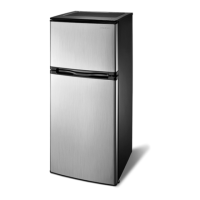
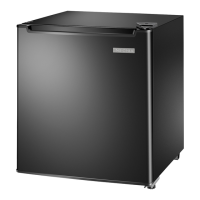
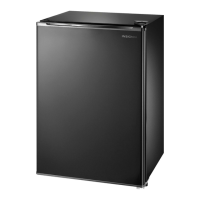
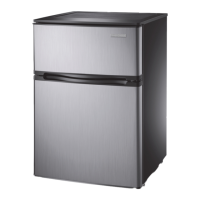
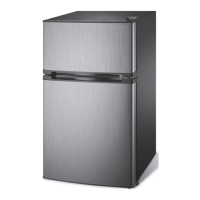
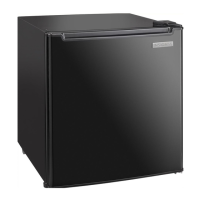
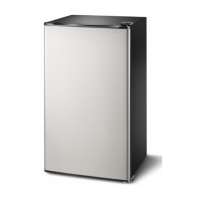
This document is a user guide for the Insignia 4.4 Cu. Ft. Glass Door Compact Refrigerator, models NS-CF44GD3 and NS-CF44GD3-C.
Function Description
The Insignia 4.4 Cu. Ft. Glass Door Compact Refrigerator is a freestanding appliance designed for storing food and beverages. It features a glass door and is suitable for various environments such as dorm rooms, offices, and garages. The refrigerator maintains internal temperatures between 32°F and 50°F (0°C and 10°C) and includes a manual defrost system. Its low-noise compressor operates at less than 40 dB, ensuring a quiet atmosphere. The appliance is equipped with interior lighting to easily view contents and adjustable shelves for flexible storage options.
Important Technical Specifications
- Storage Capacity: 4.4 cu ft (0.1 cu m)
- Temperature Range: 32° to 50° F (0° to 10° C)
- External Dimensions (H x W x D): 33 13/16 x 19 1/2 x 20 15/16 in. (86 x 49.5 x 53.1 cm)
- Internal Dimensions (H x W x D): 29 13/16 x 16 5/8 x 16 1/2 in. (75.7 x 42.2 x 42 cm)
- Weight:
- Gross: 66.1 lb. (30 kg)
- Net: 57.3 lb. (26 kg)
- Power Requirements: 115VAC~60Hz
- Current: 1.25A
- Annual Power Consumption: 228 kWh/year
- Power Cord Length: 5.4 ft. (1.65 m)
- Certifications: UL and Energy Star approved
- Compressor Noise Level: Less than 40 dB
- Shelves: 3 adjustable glass shelves
- Door: Reversible glass door with silver graphite finish
Usage Features
Installation:
- Placement: The refrigerator should be placed on a strong, level floor. It requires specific clearances: at least 7 15/16 in. (20.1 cm) on the sides, 3 15/16 in. (10 cm) at the back, and 11 13/16 in. (30 cm) at the top for proper air ventilation.
- Location Avoidance: Do not install on carpeting, in a garage, or outside. Avoid direct sunlight, heat sources (stove, heater, radiator), and moist areas. Ambient temperatures below 50°F (10°C) or above 109°F (43°C) can hinder performance.
- Leveling: The refrigerator must be level for correct operation. Leveling feet at the front can be adjusted by turning clockwise to raise or counter-clockwise to lower a side.
- Power Supply: Requires a 110V-120V, 60Hz grounded power supply with a three-prong plug. A 15-20 amp fused, grounded electrical supply is recommended. Do not use extension cords or ungrounded adapters.
- Door Reversal: The door is reversible, allowing for flexible placement. Tools required include a Phillips screwdriver, socket wrench (5/8 in.), putty knife or thin-blade screwdriver, and masking tape. The process involves removing hinges, lifting the door, moving the door bushing, reinstalling hinges on the opposite side, and ensuring the door is level for a proper seal.
- Initial Setup: After installation, let the refrigerator stand upright for approximately four hours before plugging it in to prevent cooling system malfunctions. Before storing food, allow it to run for four hours to reach the correct temperature.
Operation:
- Thermostat Control: The temperature is adjusted using a dial with settings between MIN (warmest) and MAX (coldest). The recommended setting for normal use is MED. Setting to OFF stops the cooling cycle but does not disconnect power.
- Restarting: If unplugged or power is lost, wait three to five minutes before restarting the refrigerator.
- Adjusting Shelves: Glass shelves are adjustable. To move a shelf, lift it and pull it out, then slide it into the desired position.
- Adjusting Door Racks: Door racks can be adjusted by removing all items, tapping the bottom of the rack until loose, removing it, and then pressing it into the new position until it clicks. Avoid placing too many heavy items in the door racks.
- Crisper: The crisper is designed to store fruits and vegetables, keeping them fresh and isolating flavors/odors. To remove, lift it with its glass cover and pull it out.
- Interior Light: The interior light bulb can be replaced by removing the light cover, unscrewing the old bulb counterclockwise, and installing a new one.
Maintenance Features
Cleaning:
- Exterior: Wipe the cabinet periodically with a mild detergent and warm water, then dry with a soft cloth. Avoid harsh cleaners, gasoline, benzine, thinner, or abrasive cleaners to prevent damage to the finish.
- Interior: Unplug the refrigerator and remove all food. Remove shelves, door racks, and the crisper. Clean all surfaces with a mild detergent and warm water, then rinse with a damp sponge or cloth. For a thorough clean, use a solution of one quart of lukewarm water to two tablespoons of baking soda.
- Door Gasket (Seal): Keep the door gasket clean to ensure efficient operation.
- Drying: Dry all surfaces and removable parts before reinstalling them and plugging the refrigerator back in.
Defrosting:
- Process: Turn off and unplug the refrigerator. Remove all food and place it in a cool area to prevent spoilage. Allow the refrigerator/freezer to warm naturally, or use hot water to speed up the process, using a plastic or wooden spoon/spatula to remove frost.
- Cleaning After Defrost: Wash the interior with a baking soda solution (one quart lukewarm water to two tablespoons baking soda), then rinse. Clean the compressor compartment and water drain tray.
- Restart: After defrosting and cleaning, replace food, close doors, and turn on power.
Long Vacations (Several Months):
- Turn off and unplug the refrigerator.
- Remove all food.
- Clean the interior thoroughly.
- Leave the door slightly open to prevent condensation, mold, or odors. Exercise extreme caution with children to ensure they cannot access the refrigerator.
Moving the Refrigerator:
- Turn off and unplug the unit.
- Remove all food.
- Securely tape down all loose items inside.
- Tape the door shut.
- Keep the refrigerator in an upright position during transportation.
Energy Saving Tips:
- Place the refrigerator in the coolest area of the room, away from heat sources and direct sunlight.
- Allow hot foods to cool before placing them inside.
- Wrap foods correctly and wipe containers dry to reduce frost buildup.
- Organize and label food to minimize door openings and search times.
- Avoid lining shelves with aluminum foil, wax paper, or paper toweling, as this interferes with cold air circulation.
- Limit the number of times the door is opened.
- Do not block air vents with food to ensure even cold air circulation.
- Do not store food near temperature controls.
- Avoid overfilling door racks to ensure the door closes fully.
Food Storage Tips:
- Store cooked meats above raw meats to prevent bacterial transfer.
- Cover raw meat with cling film or foil on a plate large enough to collect juices.
- Leave space around food for cold air circulation.
- Wrap or cover each food item separately to prevent flavor transfer and drying out, except for fruits and vegetables which should be stored in the crisper.
- Do not store foods that spoil quickly at low temperatures, such as bananas or melons.
- Use containers with lids to prevent moisture evaporation and preserve taste/nutrients.


 To Next Page
 General