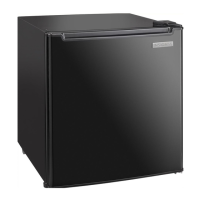
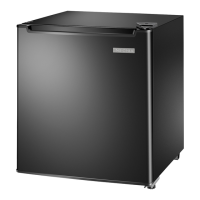
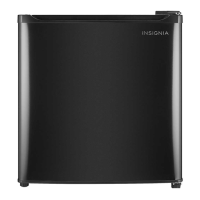
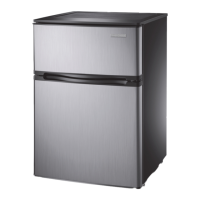
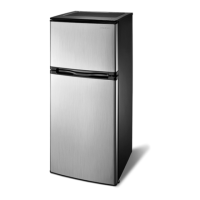
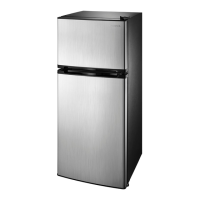
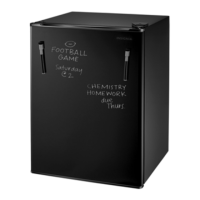
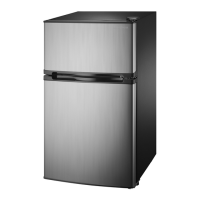
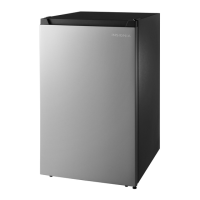
This document is a user guide for the Insignia 3.3 Cu. Ft. 12 Volt Compact Refrigerator, model NS-CF12V33BK1. It provides essential information for installation, operation, maintenance, and troubleshooting of the appliance.
Function Description:
The Insignia 3.3 Cu. Ft. 12 Volt Compact Refrigerator is designed for household and similar applications, including staff kitchen areas, farmhouses, hotels, motels, bed & breakfast establishments, and other residential or non-retail environments. It operates on a 12-volt DC power supply and is intended for cooling and storing food items. The refrigerator features a compact design, adjustable shelves, a crisper compartment, and bottle/can storage. It is not designed for recessed installation or for use with AC voltage circuits or AC outlets of an inverter.
Important Technical Specifications:
- Model: NS-CF12V33BK1
- Capacity: 3.3 Cu. Ft.
- Power Source: 12 Volt DC
- Dimensions (H x W x D): 32.7 x 19.1 x 18.5 inches (83 cm x 48.5 cm x 47 cm)
- Weight: 50.7 lbs (23 kg)
- Temperature Range: 32° ~ 46.4° F (0° ~ 8° C)
- Current: 9 A
- Refrigerant Type: R134a
- Power Supply Requirement: A 12 volt DC, 15-20-amp fused, grounded electrical supply is required. The refrigerator should be connected to its own individual electrical branch leading directly to the main DC voltage source or distribution panel.
- Minimum Space Requirements: Allow 1 inch (2.5 cm) of space between the back and sides of the refrigerator and any surrounding walls for proper air ventilation. The door should protrude at least 1 inch (2.5 cm) beyond surrounding cabinets.
Usage Features:
- Thermostat Control: The refrigerator features a thermostat control knob with settings from 0 to 7. Setting 0 turns off the cooling cycle (but not the power). Setting 7 provides the coolest temperature, while setting 1 is less cool. Setting 4 is recommended for home or office use.
- Initial Setup: Before first use, remove all packing, let the refrigerator stand upright for approximately four hours, and clean the interior.
- Door Reversal: The door position can be reversed, allowing for left or right-hand opening, to accommodate different installation needs. This process requires specific tools (10 mm nut driver, Phillips screwdriver) and involves removing and reattaching hinges and leveling feet.
- Leveling: The refrigerator must be level for correct function. Leveling feet can be adjusted by turning them clockwise to raise a side or counter-clockwise to lower it.
- Food Storage: The interior includes adjustable shelves, a bottom shelf, a crisper compartment, and bottle/can storage to organize food items.
- Energy Saving Tips:
- Allow hot foods to cool before placing them in the refrigerator.
- Avoid overloading the refrigerator.
- Wrap foods correctly and wipe containers dry to reduce frost build-up.
- Organize and label food to minimize door openings and search times.
Maintenance Features:
- Cleaning:
- Periodically wipe the exterior with a mild detergent and warm water, then dry with a soft cloth.
- To clean the interior, disconnect power, remove all food, and wash with a damp warm cloth soaked in a solution of one quart of lukewarm water to two tablespoons of baking soda.
- Keep the door gasket (seal) clean for efficient operation.
- Dry the interior and exterior with a soft cloth.
- Shutting Down: For extended periods of non-use, disconnect power, remove all food, clean the refrigerator, and leave the door open slightly to prevent condensation, mold, or odor.
- Moving: Before moving, disconnect power, remove all food, securely tape down loose items, tape the doors shut, and ensure the refrigerator remains in an upright position during transportation.
- Troubleshooting: The guide provides a table for common problems, possible causes, and solutions, such as adjusting the thermostat, replacing fuses, checking door closure, and leveling the unit.
- Warranty: The product comes with a one-year limited warranty covering defects in material or workmanship. It specifies conditions for warranty application, how to obtain service, and what is not covered (e.g., food loss, cosmetic damage, misuse, commercial use, modifications).
Safety Precautions:
The manual emphasizes several safety precautions, including:
- Proper installation and location.
- Disconnecting power before repairs or cleaning.
- Repairs by qualified service professionals only.
- Not storing flammable vapors or explosive substances.
- Not using extension cords; using continuous supply wires directly from the DC voltage source.
- Preventing child suffocation and entrapment by removing doors before disposal.
- Avoiding harsh cleaners that can damage plastic parts.
- Not cleaning glass shelves with warm water when cold.
- Keeping fingers away from "pinch point" areas.
- Not touching cold freezer surfaces with damp hands.
- Not refreezing thawed foods.
- Ensuring proper ventilation (at least 1 inch from walls).
- Avoiding direct sunlight and heat sources.
- Not connecting to AC voltage circuits or inverter AC outlets.
- Immediately discontinuing use if the main power supply line is damaged.
- Exercising caution with children; the refrigerator should not be accessible for child's play.
- Not laying the refrigerator flat during door reversal to prevent damage to the coolant system.


 To Next Page
 General