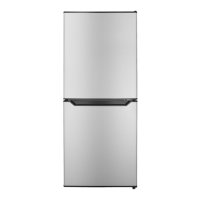
This document describes the Insignia 4.9 Cu. Ft. Bottom Mount Compact Fridge, models NS-CF49BMSS2 and NS-CF49BMSS2-C, providing essential information for its safe installation, operation, and maintenance.
The Insignia compact fridge is designed for household and similar applications, offering a convenient solution for food storage. Its primary function is to keep food items, both fresh and frozen, at optimal temperatures. The appliance features a bottom-mount freezer compartment, which is ideal for storing frozen snacks, entrees, and other items. The refrigerator compartment, located at the top, includes two shelves, one of which is adjustable, allowing for flexible organization of various food items. The design emphasizes user convenience with reversible doors, providing versatility in placement options to suit different kitchen layouts. The stainless steel exterior not only gives the fridge a sleek and modern look but also makes it easy to clean and maintain.
Before using the refrigerator, it is crucial to read and understand all safety instructions to prevent fire, explosion, electric shock, or injury. The appliance should be properly grounded to minimize the risk of electric shock. It is important to never allow children to operate, play with, or crawl inside the refrigerator, as there is a risk of child entrapment. Flammable fluids or liquids should never be used for cleaning or stored inside or near the refrigerator. Ventilation openings must be kept clear of obstruction to ensure proper operation. The use of mechanical devices or other means to accelerate the defrosting process, other than those recommended by the manufacturer, should be avoided. The refrigerant circuit must not be damaged, and electrical appliances should not be used inside the food storage compartments unless they are of the recommended type. Heavy objects should not be placed on top of the refrigerator to prevent injury from falling objects when the door is opened or closed. When disposing of an old refrigerator, the door should be removed, and shelves left in place to prevent child entrapment.
Installation of the refrigerator involves several key steps to ensure proper function and safety. Upon unpacking, all exterior and interior packaging should be removed. The inside of the refrigerator should be washed with a damp, warm cloth and a baking soda solution, then wiped dry. The refrigerator should be placed on a strong, level floor, avoiding carpeting or rugs. It is designed to be freestanding and should not be recessed or built-in. The leveling foot should be adjusted to ensure the refrigerator is level, which is critical for the doors to close and seal correctly, preventing cooling, frost, and moisture problems. Adequate ventilation is essential; at least 3.9 inches (10 cm) should be maintained between the sides and back of the refrigerator and surrounding walls, and 11.8 inches (30 cm) between the top and the cabinet above. The refrigerator should be positioned away from direct sunlight and heat sources to prevent affecting the acrylic coating and increasing electrical consumption. It is designed to operate within an ambient temperature range of 50° F (10° C) and 109° F (43° C).
Connecting power requires a dedicated 115 V, 60 Hz power supply. The power cord is equipped with a 3-prong grounding plug that must be inserted into a correctly installed and grounded outlet. An extension cord or ungrounded, two-prong adapters should not be used.
The doors of the refrigerator are reversible, allowing users to change the opening direction to better suit their space. This process involves removing the upper and bottom hinge assemblies, the freezer door, and the refrigerator door, then reassembling them on the opposite side. Tools required for this include a 5/16" socket wrench, flat blade screwdriver, Phillips screwdriver, and masking tape. After reversing, it is important to ensure the rubber gaskets make a good seal and the doors move freely.
Using the refrigerator for the first time involves plugging it in, at which point the temperature indicator lights will illuminate, and the refrigerator will default to setting 2. Before storing food, the refrigerator and freezer compartments should run for two to three hours (or four hours in warmer ambient temperatures) to reach correct temperatures. The thermostat dial, located inside the refrigerator, allows for temperature adjustment between settings 1 (warmest) and 3 (coldest), with 2 being the recommended setting. Setting the dial to 'O' turns off the cooling function. Internal temperatures can vary based on ambient temperature, the quantity of items stored, and door opening frequency.
The refrigerator's internal components, such as shelves and door racks, are designed for adjustability. The adjustable shelf can be removed by lifting its back and pulling it out, and reinstalled by aligning it with the rails and lowering it into place. Door racks can also be removed by tapping them up and pulling them out, and reinstalled by pressing them down until a click is heard, indicating they are locked. The vegetable crisper, designed to store fruits and vegetables and prevent moisture loss and flavor transfer, can be removed by lifting it with its glass cover and pulling it out. The freezer drawer can be removed in a similar manner.
Maintenance of the refrigerator is crucial for its longevity and efficient operation. Regular cleaning is recommended to keep it odor-free and efficient. Before cleaning, the refrigerator should be unplugged, and all food removed. The doors, handles, and exterior surfaces should be cleaned with a mild detergent and warm water, then rinsed. The inside should be washed with a solution of lukewarm water and baking soda, then rinsed. Baskets, shelves, and drawers should be cleaned with a mild detergent and soft cloth, then rinsed. It is important to avoid using gasoline, benzine, thinner, abrasive cleaners, or sharp objects, as these can damage the finish. Door gaskets (seals) should be kept clean to ensure a tight seal, which contributes to efficiency. All surfaces and removable parts must be completely dry before plugging the refrigerator back in.
Defrosting the refrigerator is necessary when frost builds up. This involves turning off and unplugging the refrigerator, removing all food, and allowing it to warm naturally or using hot water to speed up the process. A plastic or wooden spoon or spatula can be used to help remove frost. After defrosting, the inside, compressor compartment, and water drain tray should be cleaned before replacing food and turning the power back on.
For temporary shutdown, the refrigerator should be unplugged, all food removed, and cleaned. The door should be left slightly open to prevent condensation, mold, or odor. When moving the refrigerator, it should be unplugged, all food removed, loose items taped down, and doors taped shut. It should be transported in an upright position.
Tips for saving energy include locating the refrigerator in the coolest area of the room, away from heat sources and direct sunlight. Hot foods should be allowed to cool before placing them inside, and overloading the refrigerator should be avoided. Organizing and labeling food can reduce door openings and extended searches. Using aluminum foil, wax paper, or paper toweling to line shelves is not recommended as it interferes with cold air circulation.
Troubleshooting common issues can often be resolved by following simple steps. If the refrigerator does not work, check the power plug, voltage, and circuit breaker. Bad odors can be addressed by wrapping strong-smelling foods, checking for spoiled food, and cleaning the interior. If doors do not close completely, check for obstructions, clean door gaskets, and ensure the refrigerator is level. If the temperature is too hot, check for frequent door openings, adjust the thermostat, and ensure adequate ventilation. If the temperature is too cold, adjust the thermostat. Frost buildup can be due to frequent door openings or blocked air outlets. Difficulty opening the door can be caused by vacuum formation after closing, or can be alleviated by rubbing paraffin wax on the gasket or slightly loosening door hinges. Unusual noises or vibrations can be normal (compressor, air movement, defrosting) but can also indicate items on top of the fridge, an unlevel fridge, or incorrect shelf/drawer installation. A hot exterior is normal due to heat dissipation, especially in high room temperatures, with excessive door openings, or too much food.


 To Next Page
 General