Need help?
Do you have a question about the iOptron GEM45 and is the answer not in the manual?
Instructions for unlocking the R.A. Gear Switch and removing the mount head from its packaging.
Steps to assemble the tripod, attach the accessory tray, and level the mount.
Guide on loosening screws and using the adjustment knob to set the mount's latitude.
Instructions for threading the counterweight shaft into the mount's mounting holes.
Steps for placing the counterweight onto the shaft and securing it.
Information on the dual saddle and connecting the telescope.
Procedure for balancing the mount in DEC and RA axes after attaching the payload.
Guide for connecting power supply, hand controller, and GPS module.
Overview of using the iPolar electronic polar scope for alignment.
Instructions for using the hand controller to point and track objects.
Steps to set the time and site information on the hand controller.
Procedure to register the current mount position as the zero position.
Guidance on performing a one-star alignment for GOTO accuracy.
How to select and slew to astronomical targets using the hand controller.
Function to improve local GOTO accuracy by centering and synchronizing objects.
Recommendations for returning the mount to zero position and packing it.
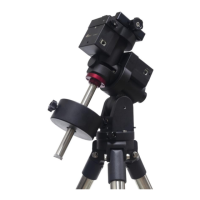
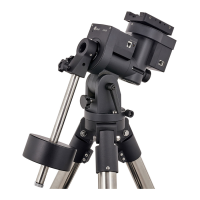
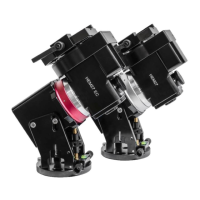
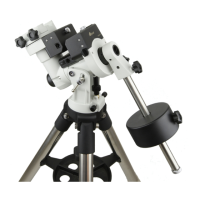
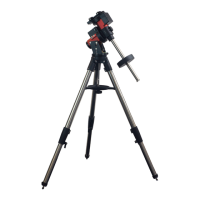
The iOptron GEM45 German Equatorial Mount is a precision instrument designed for astronomical observation and astrophotography. This mount, available in models such as the GEM45 (#7603A), GEM45EC (#7603ECA), and GEM45G (#7603AG), provides a stable and accurate platform for telescopes, enabling users to track celestial objects across the night sky. Its robust construction and advanced features make it suitable for both amateur astronomers and more experienced enthusiasts.
The primary function of the GEM45 mount is to accurately track astronomical objects as they move across the sky due to the Earth's rotation. This is achieved through its German equatorial design, which allows for precise alignment with the celestial pole. Once aligned, the mount's motorized axes compensate for the Earth's rotation, keeping the target object centered in the telescope's field of view.
The GEM45 mount is equipped with an iPolar™ electronic polar scope, which facilitates accurate polar alignment. This integrated system simplifies the often-challenging process of aligning the mount with the celestial pole, making it accessible even for users new to astrophotography. The iPolar software, used in conjunction with a computer, guides the user through the alignment process, ensuring optimal tracking performance. For models without the iPolar scope, alternative alignment methods such as Bright Star Alignment or external software assistance can be utilized.
The mount features a Go2Nova® 8407+ Hand Controller (HC), which serves as the primary interface for controlling the mount. This hand controller allows users to manually slew the telescope to desired objects, adjust slewing speeds, and initiate or stop tracking. It also provides access to various settings, including time and site information, and facilitates advanced functions like GoTo (automatic object finding) and Sync to Target (refining pointing accuracy).
For enhanced guiding capabilities, the GEM45AG model includes an iGuider™ guiding system on its dovetail saddle. This system helps to further improve tracking accuracy, which is crucial for long-exposure astrophotography.
The mount's dual saddle design (6" Vixen/Losmandy-D) allows it to accommodate a wide range of telescopes, supporting both Vixen and Losmandy-D plates. This versatility ensures compatibility with various optical tube assemblies.
Setting up the GEM45 mount involves several key steps designed to ensure stability and accuracy. The mount head is initially shipped with the R.A. Gear Switch unlocked to protect the worm/gear system during transit. Before use, the R.A. Gear Switch must be turned 90° clockwise to lock the R.A. gear system.
The mount is secured to a heavy-duty tripod using two M6 holes, 103 mm apart. An alignment peg is threaded into one of two additional M6 holes, depending on the user's latitude (high or low). An accessory tray is then inserted through the center rod and secured with a locking knob, adding stability to the setup. The tripod legs can be adjusted to level the mount, using either the built-in bubble level indicator or an external leveler.
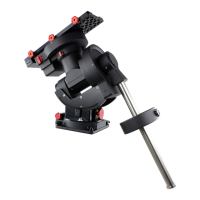
Latitude adjustment is crucial for polar alignment. The mount features a Latitude Adjustment Knob and four Latitude Locking Screws. Users can set the correct latitude value, displayed in the Latitude Mark Window, by loosening the locking screws and turning the adjustment knob. The mount head supports two latitude ranges: 14~44° and 36~68°. Switching between these ranges requires repositioning both the Latitude Position Bolt and the Latitude Locking Screws.
Counterweights are essential for balancing the payload. Before installing counterweights, the mount should be at its zero position (CW shaft pointing to the ground), and the R.A. Gear Switch disengaged. Counterweights are slid onto the stainless steel counterweight shaft and secured with a locking screw. A safety cap is placed at the end of the shaft.
Balancing the telescope and accessories is a critical step to minimize stress on the mount's driving mechanism. This process must be performed with both the R.A. and DEC Gear Switches disengaged. The mount should be set to its Zero Position, and then moved to a horizontal position to check balance. The DEC axis is balanced by moving the scope back and forth within the saddle, while the R.A. axis is balanced by moving the counterweights along the shaft. It is imperative that the balancing process is done with the gear switches disengaged to prevent damage to the worm system. Once balanced, the mount should be returned to Zero Position, and the gear switches engaged.
Connecting cables involves plugging the included 12V/5A DC power supply into the DC12V 5A socket on the R.A. axis. The Go2Nova® 8407 Hand Controller connects to the HBX port on the mount's main board. A GPS module, which helps in automatically setting time and site information, plugs into the iPORT with a coiled cable. The GPS module typically takes 1 to 2 minutes to acquire satellite signals, after which "GPS OK" will be displayed on the hand controller. Users can then disconnect the GPS module if desired. Before GPS signals are acquired, users should manually check and adjust Daylight Saving Time and enter the time zone offset.
The iPolar electronic polar scope requires software installation and calibration. A USB cable connects the mount's USB2.0 port to a computer. The iPolar software then guides the user through calibrating the camera center and performing polar alignment.
Manual operation of the mount is straightforward using the hand controller's arrow keys to slew the telescope and number keys to adjust slewing speed. The STOP/0 button starts or stops tracking. The "Set Controller" menu allows users to configure time and site settings.
The "Set Zero Position" command registers the current physical position of the mount as its zero position. This is defined as the telescope being on top of the mount head, pointing to the North Pole, with the CW shaft pointing to the ground. This setting is crucial for accurate GoTo operations. A "One Star Alignment" can be performed to correct any discrepancies in the Zero Position and improve GoTo accuracy.
Once set up and aligned, the mount is ready for GoTo and tracking. Users can select objects from various categories (e.g., Solar System) via the hand controller. The mount will automatically slew to the selected object and begin tracking. If an object is not perfectly centered, the "Sync to Target" function can be used to refine pointing accuracy.
The GEM45 mount is designed for durability, but proper maintenance is essential for its longevity and performance. The manual emphasizes the importance of carefully reading the guide before setup and use to prevent worm/gear damages due to improper uses, which are not covered by warranty.
A critical warning highlights the need to always hold the mount firmly before disengaging the Gear Switches. Failure to do so can result in the telescope swinging freely, potentially causing personal injuries or equipment damage. This caution is particularly relevant during balancing procedures.
When transporting or storing the mount, it is recommended to return it to its Zero Position and then disengage the gear system. This protects the internal mechanisms during transit. The mount should then be placed in its carrying case (included with 7603ECA, optional for 7603A, 7603AG).
Regular checks for firmware upgrades for both the hand controller and the mount are recommended. These upgrades, available on the iOptron website, often include performance enhancements, bug fixes, and new features. Similarly, ASCOM and Commander software for computer control should be kept up-to-date.
For technical support or any issues, users are directed to contact iOptron support. The design, contents, and packaging of the device may change over time, so referring to the latest online resources is always advisable.
 General
| Mount Type | German Equatorial Mount |
|---|---|
| Power Supply | 12V DC |
| Payload Capacity | 20 kg |
| Weight | Mount Head: 15.8 lbs (7.2 kg) |
| Tracking Modes | Sidereal, Solar, Lunar |
| GoTo Database | Over 200, 000 objects |
| Control System | Go2Nova® 8407 hand controller |
| Latitude Adjustment Range | 10° to 70° |
| Motor | Stepper motor |
| Gear Ratio | 360 |
| Power Requirement | DC 12V |
| Hand Controller | Go2Nova® 8407 |
| GPS | Built-in |
| Periodic Error | < ±5 arcsec |
| PE Correction | Permanent PEC |
| Communication Ports | USB |
| Polar Scope | Built-in illuminated polar scope |
| Compatibility | Vixen-style dovetail |

 To Next Page