2.2. Identifying the machine
The rating plate (fig. 1) provides the following information:
• model;
• power supply;
• total nominal power;
• serial number;
• year of fabrication;
• dry weight;
• maximum slope;
• barcode with serial number;
• manufacturer's identification.
2.3. Documentation provided with the machine
• User manual;
• Guarantee certificate;
• EC certificate of conformity.
3. TECHNICAL INFORMATION
3.1. General description
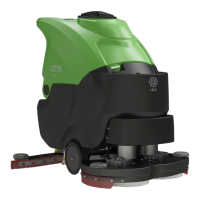
This machine is a scrubber drier for sweeping, washing and drying flat, horizontal, smooth
or moderately rough, even and obstacle free floors in civil and industrial premises.
The scrubber drier spreads a solution of water and detergent in the correct concentration
on the floor and then scrubs it to remove the dirt. By carefully choosing the detergent and
brushes (or abrasive disks) from the wide range of accessories available, the machine
can be adapted to a wide range of combinations of types of floor and dirt.
A suction system incorporated in the machine dries the floor after washing by means of
the low pressure generated in the dirty water drum by the suction motor. The squeegee
connected to the drum collects the dirty water.
The machine moves forward by means of a special electromechanical drive device.
3.2. Legend
The main parts of the machine are as follows (fig. 2):
• detergent tank (fig. 2, ref. 3): contains and transports the mixture of clean water and
cleaning product;
• the dirty water drum (fig. 2, ref. 2): collects the dirty water picked up from the floor after
washing;
• control panel (fig. 2, ref. 1);
• head assembly (fig. 2, ref. 4): the main element is the brushes (fig. 2, ref. 5) which
distribute the detergent solution on the floor and remove the dirt;
• squeegee assembly (fig. 2, ref. 6): wipes and dries the floor by collecting the water.
3.3. Danger zones
A - Tank assembly: when using certain detergents, danger of irritation for eyes, skin,
mucous membranes and respiratory tract and of asphyxia. Danger represented by
the dirt collected from the environment (germs and chemical substances). Danger of
crushing between the two tanks when the dirty water drum is replaced on top of the
detergent tank.
B -Control panel danger of short circuit.
C -Bottom of washing head: danger due to brush rotation.
D -Rear wheels: danger of crushing between the wheel and chassis.


 To Next Page