Need help?
Do you have a question about the Iseki TG6675 and is the answer not in the manual?
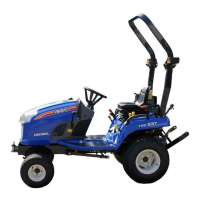
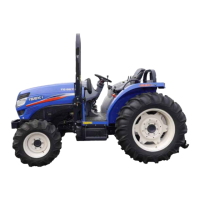
This document is an operator's manual for the ISEKI TG6675 tractor, a 4WD agricultural vehicle. It provides comprehensive information on its operation, maintenance, and safety procedures.
The tractor is designed for customary agricultural use, parks and grounds maintenance, and winter service. It is equipped with a 48.5 kW (65 hp) engine, a 4-speed synchronized mesh transmission with 12 forward and 12 reverse gears, and a hydraulically controlled 3-point linkage system.
The manual emphasizes safety with various warnings and cautions. It highlights the importance of wearing personal protective equipment during operation, never operating the tractor with panels or guards removed, and using proper trailers within the tractor's capacity. It also warns against unauthorized modifications to the tractor's structure or engine, which would void the warranty. Safety decals are strategically placed on the tractor to alert operators to potential hazards such as entanglement risks (fan, PTO shaft, belts), hot surfaces, electric shock, explosion risks (battery, ether), and overturn risks. The tractor is equipped with a safety starting system that requires the clutch pedal to be depressed, the forward/reverse lever in neutral, the PTO switch off, and the operator seated to start the engine.
The instrument panel includes a main switch with OFF, ON, and START positions, an indicator light array (pre-heat, engine oil pressure, battery charge, parking brake, fuel filter warning, coolant temperature warning, 4WD indicator, PTO drive warning, main beam, trailer indicator, caution lamp, mid PTO drive warning), a tachometer, and a liquid crystal display for operating information (fuel gauge, coolant temperature, engine hourmeter, fault codes, PTO speeds). Controls include a steering wheel with a horn switch, a direction indicator lamp control lever, a beacon switch, clutch pedal, independent brake pedals with an interlocking plate for road travel, and a parking brake lever.
Before operation, a pre-start inspection is required, including checking fluid levels, fan belt tension, radiator and air intake screens, and control operations. Starting the engine involves ensuring all safety conditions are met, such as the brake pedals latched, forward/reverse and shift levers in neutral, PTO selector levers in neutral, and the PTO switch in the OFF position. The engine should be warmed up for several minutes, especially in cold weather, before applying a heavy load. Traveling speed is selected via 12 forward and 12 reverse gears, controlled by hand and foot throttle levers, a forward/reverse lever, and shift levers. The differential lock can be engaged for improved traction in loose soil but should not be used on hard surfaces. The 4-wheel drive (4WD) system is engaged by a shift lever and should be disengaged on hard, dry surfaces to prevent tire wear and driveline damage. The Power Take-Off (PTO) system provides power to rear-mounted and mid-mounted implements, with selectable speeds (540 min-1 and 750 min-1 for rear PTO, 2023 min-1 for mid PTO). PTO engagement can be in normal or soft mode to minimize shock. The 3-point linkage system controls implement height and draft, with position and draft control levers. External auxiliary hydraulics levers and valves are available for implements requiring an external hydraulic source. The Roll-Over Protective Structure (ROPS) can be folded down for limited work in specific environments, but the seat belt must be worn when the ROPS is upright and not worn when folded down. Comfort adjustments include a tiltable steering column and adjustable seat suspension for driver weight and height.
The manual outlines a periodic inspection and maintenance schedule, including engine oil and filter changes (initial 50 hours, then every 200 hours), transmission oil and filter changes (initial 50 hours, then every 400 hours), front axle oil changes (every 600 hours), and grease fittings lubrication (every 50 hours). It also details procedures for cleaning the air cleaner, radiator, and air conditioner filters, as well as maintaining the electrical system and battery. Specific instructions are provided for adjusting brakes, parking brake, and steering free-play. The fuel system requires clean diesel fuel and air bleeding if it runs out of fuel.
The manual also includes wiring diagrams for the main harness, engine harness, other harnesses, and the cabin harness.

 To Next Page
 General